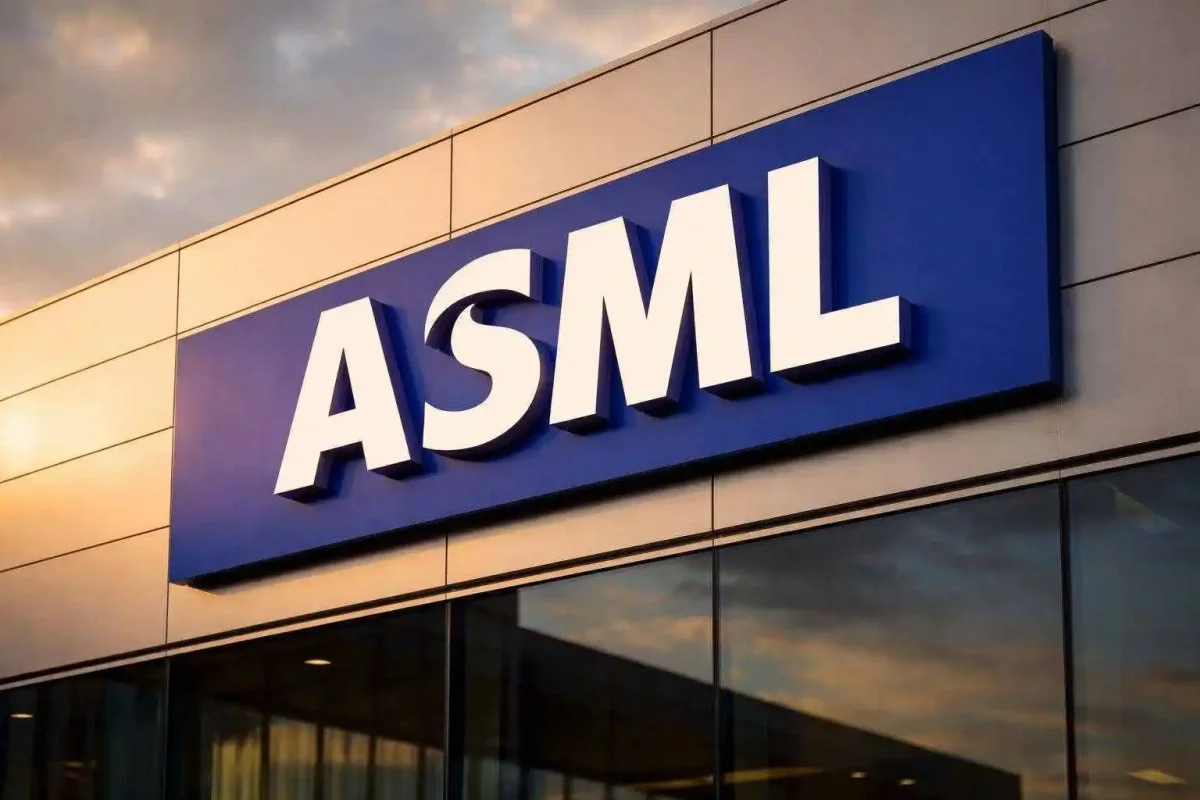
ASML Holding NV, the Dutch manufacturer of critical chipmaking equipment, has assured the market it possesses sufficient capacity to support the semiconductor industry's ambitious expansion plans for 2026, a year expected to see peak demand for artificial intelligence processors. Chief Executive Christophe Fouquet, addressing shareholders at the company's annual meeting, committed to avoiding production bottlenecks "by all possible means" following heavy investments to scale output of its lithography systems.
Revised Financial Outlook and Strong Quarter
Bolstering this confidence, ASML recently elevated its 2026 revenue forecast to a range of 36 billion to 40 billion euros. This upgraded guidance follows a robust first-quarter performance, where the company reported sales of 8.8 billion euros and net income of 2.8 billion euros. Fouquet attributed the raised outlook to customers accelerating their capacity plans for 2026 and beyond, fueled significantly by swelling budgets for AI infrastructure across major cloud service providers.
The CEO highlighted ongoing tightness in the market for both advanced logic chips, which handle core computing tasks, and memory chips. He stated that demand would "continue to outpace supply" for the foreseeable future, noting that memory manufacturers have already sold through their inventory for the year and anticipate constraints persisting past 2026, even as new production lines commence operations.
Geopolitical and Execution Risks Loom
Despite the optimistic capacity assessment, ASML's leadership outlined several material risks. The foremost short-term threat remains geopolitical, specifically the potential for further tightening of U.S.-driven export controls on China. Chief Financial Officer Roger Dassen reiterated the company's expectation that China will still constitute approximately 20% of its 2026 sales. However, he cautioned that stricter rules could push results toward the lower end of its forecast range, even though strong global demand might allow other customers to absorb some of the impacted volume.
Fouquet was also candid about execution risk, warning investors that any failure by ASML to meet its delivery timelines could prompt customers to explore competitors or alternative technologies. When questioned about emerging startups in the lithography space, he dismissed them as "ideas, not competition today," underscoring ASML's entrenched technological lead.
The High-NA EUV Adoption Question
A pivotal uncertainty for ASML's next growth phase is the adoption rate of its newest and most advanced machine, the high-numerical aperture (High-NA) extreme ultraviolet (EUV) lithography platform. This more sophisticated tool carries a price tag of roughly $400 million per unit, a significant premium over current-generation EUV systems. Adoption timelines remain fluid, with key customer Taiwan Semiconductor Manufacturing Company (TSMC) indicating it continues to "leverage existing EUV technology" to produce smaller, faster chips, deferring immediate investment in the costly new platform.
ASML remains the sole global supplier of EUV lithography equipment, which is essential for manufacturing the world's most advanced semiconductors. Dassen provided specific shipment targets, aiming for 60 units from its current EUV portfolio in 2026, with capacity to increase that to 80 units the following year. The company also continues to build its deep ultraviolet (DUV) product line, where it faces competition from Japan's Nikon and China's SMEE.
Market Context and Shareholder Returns
ASML's fortunes are inextricably linked to the capital expenditure plans of leading foundry TSMC and memory giants Samsung, SK Hynix, and Micron, all of which rely on ASML's equipment for their cutting-edge expansions. The company's shares have performed strongly this year, with investors viewing it as a foundational "picks and shovels" supplier to the broader AI boom.
At the annual meeting, shareholders approved a final dividend of 2.70 euros per share, bringing the total payout for 2025 to 7.50 euros per share. They also renewed the company's share buyback authorization, allowing repurchases of up to 10% of its issued capital. The broader European chip equipment sector traded higher following the update, with positive earnings and capital expenditure outlooks reinforcing confidence that semiconductor and data center spending remains resilient.