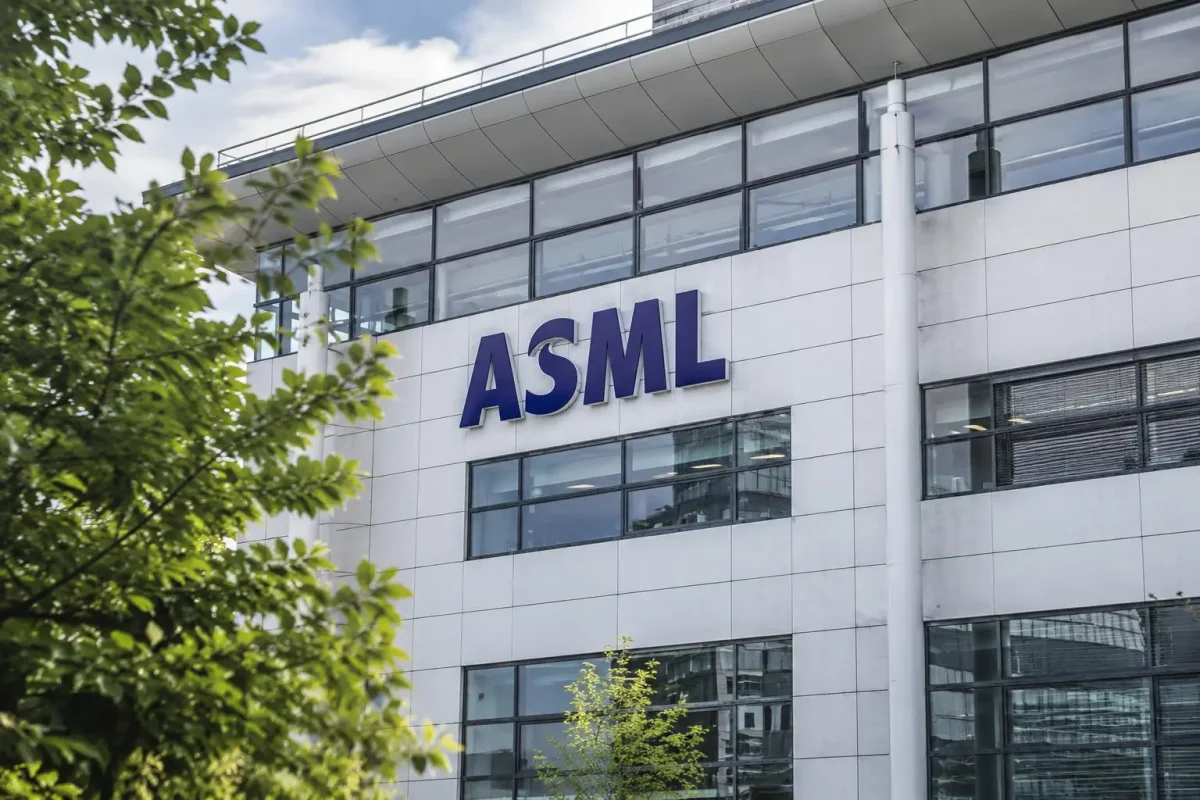
ASML Holding shares reached a new 52-week high in Amsterdam this week before retreating, as the semiconductor equipment giant navigates robust artificial intelligence chip demand against escalating geopolitical tensions over China's access to advanced chipmaking technology.
Market Performance
Shares of ASML closed at €1,384.80 on Friday, declining 0.45% for the session and approximately 1.7% lower compared to the previous week's close. The stock had earlier climbed as high as €1,437.00 during the week before pulling back, with the broader AEX index also trending lower for most of the week. The Euronext Amsterdam exchange remained closed over the weekend, with regular trading hours running Monday through Friday from 9:00 a.m. to 5:30 p.m. local time.
China Risk Re-Emerges
Investor attention has refocused on China's efforts to circumvent Western export controls after Huawei announced a new chip design strategy that emphasizes accelerating signals across chips and systems rather than solely shrinking transistor sizes. Since 2019, China has been unable to import ASML's top-of-the-line extreme ultraviolet (EUV) lithography machines, which are essential for producing the most advanced chips used in artificial intelligence applications. This restriction has effectively blocked a key pathway for Chinese chipmakers to catch up with industry leader Taiwan Semiconductor Manufacturing Co (TSMC).
Nvidia CEO Jensen Huang dismissed Huawei's strategy as a significant competitive threat, telling reporters he does not see it as a challenge to TSMC. Omdia chief analyst Lian Jye Su echoed this cautious view, noting that there is currently nothing concrete that can be independently verified regarding Huawei's claims.
Strong Demand Fundamentals
Despite these headwinds, the fundamental demand story for ASML remains compelling. The company last month forecast 2026 net sales in the range of €36 billion to €40 billion, with gross margins of 51% to 53%. In the first quarter, ASML reported net sales of €8.8 billion and net income of €2.8 billion. Chief Executive Christophe Fouquet stated that demand for chips is outpacing supply, and he expects the chip market to remain tense as artificial intelligence, satellites, and robotics drive demand faster than new manufacturing capacity can come online.
The broader semiconductor equipment ecosystem is also expanding. Lam Research recently opened a lab in Austria focused on advanced chip packaging, a critical step in boosting chip performance and reducing power consumption. ASML, along with Lam Research, Applied Materials, and KLA, supplies the expensive wafer fabrication tools necessary to support the AI-driven surge in demand for faster chips.
Export Control Risks
The primary risk for ASML lies in the potential for stricter U.S.-led restrictions on sales or servicing of its deep ultraviolet (DUV) lithography equipment, which remains crucial for producing a wide range of chips. JPMorgan analyst Sandeep Deshpande has warned that ASML's earnings per share could decline by as much as 10% under tougher export control scenarios, and lost revenue from China may not be fully replaced by other markets.
Dutch officials have pushed back against the U.S. MATCH Act, arguing that it attempts to extend U.S. authority beyond its legal boundaries. Trade Minister Sjoerd Sjoerdsma told parliament that the Netherlands believes each country should be responsible for its own legal rules.
Outlook
As the new trading week begins, market participants will be closely watching whether Friday's decline represents routine profit-taking near a 52-week high or the start of a more sustained pullback driven by China-related uncertainty. The strong AI-driven order book continues to provide a positive backdrop, but the interplay between Washington, Beijing, and The Hague presents significant hurdles for ASML and its shareholders.