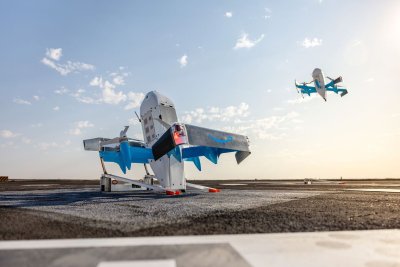
Shares of AST SpaceMobile experienced a significant decline on Tuesday, shedding more than 10% of their value as the company announced a further postponement of a key satellite launch. The sell-off coincided with a major competitive move in the sector, as Amazon unveiled plans to acquire satellite operator Globalstar.
The stock closed the midday session at $88.53, a 10.5% drop from its opening price of $103.00. This downward pressure reflects growing investor concern over execution timelines and an increasingly crowded market for direct-to-device (D2D) satellite connectivity, which allows standard smartphones to communicate directly with orbiting satellites without additional hardware.
Launch Schedule in Flux
The immediate catalyst for the decline was another delay for the launch of BlueBird 7, a critical satellite for AST SpaceMobile's operational roadmap. The launch, now scheduled for April 17 from Cape Canaveral, has been rescheduled multiple times. Initial plans in January targeted a late February launch, which was later shifted to March. The company's website continues to note that timing remains subject to change, citing variables such as launcher readiness and weather.
BlueBird 7 represents a vital test for the company's technology and deployment cadence. It is the first of AST's larger Block 2 BlueBird satellites, designed to deliver peak speeds of up to 120 megabits per second per coverage cell. The company aims to establish a launch rhythm of one mission every one to two months, with the goal of building a constellation of 45 to 60 satellites by the end of 2026.
Amazon Enters the Fray
Compounding the challenges from internal delays, the competitive landscape shifted dramatically on Tuesday with Amazon's announcement of a definitive agreement to purchase Globalstar for $11.57 billion. Analysts view this acquisition as a significant acceleration of Amazon's ambitions in satellite communications, directly competing with existing players like SpaceX's Starlink and AST SpaceMobile itself.
The deal would bring Globalstar's fleet of 24 satellites into Amazon's growing network, which already exceeds 200 satellites. This contrasts with the market leader, Starlink, which operates over 10,000 satellites and serves more than nine million customers globally. Summit Ridge Group analyst Armand Musey suggested the move allows Amazon to "leap ahead on D2D deployment," while Canaccord Genuity's Austin Moeller pointed to ongoing consolidation in the sector, driven largely by the scale and launch capacity of SpaceX.
Financial Backing and Commercial Progress
Despite the market's negative reaction, AST SpaceMobile has demonstrated foundational financial and commercial progress. The company reported full-year 2025 revenue of $70.9 million, with $54.3 million generated in the fourth quarter alone. Chief Executive Abel Avellan declared 2025 as the year the company "became a revenue generating business." Furthermore, AST has secured over $1.2 billion in contracted revenue commitments from various partners.
On the commercial front, AST continues to forge alliances. Last month, telecommunications giant Orange announced a partnership with AST and Satellite Connect Europe—a joint venture between AST and Vodafone—to advance satellite-to-smartphone connectivity. The partners plan demonstrations of voice, SMS, and data services in Romania in late 2026. Orange described its approach as multi-vendor, selecting partners based on specific market needs.
Funding and Risk Factors
The path to a fully operational constellation requires substantial capital. In a February securities filing, AST indicated plans to raise additional funds to cover the costs of building, assembling, and launching its satellite network, as well as initiating commercial operations. As of March, the company reported pro forma liquidity exceeding $3.9 billion, including cash, equivalents, and restricted cash.
The company has consistently cautioned investors about risks related to launch schedules, acknowledging dependencies on third-party launchers and external factors. The stock's volatility underscores the market's binary view: bulls are encouraged by the commencement of revenue and a substantial contract backlog, while skeptics focus on the execution risks of the launch schedule, the need to convert commitments into recurring service income, and the looming threat of well-funded competitors.
Tuesday's price action highlights that investors are awaiting a clear positive catalyst, primarily the successful launch and initial on-orbit testing of BlueBird 7. Until then, the stock is likely to remain sensitive to both internal milestones and competitive developments in the high-stakes satellite connectivity market.