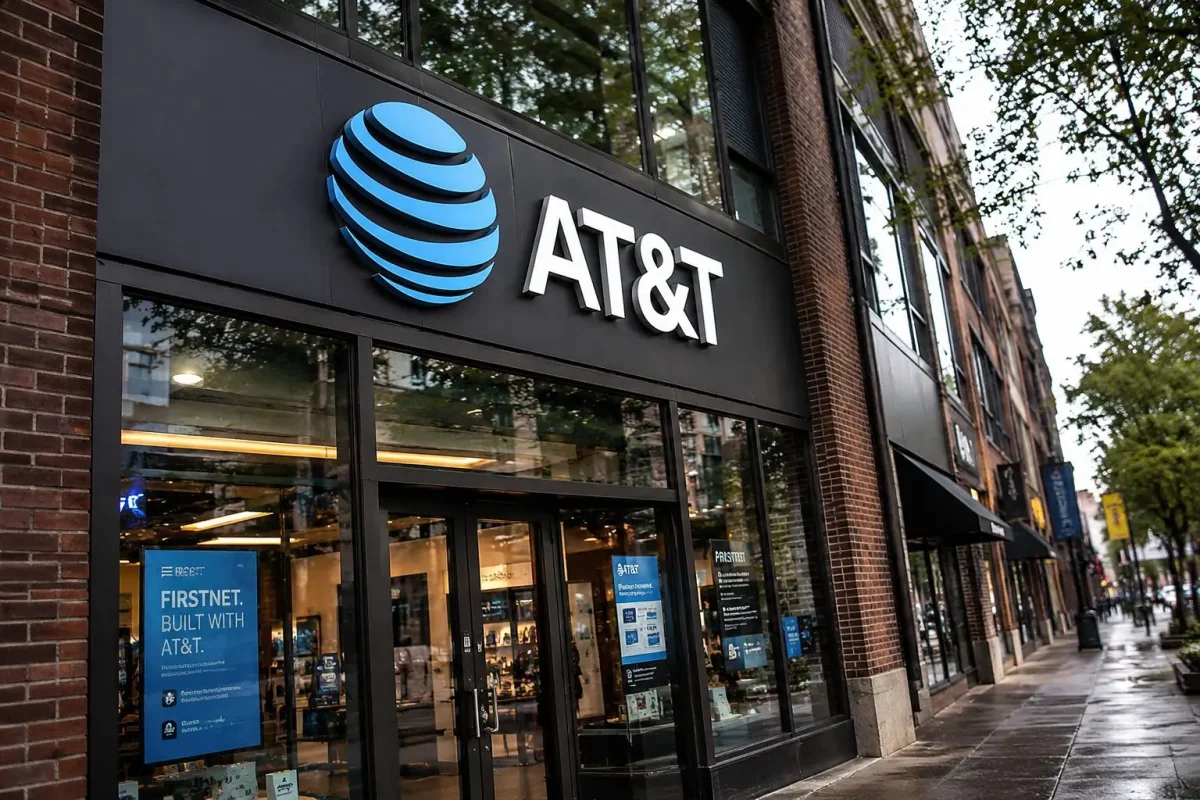
AT&T Inc. (NYSE: T) shares traded at $20.48 ahead of Thursday's New York open, down about 1.0% from the prior close, as a broad selloff in telecom stocks erased $15.74 billion from the company's market value. The decline leaves AT&T with a market capitalization of approximately $143.9 billion, raising questions about its ability to sustain planned shareholder returns.
The selloff comes amid growing investor anxiety over SpaceX's Starlink mobile ambitions, which analysts warn could disrupt the $1.6 trillion global communications industry. The NYSE will operate normally Thursday but close Friday, July 3, for the Independence Day observed holiday.
Market value wipeout threatens return targets
The $15.74 billion drop in AT&T's market cap represents roughly 35% of the $45 billion-plus in dividends and buybacks the company expects to deliver to shareholders between 2026 and 2028. For context, the loss is about twice the $8 billion in share repurchases AT&T has planned for 2026 alone, and approximately 130 times the $121 million the company spent in the recent FCC Auction 113 for spectrum licenses.
According to Barron's, the combined market value decline for AT&T, Verizon Communications Inc. (NYSE: VZ), and T-Mobile US Inc. (NASDAQ: TMUS) totaled $46 billion. Verizon shares fell 0.8% to $41.99, while T-Mobile bucked the trend, rising 3.2% to $173.06. Charter Communications Inc. (NASDAQ: CHTR) also dropped 1.6% to $139.84, and SpaceX stock (NASDAQ: SPCX) slid 7.7% to $157.54.
SpaceX-Charter talks fuel bearish sentiment
Reuters reported last week that SpaceX and Charter Communications held high-level discussions about launching a U.S. consumer mobile service, potentially using Charter's internet lines to handle some Starlink phone traffic. SpaceX has told investors it plans a Starlink mobile product that would compete directly with Verizon, AT&T, and T-Mobile.
BNP Paribas senior analyst Sam McHugh noted that Charter's hotspots and small cells could help Starlink Mobile reduce its coverage gap, but cautioned that "Charter can't offer a solution that entirely closes the gap." He added there is "no way" a Charter-SpaceX deal could eliminate terrestrial cellular networks from the U.S. connectivity market.
Oppenheimer analyst Timothy Horan was more blunt, telling MarketWatch: "SpaceX will disrupt the $1.6 trillion communications industry, in our view." Such a call can rapidly shift the risk premium for dividend stocks like AT&T.
Spectrum auction highlights competitive dynamics
The selloff is particularly notable given AT&T's relatively modest spending in FCC Auction 113, which concluded this week with $3.57 billion in gross proceeds. Verizon led spending at approximately $3.2 billion, T-Mobile spent $278 million, and AT&T allocated about $121 million for 10 licenses. SpaceX itself spent $8.5 million for two licenses, according to FCC auction data and industry reports.
The market's reaction suggests investors are pricing in risks from Starlink Mobile, cable wireless partnerships, wholesale competition, and the true strength of AT&T's network advantages.
AT&T maintains guidance, dividend intact
Despite the selloff, AT&T is sticking to its cash flow and convergence strategy. CEO John Stankey told investors in April that the company saw its "best first quarter ever for Advanced Connectivity internet customer net additions." In Q1, AT&T reported $31.5 billion in revenue, $2.5 billion in free cash flow, 294,000 postpaid phone net adds, and 584,000 advanced connectivity internet net adds.
In June, AT&T reaffirmed its Q2 free cash flow target of $4.0 billion to $4.5 billion, along with full-year 2026 guidance: free cash flow above $18 billion, capital investment of $23 billion-$24 billion, an annualized common dividend of $1.11 per share, and approximately $8 billion in buybacks.
The board has set a quarterly common dividend of $0.2775 per share, payable Aug. 3 to shareholders of record as of July 10. At the current price of $20.48, the annual yield stands at roughly 5.4%.
What's next for AT&T
Investors will focus on AT&T's Q2 earnings report, due before the NYSE opens on July 22, with a conference call at 8:30 a.m. ET. Until then, shares must navigate a three-day U.S. market break while SpaceX continues to reshape the competitive landscape.