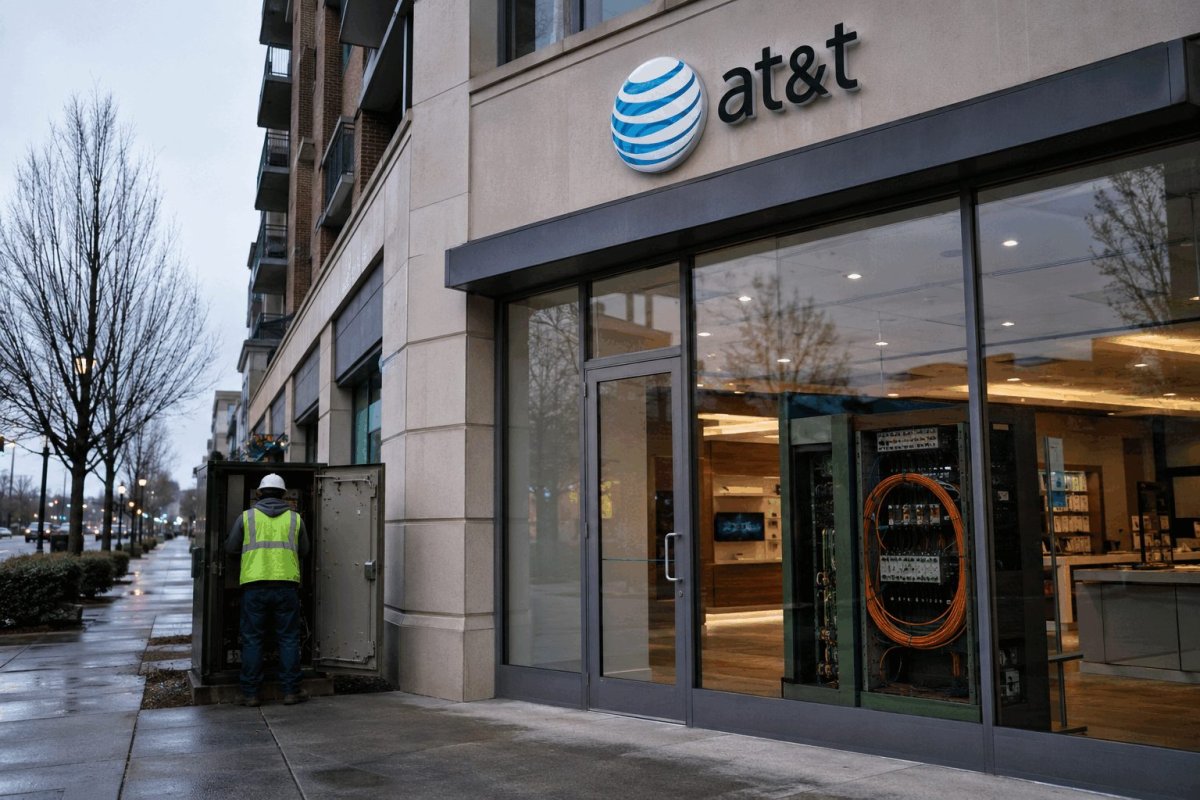
AT&T Inc. (NYSE: T) saw its shares advance 2.3% on Friday, closing at $26.01, following the release of its quarterly results that showcased robust free cash flow and continued momentum in its fiber optic network expansion. The telecommunications giant reported $4.7 billion in free cash flow for the second quarter, a figure that underscores its ability to generate capital while making significant investments in its high-speed internet infrastructure.
The stock's upward movement came on relatively light trading volume, with only 22.7 million shares changing hands compared to the 50-day average of 65.5 million. Despite the gain, AT&T's shares remain 12.7% below their 52-week peak of $29.79, reflecting broader market concerns about the company's heavy capital expenditure plans and competitive pressures in the telecom sector.
Strong Fiber Performance Drives Growth
The company's fiber segment continued to be a standout performer, with revenue surging 21.4% year-over-year. AT&T added 367,000 new fiber subscribers during the quarter, alongside 279,000 fixed-wireless customers, bringing its total network coverage to 38.6 million fiber locations by the end of the period. This expansion is part of the company's broader strategy to capitalize on the growing demand for high-speed internet services.
The Advanced Connectivity division, which encompasses fiber and wireless services, proved to be the primary growth engine. Service revenue in this segment increased by 5.1% to $23.5 billion, while operating income jumped 20.3% to $7.3 billion. The operating margin for the fiber business improved to 25.7% from 22.2% in the prior year, indicating enhanced operational efficiency and economies of scale.
Financial Highlights and Shareholder Returns
Overall, AT&T reported second-quarter revenue of $31.6 billion, a 2.3% increase from the same period last year. Adjusted operating income reached $7.5 billion, up from $6.5 billion in the previous year. The company also returned $4.1 billion to shareholders during the quarter, including $2.2 billion allocated to common-stock buybacks, underscoring its commitment to rewarding investors even as it pursues aggressive network expansion.
Management reaffirmed its adjusted earnings guidance of $2.25 to $2.35 per share for the full year. The company also projects that Advanced Connectivity EBITDA will grow by at least 6% this year, driven by continued fiber adoption and cost discipline.
Capital Expenditure Plans and Debt Concerns
AT&T's ambitious fiber rollout comes with significant costs. The company maintains its capital expenditure forecast of $23 billion to $24 billion annually through 2028. This level of investment is necessary to support the expansion of its fiber network and maintain competitive positioning against rivals like Verizon (NYSE: VZ) and T-Mobile US (NASDAQ: TMUS), which have also been investing heavily in their networks.
However, the heavy spending has raised concerns about the company's balance sheet. AT&T faces $14.5 billion in debt maturities, and the recent $23 billion spectrum purchase has added to its financial obligations. While the company has prioritized share repurchases, some analysts believe debt reduction may take precedence over buybacks in the coming years, particularly following the EchoStar deal.
Legacy Services Weigh on Results
Despite the strong performance in fiber and wireless, AT&T's legacy services continue to drag on results. Revenue from these older offerings declined 25.9% to $1.63 billion, with operating income falling 45.5%. This decline is expected as customers migrate to newer technologies, but it highlights the ongoing transition costs associated with modernizing the network.
Looking ahead, the focus for AT&T will be on execution rather than announcements. The company must leverage its expanded fiber network to deliver sustained margin improvements while maintaining strong free cash flow. With the stock trading at a relatively low price-to-earnings multiple of 8.6x, the market appears to be pricing in slower growth and higher infrastructure spending. However, the robust cash flow and fiber momentum could provide upside if the company continues to execute effectively.
As of Friday's close, AT&T's market value stood at $180.7 billion. The stock's dividend yield, which is close to the current Treasury yield, may also provide support for the shares as investors seek income in a low-yield environment.