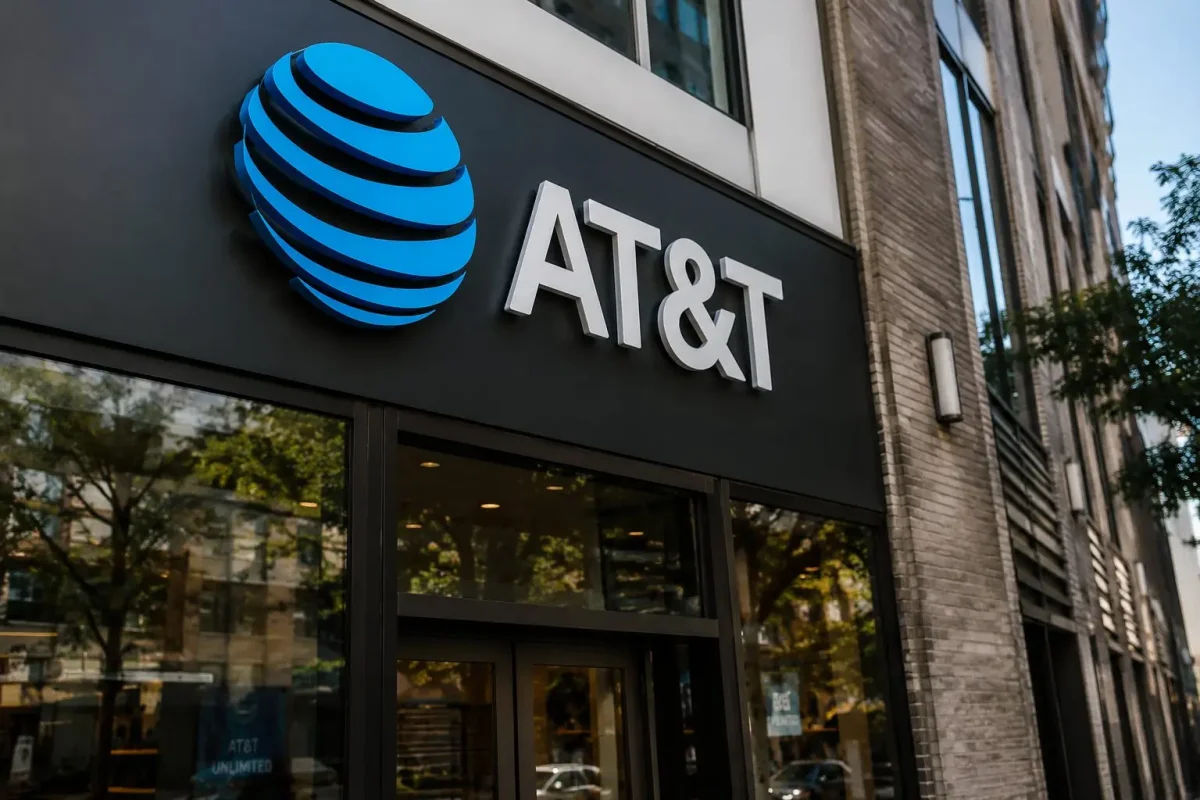
AT&T (T) shares fell sharply Wednesday after Oppenheimer downgraded the stock, citing growing competitive pressure from SpaceX's Starlink satellite broadband network. The stock slid 3.7% to $23.73 in afternoon trading, touching an intraday low of $23.45.
The downgrade reflects a shift in sentiment toward the telecom giant, which has long been viewed as a steady cash-flow generator. Oppenheimer analyst Timothy Horan cut AT&T to Perform from Outperform and withdrew his $32 price target, according to Barron's. Horan warned that Starlink's expansion could erode AT&T's broadband subscriber growth and eventually impact its mobile business.
Oppenheimer's report highlights the broader disruption SpaceX is causing in the $1.6 trillion U.S. communications industry. The firm raised its 2035 space revenue forecast to $800 billion from $500 billion, citing Starlink's rapid scaling ahead of SpaceX's planned Nasdaq listing on June 12. The analyst noted that low-Earth-orbit satellites offer lower latency than traditional systems, making them increasingly competitive.
The selling pressure extended beyond AT&T. Verizon (VZ) dropped 3.0%, and T-Mobile US (TMUS) slid 3.8%. The broader market also weakened, with the SPDR S&P 500 ETF (SPY) falling 0.6% and the Invesco QQQ ETF (QQQ) dipping 0.3%.
AT&T's investment thesis has centered on its fiber broadband expansion, wireless bundling, and free cash flow generation. In the first quarter, the company reported 512,000 consumer advanced home internet net adds, including 273,000 AT&T Fiber subscribers, and 294,000 postpaid phone net adds. Free cash flow came in at $2.5 billion, down from $3.1 billion a year earlier, as the company increased fiber spending.
The company is pressing ahead with its broadband strategy, rolling out a new fiber lineup starting June 7. The plans offer speeds of 300 Mbps, 500 Mbps, 1 GIG, and 5 GIG, with potential annual savings of up to $420 for customers bundling wireless and home internet. Jenifer Robertson, AT&T's executive vice president and general manager, said the new plans emphasize straightforward value and performance.
Despite these efforts, the bear case centers on timing and competitive dynamics. While satellite networks may take years to match fiber's speed and reliability in dense urban areas, analysts caution that aggressive pricing or capacity boosts from Starlink could force AT&T to spend more to retain subscribers. If Starlink scales faster than expected, AT&T's premium valuation as a safe-haven stock could erode.
Oppenheimer's Horan warned that Starlink could entrench itself in critical applications, reducing churn and increasing pricing power. This could accelerate subscriber and revenue declines for AT&T, Verizon, and T-Mobile. The potential for a Starlink public listing adds another layer of uncertainty, as it could raise capital for further expansion.
AT&T's fiber network now reaches over 37 million consumer and business locations, with a target to pass 40 million by the end of 2026 and 60 million by 2030. However, the company's ability to maintain its cash-flow-driven investment case will depend on how effectively it can defend its broadband and wireless turf against rising satellite competition.