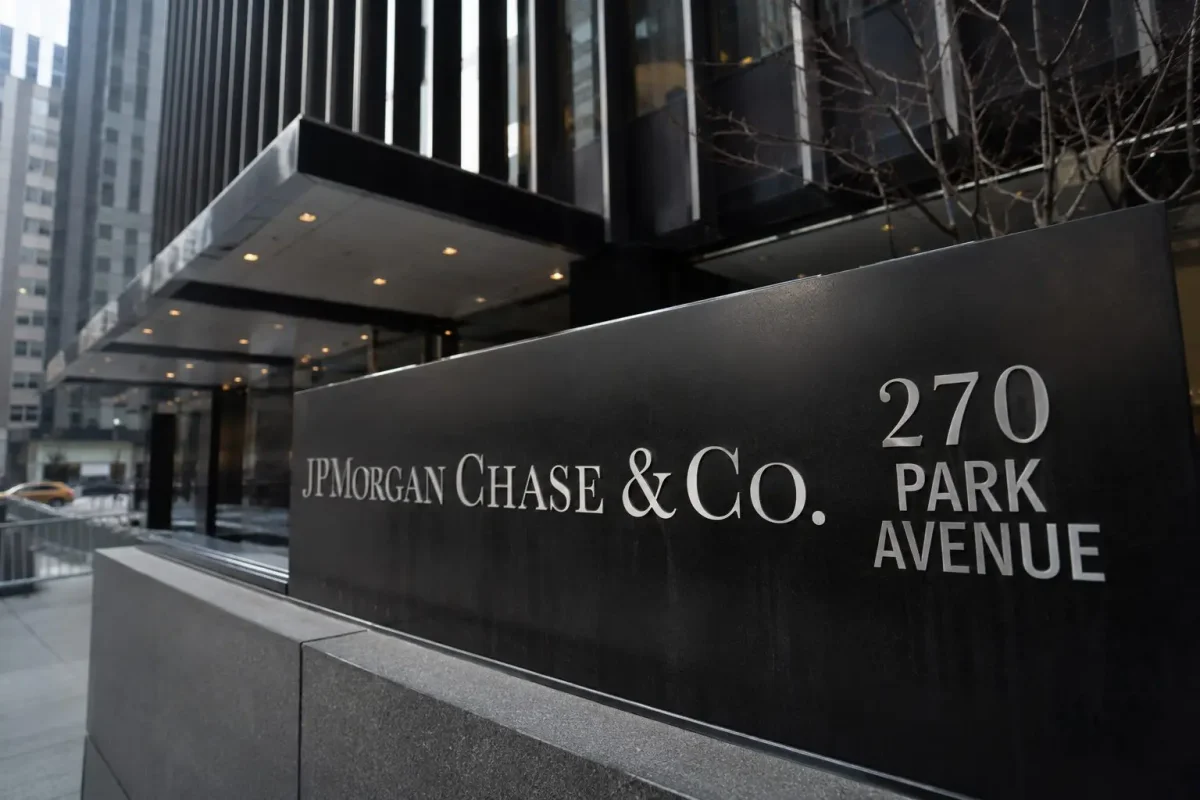
NEW YORK, July 18, 2026, 17:12 EDT — JPMorgan Chase (NYSE:JPM) is closing in on a $1 trillion market capitalization, even as the bank contends with escalating capital requirements. The financial giant ended Friday's trading session at $341.10 per share, giving it a market value of $927.9 billion. A mere 7.8% increase would push the valuation past the trillion-dollar milestone.
JPMorgan's adjusted return on tangible common equity held steady at 23% for the second quarter, matching the first quarter's performance and surpassing the 21% recorded in the same period a year earlier. However, the bank's standardized risk-weighted assets surged by approximately $103 billion during the quarter, contributing to a 20-basis-point decline in its standardized CET1 capital ratio to 14.1%.
The bank's market capitalization stands $72.1 billion short of the $1 trillion mark. Based on Friday's closing price and total shares outstanding, each share would need to reach approximately $367.62 to achieve that valuation. JPMorgan shares are currently trading at roughly three times tangible book value, which stood at $113.35 per share as of June 30.
JPMorgan's scale is evident when compared to its peers. The bank's market cap of $927.9 billion is 18.6% larger than the combined market capitalizations of Bank of America (NYSE:BAC) at $454.5 billion and Goldman Sachs (NYSE:GS) at $328.1 billion. JPMorgan's trailing price-to-earnings ratio of 16.3x remains below those of Goldman Sachs (19.5x) and Morgan Stanley (NYSE:MS) (19.5x), though direct comparisons are complicated by differing revenue mixes.
The bank reported a record net income of $21.2 billion for the second quarter, including $4.2 billion in significant items after tax. The largest of these was a $4.6 billion gain related to Visa (NYSE:V) shares, with additional equity investments contributing $1.0 billion. Excluding these items, adjusted profit reached $16.9 billion, a 13% increase year over year.
Operating businesses showed robust growth. Markets revenue climbed 35% to $12.1 billion, with equities revenue soaring 86%. Investment-banking fees advanced 30%. Chief Financial Officer Jeremy Barnum expressed caution about repeating the equities rally, calling it "a little bit hard to imagine that being repeated," but characterized the overall market environment as supportive.
Capital returns provided an additional boost to shareholders. JPMorgan distributed $4.0 billion through dividends and repurchased $6.2 billion in stock during the second quarter, with total distributions representing about 60% of adjusted profit. The bank plans to pay a $1.65 dividend per share for the third quarter, up 10% from $1.50.
Management raised its 2026 net-interest-income outlook to $105.5 billion, up from a previous estimate of $103 billion, while lifting adjusted expense guidance to $107.5 billion from $105 billion. Analysts remain divided on the stock's potential. Bank of America analyst Ebrahim Poonawala maintained a Buy rating with a new price target of $420, about 23% above Friday's close. Conversely, Morningstar (NASDAQ:MORN) analyst Austin Taggart viewed shares as "fairly valued" following the results.
Risks include a potential slowdown in equities trading, which could reverse recent gains, as well as higher costs and increased risk-weighted assets that may pressure returns. These factors could challenge the justification for JPMorgan's valuation at three times tangible book value. No investor events are scheduled for the coming week, and U.S. cash markets reopen Monday, with investors watching to see if the 23% adjusted return can be sustained against a larger capital base.