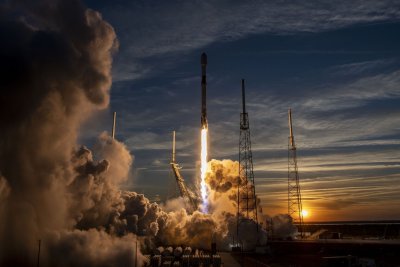
Shares of AT&T Inc. (NYSE:T) fell 2.0% to $22.91 by late Wednesday morning, erasing roughly $3.3 billion in market value, after SpaceX (NASDAQ:SPCX) unveiled plans to build a terrestrial mobile network under its Starlink brand. The announcement has intensified fears that the satellite operator could disrupt the U.S. wireless market, where AT&T, Verizon (NYSE:VZ), and T-Mobile (NASDAQ:TMUS) have long dominated.
The market reaction was broad: Verizon slipped 2.5% and T-Mobile dropped 2.2%, with the combined equity value lost by the three carriers estimated at $12.4 billion. The decline comes despite AT&T reaffirming its 2026 free-cash-flow outlook of at least $18 billion—the $3.3 billion market cap loss represents about 18% of that minimum forecast.
Starlink's Ambitious Entry
SpaceX President Gwynne Shotwell said Starlink will evolve into “a true mobile service” and predicted it would capture “quite a few” customers from the three incumbents. However, the company has not disclosed the cost of building the terrestrial network, which would require extensive infrastructure and spectrum deployment.
Both AT&T and SpaceX recently acquired spectrum licenses from EchoStar Corp. (NASDAQ:ECHO). AT&T completed a deal valued at approximately $23 billion on July 28, securing about 50 MHz of spectrum across the nation. SpaceX finalized two transactions totaling $19.6 billion, gaining 65 MHz, including terrestrial rights.
Spectrum and Execution Challenges
The spectrum comparison highlights why investors are concerned, but also underscores the significant execution hurdles SpaceX faces. Acquiring spectrum does not automatically translate into cell site deployment, retail networks, or comprehensive coverage. Craig Moffett of MoffettNathanson called launching a rival consumer service within five years “extraordinarily challenging” unless SpaceX leases an existing network. David Barden of New Street Research noted that 65 MHz would not easily match what carriers have built over three decades.
AT&T's Financial Position
AT&T continues to show strong operational metrics. In the second quarter, it reported 432,000 net additions for postpaid phone subscribers, with postpaid phone churn at 0.86%. Advanced-internet net additions totaled 646,000, and the company’s fiber network now passes 38.6 million locations. The company’s convergence strategy—bundling wireless and fiber—remains a key differentiator, with 42.5% of advanced internet customers also subscribing to AT&T wireless.
Cash returns remain a priority. CEO John Stankey stated, “We are accelerating the pace of our planned share repurchases this year to approximately $10 billion.” In Q2, AT&T returned $4.1 billion to shareholders, including $2.2 billion in buybacks. The stock’s dividend yield stands at 4.8%, and the 2026 free-cash-flow target implies an equity yield of 11.3%.
Analyst Sentiment
Most analysts remain bullish, with 16 Buy or Overweight ratings, 11 Holds, and one Sell. The mean price target is $28.65, suggesting about 25% upside from current levels. Wolfe Research upgraded AT&T to Outperform on July 23 with a $29 target, noting that SpaceX would need years to bridge the gap in terrestrial networks and spectrum.
However, risks remain. SpaceX could accelerate its timeline through a network-leasing deal or acquisition. Aggressive pricing competition could pressure service revenue growth and cash flow. AT&T’s net debt stood at $126.4 billion as of June 30.
The current selloff reflects long-term competitive threats rather than a revised outlook. AT&T has confirmed its projections, and SpaceX has not disclosed a budget for ground network development. The gap between promise and execution remains the key concern for investors.