Canada's federal deficit narrowed sharply in the first quarter of the fiscal year as revenue growth outpaced spending, but rising debt charges and an uncertain trade environment keep the full-year outlook clouded.
According to the Department of Finance's June Fiscal Monitor, the federal government recorded a C$370 million deficit from April through June 2026, a dramatic improvement from the C$6.28 billion shortfall in the same period last year. Revenue rose 9.8% to C$132.64 billion, while program expenses excluding actuarial losses increased 4.3% to C$117.16 billion.
The better-than-expected start was driven by broad-based gains across major tax lines. Personal income-tax receipts climbed 7.9%, corporate income-tax receipts rose 4.7%, and goods-and-services tax (GST) revenue surged 15.5%. Other revenue, which includes interest, penalties, Crown-corporation income, and sales of goods and services, jumped 38.9%.
However, financing costs moved in the opposite direction. Public-debt charges increased 6.1% to C$14.61 billion for the quarter and 12.4% in June alone. By TS2's calculation, debt charges consumed 11.0 cents of every revenue dollar, only slightly better than the 11.4 cents a year earlier. The Bank of Canada's latest benchmark table put the 10-year federal yield at 3.83% and the long-term benchmark at 4.17% on Sept. 17.
This creates a tension for bond markets: faster revenue growth lowers the immediate risk of a larger borrowing requirement, but higher effective rates on a growing stock of marketable bonds keep adding to expenses. The government also financed a C$39.48 billion cash requirement during the quarter, which is not the same as the accrual deficit.
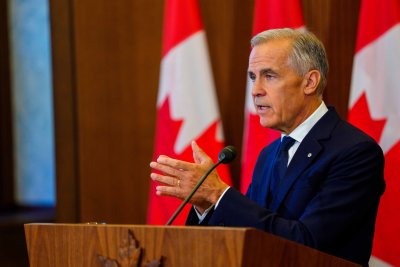
The Spring Economic Update still projected a C$65.3 billion deficit for the full 2026-27 fiscal year and federal debt equal to 41.5% of GDP. The day-to-day operating balance was forecast at a C$10.5 billion deficit, with a surplus only expected in 2028-29. However, a Canadian Press report said Prime Minister Mark Carney now expects that operating balance to be achieved a year earlier.
Investors should note the distinctions in how Ottawa classifies spending. The government separates capital investment from day-to-day operating costs, and the new "productivity mega-deduction," estimated to cost C$36 billion over five years, is a disputed example. The total deficit, debt-to-GDP ratio, and borrowing program remain the key metrics to watch.
The Fiscal Monitor is unaudited and warns that monthly results can be volatile due to the timing of receipts and expenses, with a large share of annual spending typically recorded in March. The C$5.91 billion year-over-year improvement after three months is evidence of a better starting point, not a C$24 billion annual upgrade.
For Canadian bank and consumer stocks, the rise in personal income-tax receipts and GST revenue points to firmer nominal activity. However, trade uncertainty remains a counterweight: customs-duty revenue fell 32.5% after the repeal of prior countermeasures, and stronger tax receipts could fade if tariffs slow investment and hiring.
Energy investors face a mixed signal. Higher oil prices can boost Canadian corporate income and government receipts, but they also raise transport costs and can keep inflation expectations and bond yields elevated. A fiscal benefit for Ottawa is not automatically a margin benefit for airlines, manufacturers, or households.
The next decisive check is the fall budget, which will reveal whether the first-quarter revenue surprise survives new spending, how Ottawa classifies the productivity deduction, and whether stronger nominal GDP lowers the debt ratio without a larger bond program. Until then, the evidence supports a narrower fiscal gap, not a completed consolidation.