ATLAS Infrastructure Partners UK Ltd. has significantly reduced its position in Edison International (NYSE:EIX), selling 395,820 shares during the fourth quarter. The sale represents a 9.2% decrease in its holdings, leaving the firm with approximately 3.9 million shares valued at roughly $234 million. This stake now accounts for 1.01% of Edison International's outstanding shares and remains ATLAS's fifth-largest portfolio position at 11.7%.
While ATLAS trimmed its exposure, other institutional investors have been increasing their stakes. Jones Financial Companies, Empowered Funds, Woodline Partners, and Sivia Capital all added to their EIX positions in recent quarters. Baird Financial Group initiated a new position in the utility company. Overall, institutional investors and hedge funds collectively own 88.95% of Edison International shares.
Insider activity also caught attention, with Director Peter J. Taylor selling 500 shares on April 13 under a pre-arranged trading plan, reducing his personal holdings by 1.44%. Analysts have turned more cautious on the stock, as Seaport Research Partners downgraded Edison International from buy to neutral on April 20.
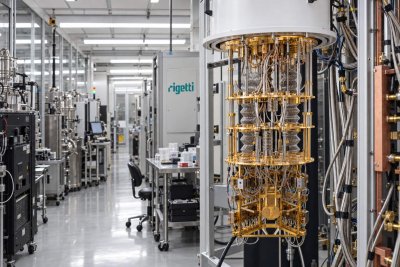
In the technology sector, Rigetti Computing (NASDAQ:RGTI) announced a potential $100 million research and development funding deal with the U.S. Department of Commerce and joined Hewlett Packard Enterprise's hybrid quantum supercomputing consortium. Despite a 21.81% one-month share price gain and strong 78.37% return over the past year, the stock is assessed as 26.5% overvalued. Analysts estimate a fair value of $16.00 per share against the current closing price of $20.25. Rigetti remains a pre-scale quantum hardware company with 2025 revenue estimated at just $7.1 million, reflecting high investor expectations for future growth amid ongoing volatility.
Okta (NASDAQ:OKTA) has seen its stock rise 26.2% recently but faces soft demand with only 10.8% billings growth and a slowed revenue projection of 9.1%, down from 27.1% growth over five years. Despite a 5.5% GAAP operating margin improvement, Okta's valuation at 6.3 times forward price-to-sales suggests limited upside. Analysts caution about increased competition and demand headwinds, recommending instead a dominant aerospace company known for effective mergers and acquisitions.
On the ASX300, Lifestyle Communities Limited (ASX:LIC) led gains with a 9.76% increase, closing at A$5.51. Other top gainers included Qoria Limited (QOR) up 6.38%, and Electro Optic Systems Holdings Limited (EOS) rising 4.83%. On the downside, Chalice Mining Limited (CHN) fell 8.47% to A$1.35, followed by Dateline Resources Limited (DTR) down 8.11% and Ora Banda Mining Limited (OBM) down 7.53%.
The Agency, a Los Angeles-based luxury real estate firm, opened its first office in Placencia, Belize, expanding its Central American footprint alongside locations in Nicaragua, Costa Rica, and Panama. The move targets Belize's growing appeal to foreign buyers seeking second homes and resort investments. Managing partners Dean and Kim Astren will lead the new office. Belize's market attractiveness includes English as the main language, common law legal system, no capital gains tax, and no restrictions on foreign ownership, though past fraud cases advise caution.
In a major talent move, OpenAI secured Noam Shazeer, a key AI researcher and former Google vice president known for co-leading Google's Gemini AI models. Shazeer will lead architecture research at OpenAI, focusing on scalable AI model design. His move comes amid fierce competition among major players for elite AI talent. Shazeer, a co-author of the foundational transformer model, significantly shaped modern AI development. The transition coincides with OpenAI's preparations for an initial public offering, suggesting intensified rivalry with Google, which recruited him back in 2024 for $2.7 billion through the Character.AI acquisition.
The bond market is signaling sustained higher interest rates, with the yield curve between two-year and 10-year U.S. Treasuries narrowing. This shift reverses earlier trends favoring rate cuts that supported risk assets like cryptocurrencies. The two-year yield now reflects expectations of continued tight Federal Reserve policy, while the 10-year yield signals concerns over long-term growth but remains relatively stable. After the Fed's recent decision to hold rates, the market anticipates a prolonged period of higher borrowing costs.