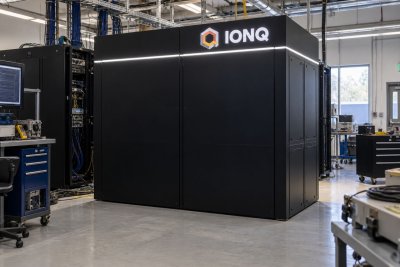
IonQ (NYSE:IONQ) is approaching its second-quarter earnings report on August 5 with a market capitalization of approximately $12.2 billion, a figure that represents about 46 times the midpoint of the company's 2026 revenue guidance. While the quantum computing leader reported a strong first quarter, the focus has shifted from top-line growth to the quality of its revenue streams.
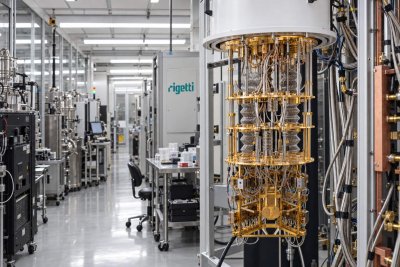
The company closed trading at $32.84 on Friday, down 3.6% for the day and 5.6% below the prior Friday's close. Trading volume was roughly 54% of the 65-day average, indicating muted participation ahead of the earnings event. Among quantum computing peers, IonQ posted the sharpest weekly decline, though Friday's losses were more contained than those of Rigetti Computing (NASDAQ:RGTI), D-Wave Quantum (NYSE:QBTS), and Quantum Computing Inc. (NASDAQ:QUBT).
Revenue Quality Under the Microscope
IonQ reported $3.1 billion in cash, cash equivalents, and investments as of March 31. After deducting this cash pile, the company's enterprise value-to-sales multiple stands at roughly 34 times. The company's first-quarter revenue of $64.7 million surpassed the $49.7 million analyst consensus, prompting management to raise full-year guidance to a range of $260 million to $270 million. However, to hit the second-half target, quarterly revenue must reach approximately $66.9 million, just 0.6% above the second-quarter midpoint.
This modest sequential growth requirement underscores the importance of revenue quality. IonQ disclosed $470 million in remaining performance obligations (RPO) as of March 31, about 1.8 times the midpoint of its 2026 sales forecast. The company notes that RPO includes both funded and unfunded elements within signed contracts, meaning a large backlog does not guarantee near-term revenue realization. Investors are increasingly focused on the conversion rate of these obligations into recognized revenue.
Commercial and International Mix
In the first quarter, approximately 60% of IonQ's revenue came from commercial customers, with 35% from international sources and 35% from multi-product deals. The company reports organic revenue separately by excluding contributions from acquired businesses. Strong organic conversion would provide clearer evidence of core demand. CEO Niccolo de Masi told Reuters in May that profitability is not the primary focus this year, emphasizing revenue growth and research investments instead.
D.A. Davidson analyst Alex Platt noted that May's share price action reflected high market expectations. Platt also pointed to lingering doubts about the commercial viability of trapped-ion technology, IonQ's core quantum computing approach. These concerns contribute to the stock's elevated beta of 2.70, making it sensitive to interest rate moves and shifts in technology risk appetite.
Macro and Earnings Risks
Volatility is expected next week as the Federal Reserve meets on July 28-29 and advance GDP figures alongside June income and spending data are released on July 30. These macro events could influence sentiment ahead of IonQ's earnings. The company is projecting an adjusted EBITDA loss of between $310 million and $330 million for the full year, and a reduction in guidance could weigh heavily on a stock trading at 46 times projected sales.
IonQ is scheduled to report results after the market close on August 5, with a conference call at 4:30 p.m. EDT. The August report does not need to show rapid sequential growth, but it must provide evidence that funded, organic demand is sufficient to support the current valuation. Risks remain significant, and the market will be watching closely for signs of sustainable revenue quality.