Rocket Lab (RKLB) introduced a new space-grade solar cell on Tuesday, a move that addresses a critical supply chain vulnerability but does little to ease the company's lofty valuation. The announcement came after market close, with shares having already gained 2.5% to $65.87 on volume of 24.1 million shares.
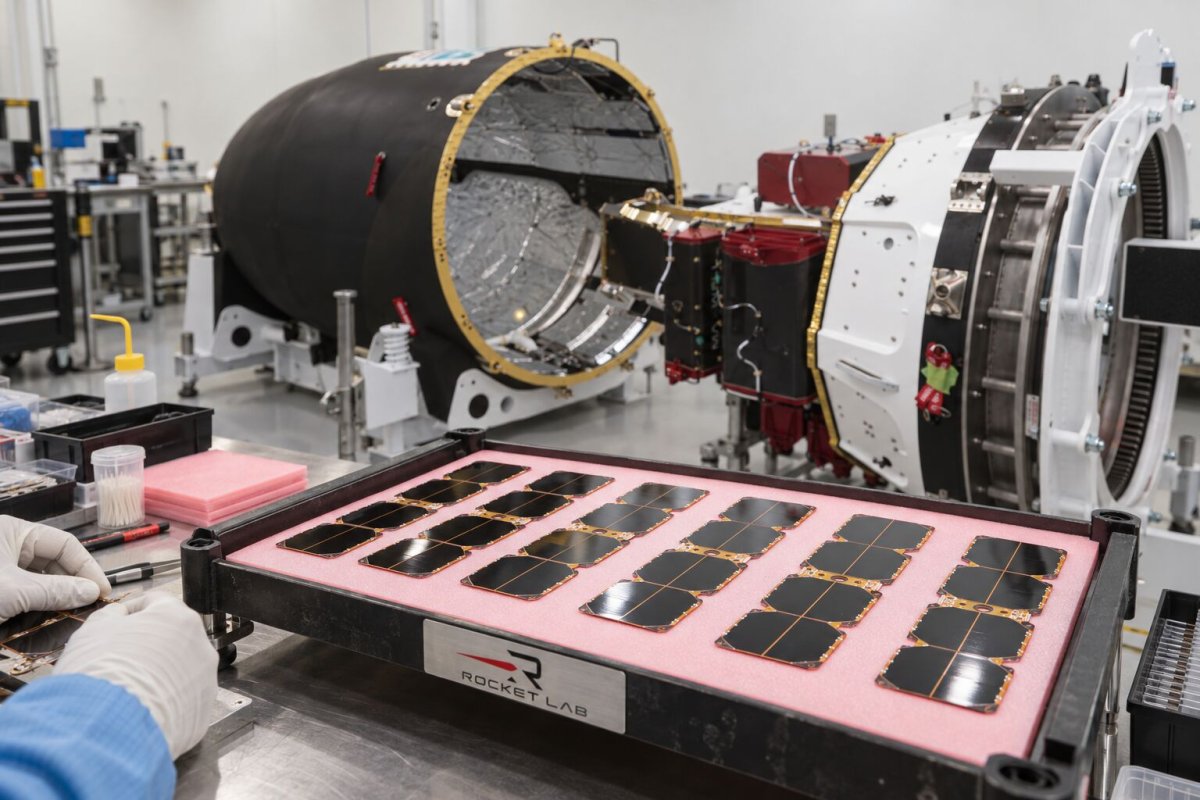
The new product, dubbed IMM Apex, is a germanium-free solar cell that boasts a 31.5% beginning-of-life conversion efficiency and weighs 40% less than Rocket Lab's previous generation. The company says it is designed as a drop-in replacement, meaning satellite manufacturers can integrate it without redesigning their systems.
This is a significant technical achievement. In the satellite industry, every kilogram counts, as launch costs are directly tied to mass. A lighter solar cell can either reduce overall spacecraft weight or free up capacity for additional payload, propulsion, or communications equipment. Moreover, eliminating germanium—a material subject to export controls and price volatility—removes a major supply chain headache.
Germanium: A Geopolitical Risk
The importance of this move is underscored by recent market dynamics. According to the U.S. Geological Survey's 2026 commodity summary, China remained the dominant producer and exporter of germanium in 2025. U.S. imports of the metal plummeted 67% to an estimated 7,000 kilograms following China's 2024 export ban. The European spot price for high-purity germanium surged from $3,150 per kilogram in January 2025 to $5,380 by October.
Germanium wafers are traditionally used as substrates in multijunction solar cells for space applications. By eliminating this component, Rocket Lab not only reduces its exposure to a volatile input but also diminishes its reliance on a politically sensitive supply chain.
Production and Government Support
Rocket Lab says IMM Apex is available now, with manufacturing already at a "multi-100-kilowatt" scale. The company's earlier IMM technology has a proven track record, having operated in orbit for over a decade and powered NASA's Ingenuity Mars helicopter. In total, Rocket Lab's solar products have been used on more than 1,100 satellites.
The U.S. government is backing the expansion. The Department of Commerce has awarded Rocket Lab up to $23.9 million to modernize its compound-semiconductor facility in Albuquerque, New Mexico. The National Institute of Standards and Technology (NIST) notes the $97.5 million project aims to boost production capacity by 50% over three years.
The Missing Revenue Numbers
Despite the technological promise, Rocket Lab has not disclosed a named customer for IMM Apex, nor has it provided contract values, unit pricing, or expected revenue contributions. Crucially, the company has not revealed whether the new manufacturing process will improve gross margins after accounting for yield, qualification, and capital costs. These omissions leave investors in the dark regarding the financial impact.
Rocket Lab's space systems division is already a major revenue driver. In the second quarter, product revenue reached $181.3 million, accounting for 77% of total revenue, while service revenue contributed $52.7 million. However, the company does not break out solar cell sales separately, making it difficult to gauge the product's individual performance.
Valuation Concerns Persist
The company reported record Q2 revenue of $234.1 million, up 62% year-over-year, with a backlog of $2.36 billion. Yet, it still posted a GAAP gross margin of 36.1%, an operating loss of $57.5 million, and a net loss of $49.3 million. Guidance for Q3 projects revenue between $250 million and $265 million, with an adjusted EBITDA loss of $17 million to $23 million.
Using management's guided basic share count of 641 million and Tuesday's closing price, Rocket Lab's indicative equity value stands near $42.2 billion—roughly 41 times the annualized midpoint of Q3 revenue. This rich multiple suggests the market is already pricing in substantial future growth.
What Would Change the Story?
For IMM Apex to become financially material, three key disclosures would be needed: a major design win from a satellite constellation or national security program, evidence that the 40% mass reduction translates into market share gains without price erosion, and proof that germanium removal expands margins rather than merely offsetting costs elsewhere.
The drop-in compatibility could accelerate adoption, but "available now" doesn't mean qualified for every mission. Space hardware undergoes lengthy validation cycles, and a cell's beginning-of-life efficiency says little about its lifetime performance under radiation and temperature extremes.
The bull case for Rocket Lab is that vertical integration allows it to sell more content per spacecraft—from solar cells to satellite buses to launch services. IMM Apex strengthens that offering and addresses a customer pain point. The bear case is that even a successful product may be too small to justify a $42 billion valuation. The next meaningful catalyst won't be another efficiency claim; it will be an order that translates watts, capacity, and margins into dollars.