IonQ (NYSE: IONQ) shares climbed 8.4% to $42.83 in early trading Tuesday, buoyed by the quantum computing company's unveiling of its 256-qubit Superion platform and an upward revision to its 2026 revenue outlook following the acquisition of SkyWater Technology's foundry business. The rally reflects a tangible manufacturing milestone, yet the stock's market capitalization of approximately $17.35 billion means investors are still paying roughly 38 times the midpoint of the new sales guidance.
This valuation tension underscores the market's dilemma. IonQ has moved beyond mere presentations, announcing that integrated chips have been fabricated, ions trapped in prototype systems, and orders are now open. However, customer deliveries are not slated to begin until 2027. Moreover, the enhanced revenue forecast includes contributions from the acquired semiconductor foundry, not a sudden acceleration in IonQ's core quantum business.
Superion: From Roadmap to Manufacturing Test
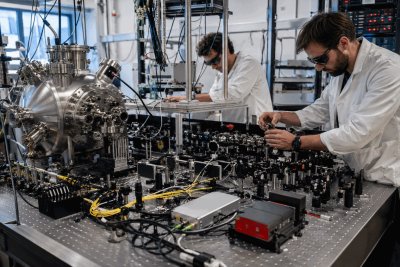
IonQ's Superion announcement offers three key pieces of evidence beyond the headline qubit count. The company reports it has fabricated its first fully integrated 256-qubit quantum processing units at SkyWater, trapped ions in prototype machines under construction at several U.S. sites, and completed six chip tapeouts in the first half of 2026.
IonQ also claims that working with SkyWater shortened its design cycle from nine months to two and produced 12 times as many wafer lots over six months compared to its previous foundry relationship. While these are company-reported process improvements rather than proof of repeatable high-volume output, they provide investors with a measurable metric to assess whether the July acquisition can transform one-off quantum machines into batch-produced products.
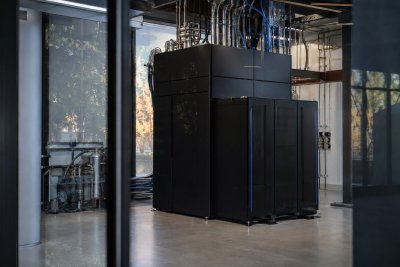
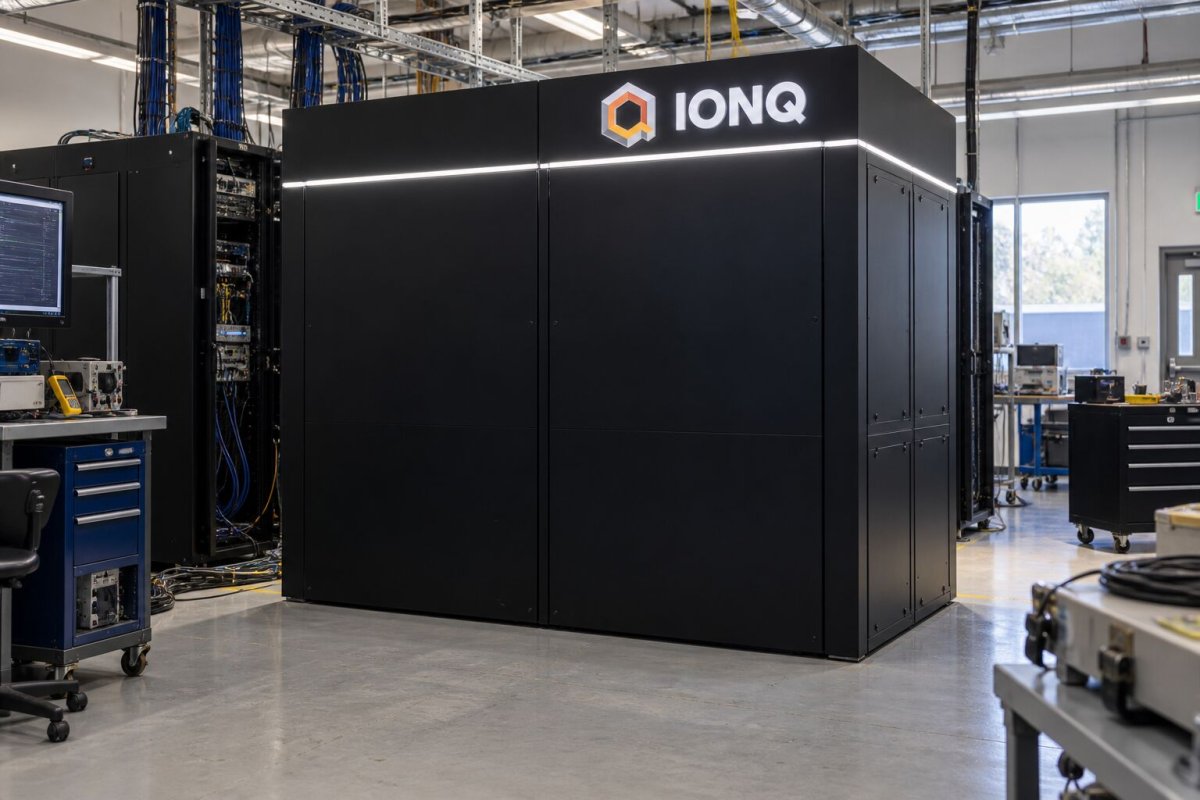
Architecturally, Superion integrates electronic qubit control directly onto the chip, reducing reliance on laser-based control systems used in earlier trapped-ion designs. IonQ states the 256-qubit machine will fit into a standard server rack, with its first unit already pre-sold in the first quarter and deliveries planned for 2027. The company is concurrently developing a 10,000-qubit generation and targeting a fault-tolerant lab system in 2027, followed by a manufacturable commercial version in 2028. All forward-looking statements beyond the demonstrated prototype work remain speculative.
5 Million Guidance: Not a Pure Organic Boost
In a separate filing, IonQ projected 2026 revenue of $450 million to $460 million, up from the $280 million to $290 million stand-alone range issued in August. The midpoint rose by $170 million, or 59.6%, but the new outlook includes SkyWater's revenue from the July 31 acquisition date through year-end, blending quantum-platform sales with foundry revenue. Investors should not interpret the increase as a like-for-like organic guidance raise.
The underlying financials remain early-stage. IonQ reported $80.05 million in second-quarter revenue and $60.11 million in cost of revenue, yielding a gross profit of $19.94 million and a gross margin of approximately 24.9%. The company's June-quarter 10-Q revealed $254.8 million in operating cash used during the first half, with $2.96 billion in cash, equivalents, and marketable securities as of June 30.
That cash position predates the SkyWater closing. IonQ says the transaction required about $1.06 billion in cash, including $741.3 million in purchase consideration and roughly $315.1 million for debt repayment and other costs. While the balance sheet remains a strength, the pre-deal cash figure overstates the cushion available post-closing.
What the 38x Multiple Demands
Using the $17.35 billion market cap and the $455 million guidance midpoint, IonQ trades at roughly 38.1 times projected 2026 revenue. This is a price-to-sales measure, not an enterprise-value multiple, and the acquired foundry sales complicate comparisons with the old business. Still, it's a demanding price for a company with a sub-25% gross margin and significant cash burn.
The bull case contends that today's sales are the wrong denominator. With electronic control and a captive foundry, IonQ could scale manufacturing of upgradeable systems, moving from custom hardware toward a repeatable platform with cloud and service revenue. Tuesday's six tapeouts, first fabricated chips, and trapped-ion prototype are steps in that direction.
The counterargument is that the stock already prices in much of this transition before a production Superion reaches a customer. The next decisive proof won't be another qubit target; it will be named orders beyond the first pre-sale, on-time 2027 deliveries, repeatable system yields, and improving margins as manufacturing scales.
IonQ's investor day begins at 12:30 p.m. ET Tuesday. Investors should listen for a bridge between the old and new revenue guides, the portion of 2026 sales expected from SkyWater, and concrete Superion production milestones. Those details will determine whether the 8% rally reflects a newly de-risked manufacturing story—or simply a higher price on the same long-duration promise.