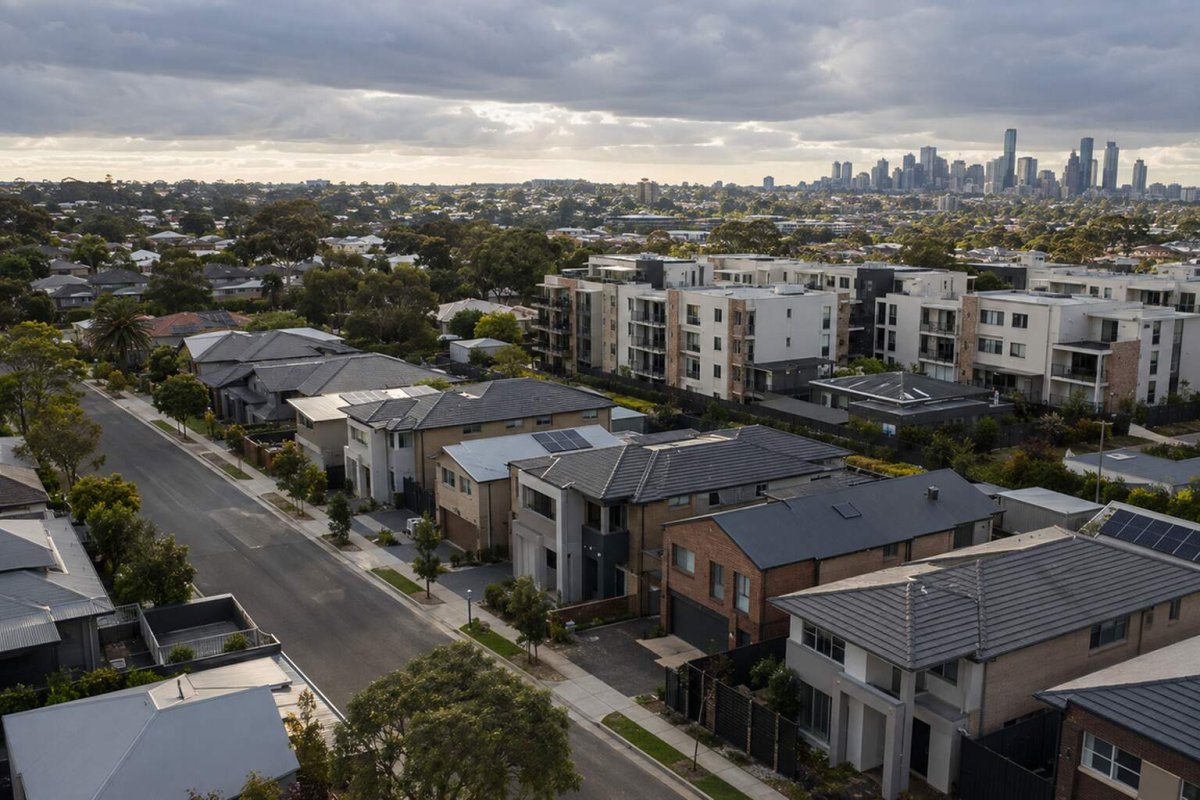
The Australian property market correction has broadened significantly, with home values falling across 93% of capital-city suburbs in the three months to August. Despite this widespread decline, the nation's banking sector continues to demonstrate resilience, with no signs of a solvency crisis emerging on current balance sheets.
National home values dropped 0.9% in August, marking the fifth consecutive monthly decline and leaving prices 3.6% below their March peak. The downturn's breadth is remarkable, affecting nearly every suburb in major cities. Sydney led the decline with a 1.4% monthly fall, leaving values 7.1% below their February high. Melbourne and Canberra each lost 1.1%, while Brisbane fell 1.0% and both Adelaide and Perth declined 0.8%.
The housing market is clearly shifting toward buyers, with national sales volumes down 15.5% year-over-year. Capital-city listings during the four weeks ending August 30 were 24% above last year and 8% above the five-year average, indicating rising inventory and softening demand.
However, the correction must be viewed in context. Despite the recent slide, home values remain approximately 50% above early 2020 levels and about 5% higher than a year ago, according to the Reserve Bank of Australia (RBA). Commonwealth Bank economists project a total peak-to-trough decline of around 9%, suggesting the current 3.6% fall is less than halfway through the expected adjustment.
For shareholders in Australia's mortgage-heavy banks, the near-term impact will likely be felt through slower lending growth and reduced consumer spending rather than capital erosion. Commonwealth Bank of Australia (ASX: CBA) reported its Australian home-loan portfolio grew to AUD 680 billion as of June 30, up from AUD 634 billion a year earlier, but applications have fallen approximately 15% over the past 12 weeks and are 17% lower year-over-year.
CBA CFO Alan Docherty still projects housing credit growth of 4-5% over the coming year. The bank also noted a widening spending gap, with mortgage customers increasing spending about 15% over five years compared to 25% for non-mortgage customers. This divergence suggests higher mortgage repayments are constraining consumption, which could impact card volumes and small-business demand.
Competition is intensifying as banks chase a shrinking pool of qualified borrowers, potentially squeezing net interest margins. However, arrears remain low. CBA's portfolio-wide dynamic loan-to-value ratio stood at 40.71% at June 30, with home loans at least 90 days past due at 0.73% of balances, up just 10 basis points during the half. ANZ reported Australian housing arrears of 0.86% in August, up three basis points from March.
Capital positions are robust. CBA reported a common-equity Tier 1 capital ratio of 12.0%, well above its 10.25% regulatory minimum, while ANZ's ratio was 12.51%. CBA booked AUD 788 million in loan-impairment expenses for the year, equivalent to eight basis points of average loans, and retained a AUD 2.7 billion provision buffer above central-case losses.
The RBA's March financial stability review modeled a severe 40% house-price fall, finding that about 80% of mortgagors would retain positive equity. However, positive equity does not guarantee payment ability if borrowers lose their jobs. The unemployment rate, currently 4.5% as of July, is the key variable that could turn a price correction into a credit event.
Monetary policy remains tight, with the RBA holding its cash rate at 4.35% after three increases in 2026. The next labor force report is due September 24, followed by the RBA's rate decision on September 29. Rising unemployment combined with a jump in 90-day arrears would weaken the current benign credit outlook. For now, the CBA forecast of a 9% decline with stable jobs would mainly threaten mortgage growth and household demand, while a sharper fall with job losses would put provisions and capital at the forefront.