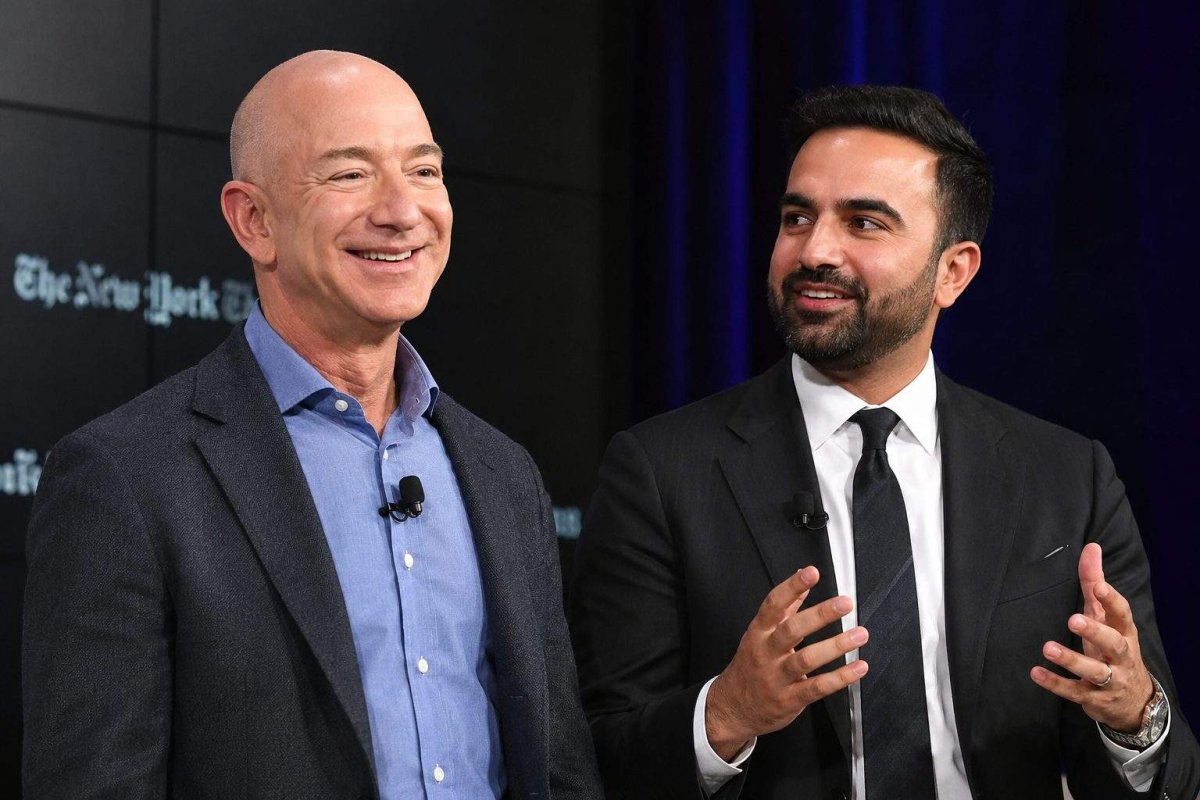
In a bold move that reignites the national tax debate, Amazon founder and executive chairman Jeff Bezos has called for the complete elimination of federal income taxes for the bottom 50% of American earners. Speaking with CNBC's Andrew Ross Sorkin, Bezos argued that these taxpayers should owe 'zero' to the Internal Revenue Service, not merely a reduced amount. 'I don't want to reduce it, I want to eliminate it,' Bezos stated. 'Zero is a better number than $1.'
The proposal directly challenges New York City Mayor Zohran Mamdani and other Democratic leaders who are pushing for higher taxes on the wealthy to fund social programs. Mamdani has been advocating for a new tax on luxury second homes, known as a pied-à-terre tax, which would target properties valued at over $5 million whose owners claim a primary residence outside the city. The mayor's office estimates this could generate $500 million annually for city services and affordability initiatives.
Bezos criticized Mamdani's approach, arguing that raising taxes on billionaires would not materially help middle- and lower-income workers. 'You could double the taxes I pay, and it's not going to help that teacher in Queens,' Bezos told InvestmentNews. Mamdani fired back on social media: 'I know a few teachers in Queens who would beg to differ.'
According to data from the Tax Foundation, taxpayers in the bottom half of earners—those making less than $53,801 in 2023—accounted for just 12.3% of all adjusted gross income and paid only 3.3% of federal individual income taxes. In contrast, the top 1% of earners covered 38.4% of the total tax burden. Bezos illustrated his point with a hypothetical: 'A nurse in Queens making $75,000 a year and paying over $1,000 a month in taxes. We shouldn't be asking this nurse in Queens to send money to Washington. They should be sending her an apology.'
The tax debate extends beyond New York. Democratic lawmakers are pushing wealth tax proposals in California, in Congress, and in other states. Bezos, however, has not detailed how his plan would be enacted by Congress or what measures would fill the resulting revenue gap. Critics note that Bezos himself paid no federal income taxes in 2007 and 2011, according to a 2021 ProPublica investigation, which highlighted how stock gains can escape income taxation for the ultra-wealthy.
Wall Street has not remained silent. Mamdani has engaged with CEOs from major banks like JPMorgan Chase (Jamie Dimon) and Goldman Sachs (David Solomon), while hedge fund managers Bill Ackman and Ken Griffin have publicly criticized New York's tax plans. Bezos defended Griffin, whose $238 million Manhattan penthouse has been a target of Mamdani's rhetoric, saying, 'Ken Griffin isn't a villain.'
The New York property tax proposal faces practical hurdles. The city comptroller's office indicated that first bills under the plan would likely not go out until November 2026, with open questions around valuations, rentals, and enforcement. New York Governor Kathy Hochul has supported the idea as a way to stabilize city finances and avoid service cuts. 'If you can afford a $5 million second home that sits empty most of the year, you can afford to contribute like every other New Yorker,' Hochul said.
Bezos framed his proposal as a political statement rather than a fully fleshed-out bill, telling political leaders he would push the idea forward. He emphasized that wiping away the tax bill for lower earners could be 'very meaningful' for those families, even though it represents a small slice of federal revenue. The broader market context suggests that tax policy will remain a central issue in upcoming elections, with potential implications for consumer spending, investment, and economic growth.