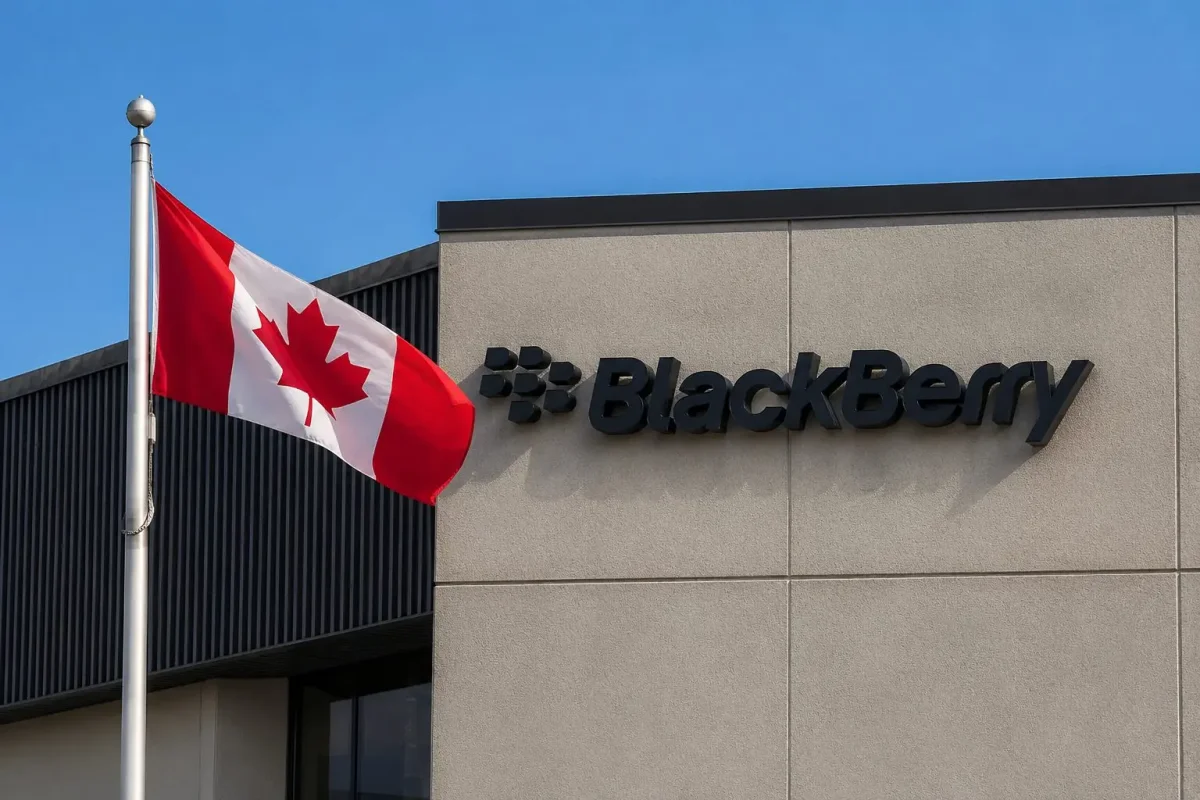
BlackBerry Ltd (NYSE: BB) saw its U.S.-listed shares climb 7.8% to $9.70 on Monday, with trading volume exceeding 25 million shares, as investors continued to rally around the company's software-focused turnaround strategy. The stock opened at $9.28 after closing at $9.00 and reached an intraday high of $9.74, pushing the company's market capitalization to approximately $5.77 billion.
In Toronto, BlackBerry's shares outperformed the broader market, surging over 8% to hit a 52-week high of C$13.45. This move came despite the S&P/TSX Composite Index declining 0.3% earlier in the session, weighed down by weakness in financial and mining stocks.
The latest upward momentum is notably not tied to any new handset product but rather to growing investor enthusiasm for QNX, BlackBerry's embedded software division. QNX is a real-time operating system designed for mission-critical applications in automotive, industrial, medical, and other safety-sensitive devices. The company's focus on robotics and secure communications with government and regulated clients has been a key driver of recent interest.
BlackBerry reported last week that a survey of 1,000 robotics developers identified software architecture and integration as the top performance bottlenecks, ahead of hardware concerns. Jim Hirsch, QNX's global vice president of sales for general embedded markets, noted that developers "consistently cite four core challenges: safety, determinism, cybersecurity, and integration."
The company's fiscal fourth-quarter results, released in April, provided further fuel for bullish sentiment. QNX posted a 20% year-over-year increase in revenue to $78.7 million, while the royalty backlog reached approximately $950 million. Management also guided for first-quarter revenue above Wall Street expectations. CEO John Giamatteo emphasized that the business delivers "highly regulated, complex, mission-critical solutions," a phrase that has become central to the investment thesis.
BlackBerry's competitive landscape now extends beyond legacy handset rivals to include other embedded and safety software companies. Notably, Nvidia (NASDAQ: NVDA) has emerged as a key hardware AI partner. In April, QNX announced an expansion of its collaboration with Nvidia to integrate its safety OS with Nvidia's IGX Thor platform, targeting robotics, medical, and industrial applications. QNX President John Wall stressed that "safety and determinism cannot be afterthoughts."
Security remains a focal point for traders. In May, BlackBerry announced that its AtHoc platform had completed FedRAMP Class D High re-certification. FedRAMP is the U.S. government's cloud security assessment program, and Class D High covers sensitive unclassified systems where failure could significantly impact operations or safety. Ramon Pinero, head of secure communications at BlackBerry, called the re-certification proof of "operational maturity and security rigor."
On the capital return front, BlackBerry renewed its normal course issuer bid in May, allowing it to repurchase up to 26.8 million common shares through May 2027. However, this remains a secondary consideration for most investors.
Despite the positive momentum, risks persist. The stock's rally may have outpaced the underlying business performance, as the QNX backlog must still convert into revenue. Robotics and automotive deployment timelines can shift, and government security contracts are inherently uneven. A momentum-driven rally could unwind quickly if the company's next quarterly report fails to deliver on software revenue and cash flow expectations.
BlackBerry's next major test will come on June 25, when it reports first-quarter fiscal 2027 results for the period ending May 31. The earnings release will be closely watched for signs of sustained growth in QNX and secure communications.