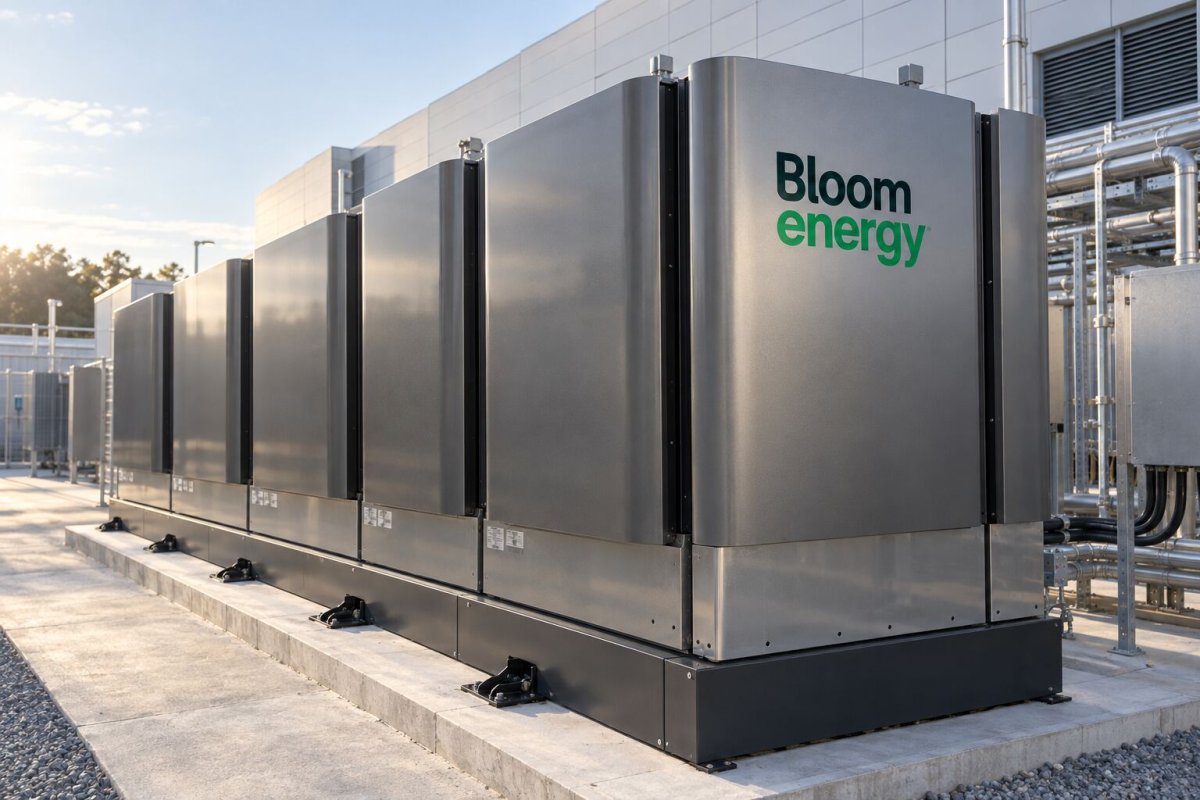
Bloom Energy (BE) shares are set to open sharply higher on Tuesday, with premarket trading indicating a 5.8% gain to $267.63. The surge follows the announcement that the fuel-cell maker will join the S&P 500 index, a milestone that brings both prestige and a wave of forced buying from index funds. However, the stock's valuation — trading at roughly 99 times its own 2026 adjusted earnings guidance — is drawing scrutiny from analysts who question whether the growth narrative justifies the price.
Index Inclusion Sparks Rally
S&P Dow Jones Indices revealed after Friday's close that Bloom Energy will replace Molson Coors Beverage in the benchmark index, effective before the September 21 open. This means index funds tracking the S&P 500 will be required to hold Bloom Energy in proportion to its float-adjusted market capitalization. The announcement triggered a 7.4% rally on Friday, and with Tuesday's premarket indication, the stock has climbed 13.6% over two sessions.
Based on the company's latest reported share count of 294.5 million, the recent surge has added approximately $9.4 billion in market value since Thursday. The mechanical demand from index funds is substantial — S&P Global estimates that $13 trillion is directly indexed to the S&P 500. However, the exact amount of forced buying remains uncertain, as the index uses float-adjusted weights and the company's pro forma weight has not been disclosed.
Valuation at Extreme Levels
At the premarket price of $267.63, Bloom Energy's market capitalization stands at approximately $78.8 billion. This valuation implies a price-to-sales ratio of roughly 18.8 to 20.2 times management's full-year revenue guidance of $3.9 billion to $4.2 billion. More strikingly, the stock trades at 94 to 105 times the adjusted EPS guidance of $2.55 to $2.85, with the midpoint at 99 times.
UBS analysts have raised their price target to $325 from $300, maintaining a Buy rating. The target is based on an 11.25-times enterprise-value-to-sales multiple applied to a 2028 revenue estimate of $8.9 billion. This implies that the bullish case hinges on rapid growth persisting for another two years, a scenario that may be optimistic given the current valuation.
Strong Fundamentals Behind the Hype
Bloom Energy's inclusion in the S&P 500 is not solely based on index mechanics. The company reported impressive second-quarter results, with revenue surging 165.5% to $1.065 billion and product revenue up 215.4%. Gross margin expanded to 33.4% from 26.7%, and operating income swung to a $182.2 million profit from a $3.5 million loss a year earlier. Operating cash flow was robust at $226.4 million.
Management raised its 2026 guidance, now expecting revenue of $3.9 billion to $4.2 billion, non-GAAP operating income of $800 million to $900 million, and non-GAAP EPS of $2.55 to $2.85. The company's fuel cells are seen as a solution for AI data centers that need power quickly without waiting for grid connections. A recent collaboration with Hitachi in Japan also opens up international opportunities.
Balance Sheet Solid, but Concentration Risks Loom
Bloom Energy's balance sheet appears stable, with $2.667 billion in unrestricted cash against $2.475 billion in recourse debt and a negligible $2.6 million in non-recourse debt. However, the company's customer concentration is a significant concern. One contractual customer accounted for 73% of first-half revenue, and in the second quarter, two customers contributed 44% and 21% of revenue, respectively. This dependence on a few customers makes revenue lumpy and unpredictable.
Dilution is another factor to watch. Outstanding shares increased from 280.0 million at the end of December to 294.5 million by July 22, a 5.2% rise, partly due to Oracle's cashless warrant exercise. This dilution means that company growth must outpace share count increases to benefit per-share metrics. Additionally, the company's warranty reserve jumped to $77.8 million from $20.0 million at year-end, including a $58.3 million specific reserve.
What to Watch Ahead of September 21
Investors will be closely monitoring whether Bloom Energy can maintain its gains once regular trading opens. Elevated trading volume leading up to the rebalance would indicate arbitrageurs and benchmark-aware funds are positioning themselves. More importantly, future disclosures will be scrutinized for signs of reduced customer concentration and sustained revenue and margin growth. The S&P 500 inclusion provides a short-term catalyst, but at 99 times forward earnings, the stock already prices in a multi-year growth story that may be difficult to deliver.