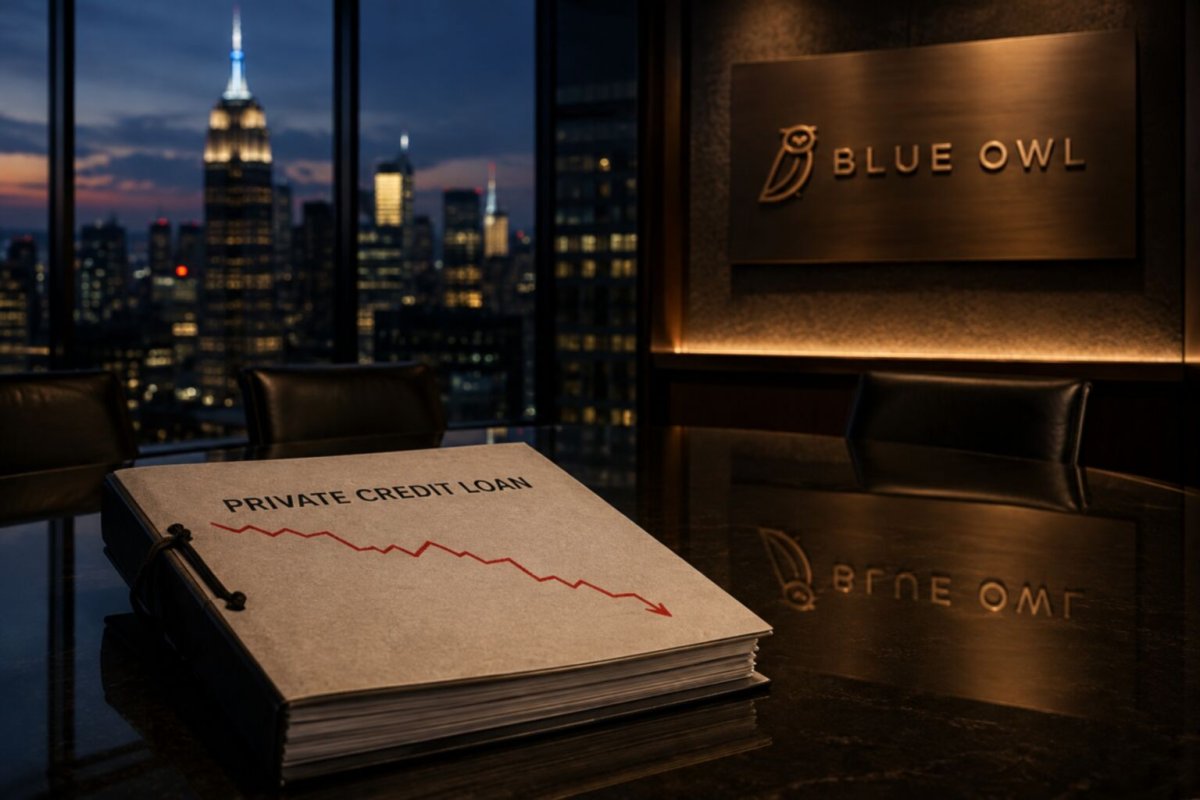
Blue Owl Capital Corporation (NYSE: OBDC) has slashed the value of four loans tied to Loparex, a specialty materials company, by a staggering 93% in just six months. The markdown, disclosed in the fund's second-quarter filing, has thrust the private credit industry's valuation practices into the spotlight and intensified scrutiny on OBDC's shares, which already trade at a significant discount to net asset value (NAV).
The four loan positions, which carried a combined fair value of $122.43 million at the end of 2025, were marked down to just $8.34 million by June 30, 2026. The sharpest decline occurred in the second-lien debt, which plummeted from 88.4 cents on the dollar to a mere 5 cents. This rapid deterioration, representing a $114.09 million loss in stated value, nearly matches the $114.5 million net unrealized loss the fund attributed to Loparex in its quarterly report.
A Test for Private Credit Marks
The Loparex write-down serves as a stark reminder of the challenges inherent in valuing private assets, which do not trade on public exchanges and rely on manager estimates. For OBDC, the markdown raises a critical question: how quickly do private-credit marks capture underlying trouble? The answer, as Loparex demonstrates, may be slower than investors would prefer, even as the fund's overall portfolio metrics remain relatively healthy.
Despite the Loparex hit, OBDC reported that only 0.8% of its investments by fair value were on non-accrual status as of June 30. Performing investments still represented 99.2% of the portfolio, a figure that suggests the damage is contained. However, the fund's shares have not escaped unscathed, trading at $11.40 as of Friday's close, a 20.1% discount to the reported June NAV of $14.26 per share.
What Happened at Loparex?
According to a Bloomberg report, Loparex missed a June payment on its second-lien debt, prompting creditors to grant forbearance through September. Moody's has deemed the company in default and flagged the possibility of a Chapter 11 filing. OBDC President Logan Nicholson acknowledged on an August 6 earnings call that a planned equity infusion for Loparex failed to materialize, leading to the markdown during the quarter.
The four loan positions included two first-lien and two second-lien facilities. The second-lien loans, with a face value of $133 million, were marked to just $6.65 million, a 94.3% decline. The larger first-lien position fell from $4.12 million to $0.89 million, a 78.5% drop, while a smaller first-lien position held near par and was included only in the combined figures.
Portfolio Impact and Investor Debate
Loparex represented about 0.90% of OBDC's $15.11 billion amortized-cost portfolio as of June, but after the marks, it accounted for just 0.056% of the fund's $14.96 billion fair value. This limits the direct arithmetic damage from a further decline, providing some comfort to bulls who view the situation as an isolated event. Nicholson reiterated that the issues under management remain specific to Loparex.
However, skeptics point to the timing and magnitude of the markdown as evidence that private valuations can appear benign while trouble brews beneath the surface. The Loparex case shows how a loan can lose nearly all its value before a cash recovery becomes observable, underscoring the risk that other marks may be overly optimistic.
Market Signals and Dividend Coverage
OBDC's share price has shown resilience since the earnings-week low, recovering to $11.40 by September 4, up 3.6% from an August 3 low of $11.00. The stock closed Friday up 0.2%, and with U.S. markets closed for Labor Day on Monday, Tuesday's session will provide the first full test of investor sentiment following the Loparex disclosure.
The fund's dividend appears well-covered, with adjusted net investment income of $0.34 per share in the second quarter, covering the $0.31 base dividend plus a $0.02 supplement. Part of the income boost came from a non-recurring gain related to the Mavis Tire investment, which may not repeat. The base dividend yield stands at 10.9%, a level that could attract income-focused investors despite the NAV discount.
Broader Implications for Blue Owl
Blue Owl Capital Inc. (NYSE: OWL), the adviser to OBDC, could face reputational and fundraising challenges if credit surprises become a pattern. While one borrower does not establish a trend, it sharpens the market's scrutiny of the firm's underwriting and valuation processes. For OBDC shareholders, the risks are two-sided: further write-downs or a weak recovery could reduce NAV and interest income, while stable marks elsewhere, steady dividends, and discounted buybacks could reward patience.
Tuesday's trading will offer an initial gauge of investor sentiment, but the lasting evidence will come later. Loparex recovery proceeds, portfolio-wide non-accrual trends, and future mark-to-market filings will ultimately determine whether this was a one-off bad loan or an early warning sign for the private credit sector.