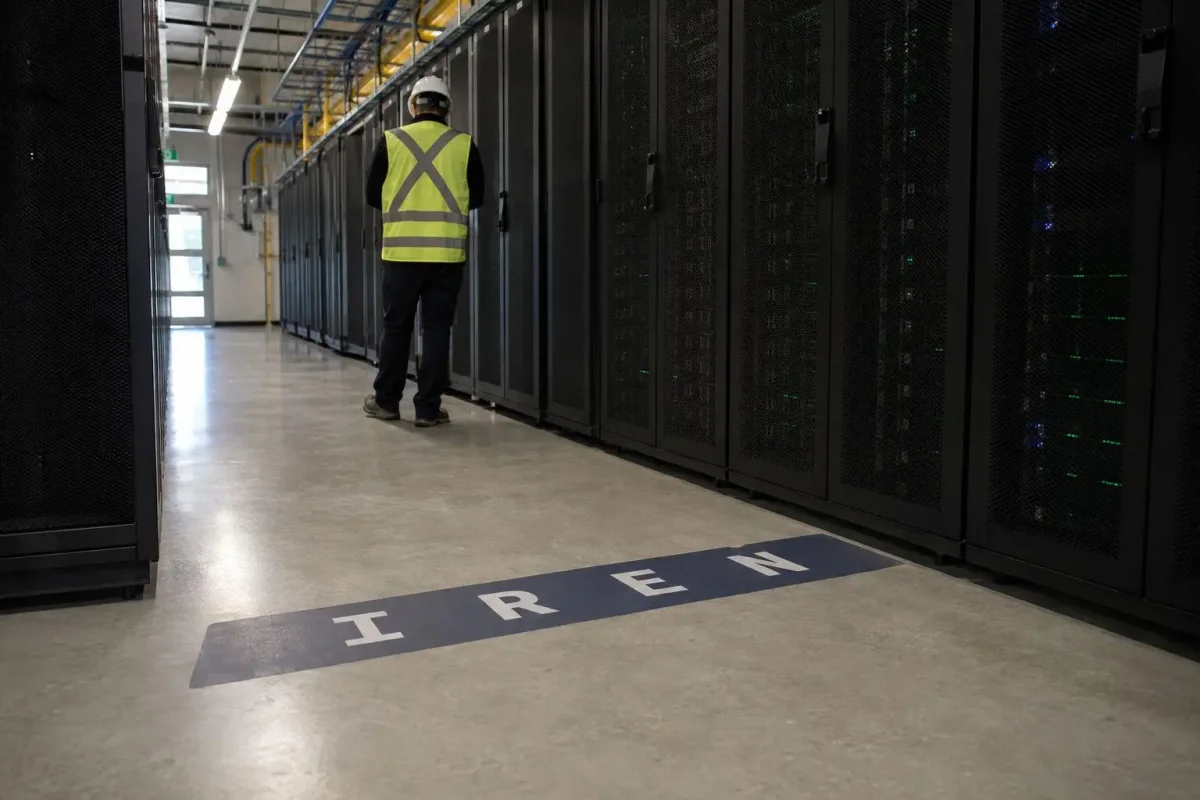
IREN Limited (NASDAQ:IREN) saw its shares surge 7.6% to close at $39.60 on Wednesday, recouping a significant portion of the losses incurred after last week's fiscal year results. Despite the rebound, the stock remains 2.3% below its August 27 close, highlighting the market's cautious stance on the company's ambitious AI expansion plans.
The core of the investor debate centers on IREN's contracted AI-cloud revenue. As of August 26, only $1 billion of the $4 billion in annualized run-rate revenue (ARR) was operational. The remaining $3 billion, representing 75% of the contracted target, is slated to come online by December 31, subject to successful commissioning, testing, and customer acceptance. This gap between contracted and operational capacity is the key metric driving the company's valuation.
At its current equity value of $15.6 billion, IREN trades at 15.6 times its operating ARR. However, this multiple would compress to just 3.9 times if the full $4 billion target becomes operational by year-end. These are equity-value ratios, not enterprise-value multiples, and ARR is a non-GAAP measure, meaning recognized revenue could be materially lower than the annualized figures suggest.
The company's transition from bitcoin mining to AI cloud services is well underway. In the June quarter, AI-cloud revenue more than doubled sequentially to $70.5 million, surpassing bitcoin mining revenue, which fell 40% to $66.7 million. Total quarterly revenue slipped 5% to $137.2 million, while adjusted EBITDA dropped to $19.2 million from $59.5 million in the prior quarter, reflecting the cost of the strategic pivot.
To fund this massive buildout, IREN has secured substantial financing, including a $3.6 billion package for Microsoft (NASDAQ:MSFT) at a 6% weighted interest rate, covering 96% of related GPU spending. Another $2.4 billion facility, led by Blue Owl Capital (NYSE:OWL) and PIMCO, carries a 9% rate and funds 90% of associated GPU costs. Additionally, the company raised $2.11 billion from share issuance and $3 billion from convertible notes during the June quarter.
Execution is now the primary focus. The first 50-megawatt deployment at Childress reached Microsoft in August, with Horizon 2 currently commissioning and Horizons 3 and 4 targeted for delivery in the fourth quarter. Co-Chief Executive Daniel Roberts emphasized that the company's 2026 capacity is largely sold out, but investors are waiting for tangible proof of deployment progress.
Analyst sentiment remains broadly positive, with S&P Global's August 28 poll showing 13 positive ratings, three holds, and one sell. The average price target of $77.84 is nearly double Wednesday's close. However, the stock's recent volatility—down 12.5% on Friday before Wednesday's rebound—underscores the high-stakes nature of the company's transformation.
Looking ahead, the next major catalyst will be new commissioning disclosures, as no investor presentations are scheduled until the fourth quarter. Construction delays could defer customer acceptance and cash receipts, while GPU debt and potential equity issuance add further risk. The market's confidence in IREN's contract book has been partially restored, but the path to full valuation depends on converting signed capacity into reported revenue.