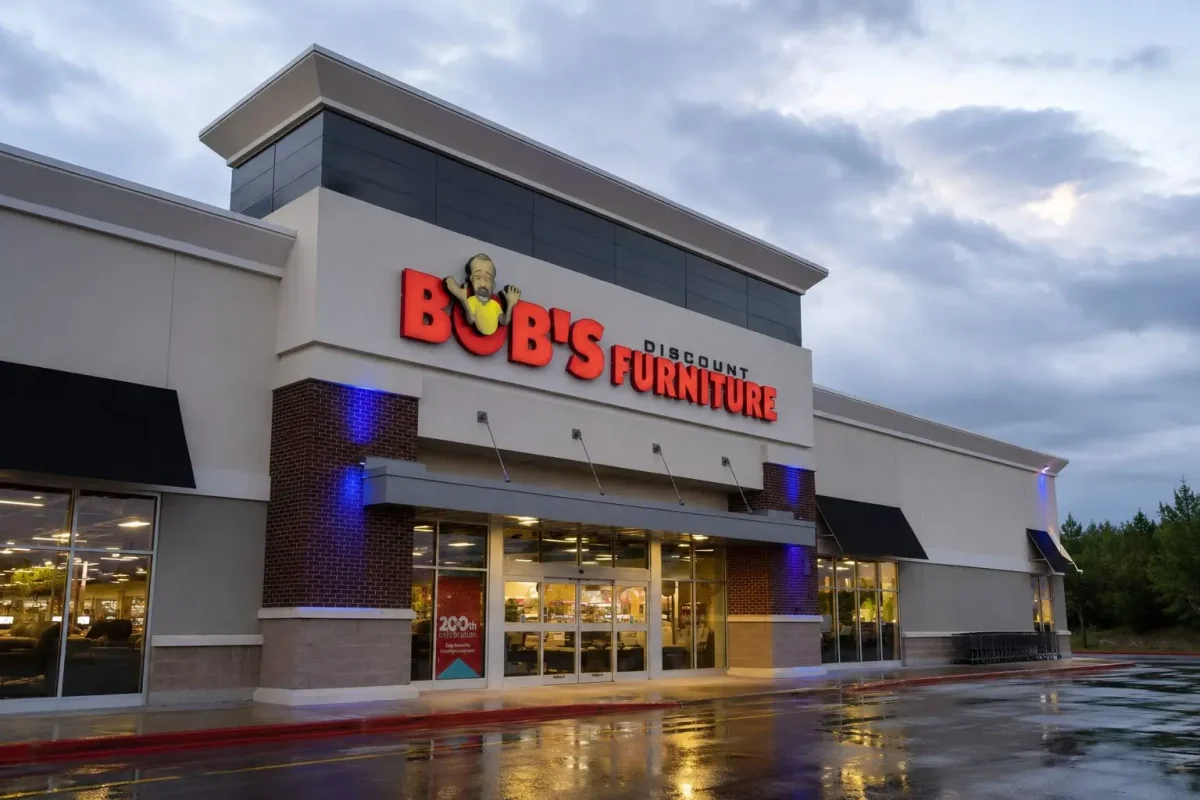
Bob's Discount Furniture (NYSE:BOBS) closed last week at $17.87, up 7.2% from the prior Friday, but the company faces a significant operational challenge in the months ahead. The retailer must achieve a normalized adjusted EBITDA margin of approximately 11.4% in the second half of fiscal 2026 to meet its full-year midpoint guidance, a target that appears demanding given recent performance.
The required margin is 318 basis points higher than the 8.2% reported in the first half of the year, and only 28 basis points above the 11.1% achieved in the same period last year. Management acknowledges the difficulty, noting that delivery performance must improve to close the gap.
Q2 Earnings: A Tale of Two Metrics
In the second quarter, Bob's reported a 64.1% surge in GAAP net income to $57.8 million, but adjusted net income fell 13.7% to $27.8 million, with adjusted diluted EPS down 31% to $0.20. The disparity stems from tariff refunds and related interest income that boosted reported figures but were excluded from adjusted results.
The company secured $45.1 million in tariff refunds, of which $37.9 million reduced cost of sales, $5.7 million was applied to inventory, and $1.5 million was recognized as interest income. This created a 610-basis-point gap between reported gross margin (51.5%) and adjusted gross margin (45.4%).
Revenue Growth and Store Expansion
Net revenue rose 8.8% to $619.6 million, with comparable sales up 2.3%. While in-store traffic slowed, higher order values and conversion rates offset the decline. E-commerce revenue surged 24.1%, outpacing the 6.0% growth at physical stores. The chain added four new locations, bringing its total to 218 stores.
CEO Bill Barton said the "Everyday Low Price approach continues to resonate" with customers, though the company faces rising costs related to expansion. Pre-opening expenses are now expected to reach nearly $26 million, up from a prior range of $23 million to $24 million, as Bob's targets around 20 new openings this year.
Second-Half Targets and Market Reaction
To hit the midpoint, normalized second-half revenue must increase 8.6% year-over-year to approximately $1.37 billion, with adjusted EBITDA growing 11.3% to $156.6 million. This implies a normalized adjusted EBITDA margin of 11.4%, excluding the impact of the extra 53rd week.
Liquidity stood at $176.6 million at quarter-end, with an additional $41.9 million received subsequently. The stock slipped 1.1% on Friday to $17.87, though it remained up 7.2% for the week. Trading volume surged to 2.5 million shares on Thursday, a 3.4-fold increase from July 31, as investors digested the mixed results.
Analyst Views and Sector Context
Several analysts raised their price targets following the report. Raymond James increased its target to $22, RBC Capital Markets to $22, Evercore ISI to $20, and Baird to $19. The consensus among six analysts is five buy ratings and one hold, with a mean price target of $20.75, implying 16.1% upside.
RBC's Steven Shemesh highlighted share gains in a stable category and favorable momentum in the third quarter. However, the stock's post-earnings decline contrasted with gains in most furniture peers, suggesting investors focused on margin quality rather than the tariff-boosted headline numbers.
Looking ahead, July's Consumer Price Index is due Wednesday, followed by Producer Price Index on Thursday and retail sales data on Friday. These releases could influence consumer spending sentiment and freight costs. With approximately 76% of 2025 revenue derived from imported finished products, Bob's remains exposed to tariff volatility, ocean freight rates, and currency fluctuations, any of which could pressure margins further.