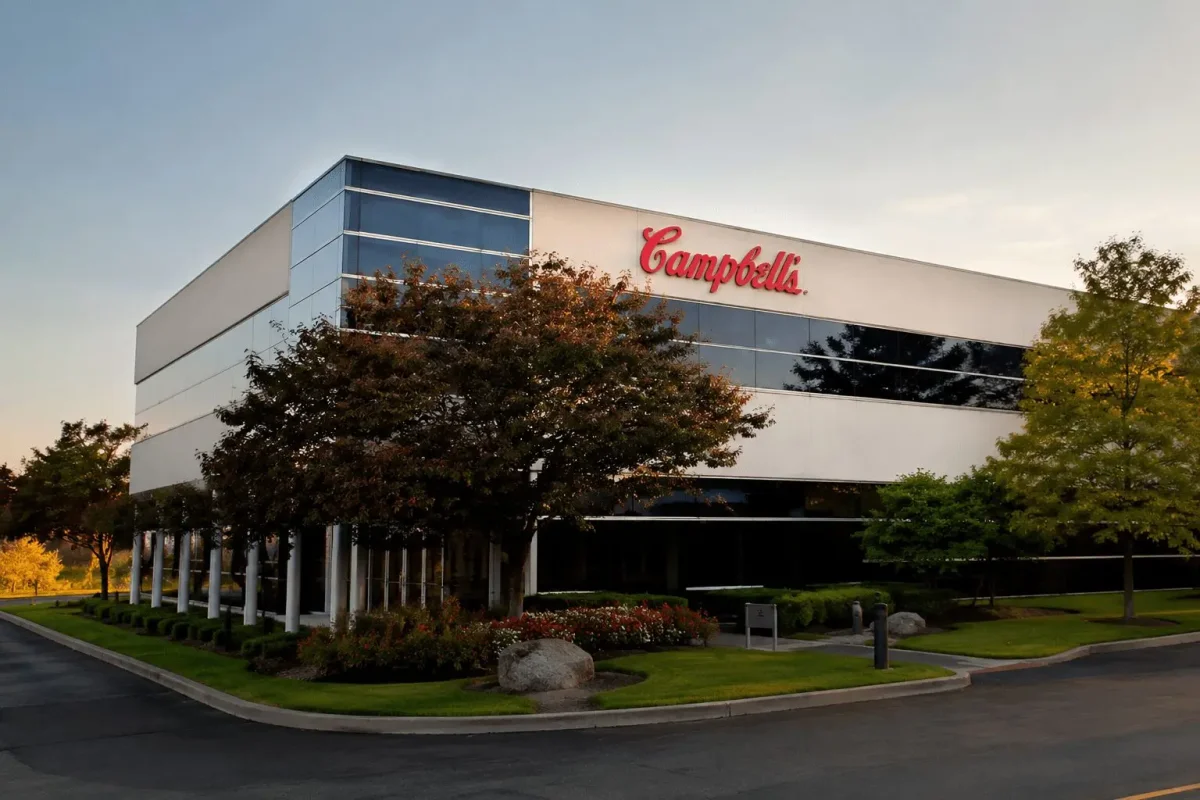
Campbell's Company (CPB) shares edged higher in premarket trading Monday, gaining 12.5 cents to $21.68, after the soup and snack maker reported fiscal third-quarter adjusted earnings that narrowly beat analyst estimates. However, the stock continues to face headwinds from declining sales, soft volumes, and the impending removal from the S&P 500 index.
Quarterly Results and Outlook
For the fiscal third quarter ended May 3, Campbell's reported net sales of $2.37 billion, a 4% decline year-over-year. Adjusted earnings per share came in at 50 cents, down from 73 cents in the prior-year period but above the 48 cents consensus estimate compiled by LSEG. The company maintained its full-year fiscal 2026 outlook, projecting organic net sales to decline 1% to 2% and adjusted EPS in the range of $2.15 to $2.25.
Segment Performance and Margin Pressure
Weakness was evident across both major segments. Meals & Beverages revenue slipped 4% to $1.43 billion, while Snacks also fell 4% to $940 million. U.S. soup sales dropped 8%, driven by declines in both condensed and ready-to-serve varieties. Salty snacks, crackers, and fresh bakery products led the snack segment's decline. Adjusted gross margin contracted 240 basis points to 27.7%, with the company citing cost inflation, tariffs, and supply-chain expenses. Productivity gains, cost savings, and pricing actions partially offset the margin compression.
Cost-Cutting Initiatives
Campbell's is accelerating its cost-reduction efforts to protect profitability. The company reported $20 million in quarterly savings, bringing its cumulative total to $200 million toward the $375 million target by fiscal 2028. These savings are expected to help mitigate the impact of tariffs and ongoing inflation.
S&P 500 Removal and Market Implications
S&P Dow Jones Indices announced Friday that Campbell's will be removed from the S&P 500 before the open on June 22 and moved to the S&P SmallCap 600 index. Flex Ltd. (FLEX) will replace Campbell's on the large-cap benchmark. The index removal could trigger short-term selling by passive funds tracking the S&P 500, though this is a technical rebalancing event rather than a reflection of the company's fundamental health.
Industry Context
Campbell's challenges are not unique in the packaged food sector. Last week, Kraft Heinz (KHC) outlined plans to boost marketing and product development spending to counter competition from healthier brands and private-label alternatives. BNP Paribas analyst Max Gumport warned that if volumes do not recover, Kraft Heinz may need to invest even more, which he described as unsustainable after $600 million in spending.
Campbell's profit beat may mask ongoing demand weakness. If budget-conscious consumers continue to favor cheaper store brands, or if tariffs and commodity costs remain elevated, the company might need to rely more heavily on discounts or price cuts to maintain shelf space, risking further margin erosion. The stock's removal from the S&P 500 adds a layer of technical pressure, but long-term investors will focus on whether the company can stabilize volumes and restore growth.