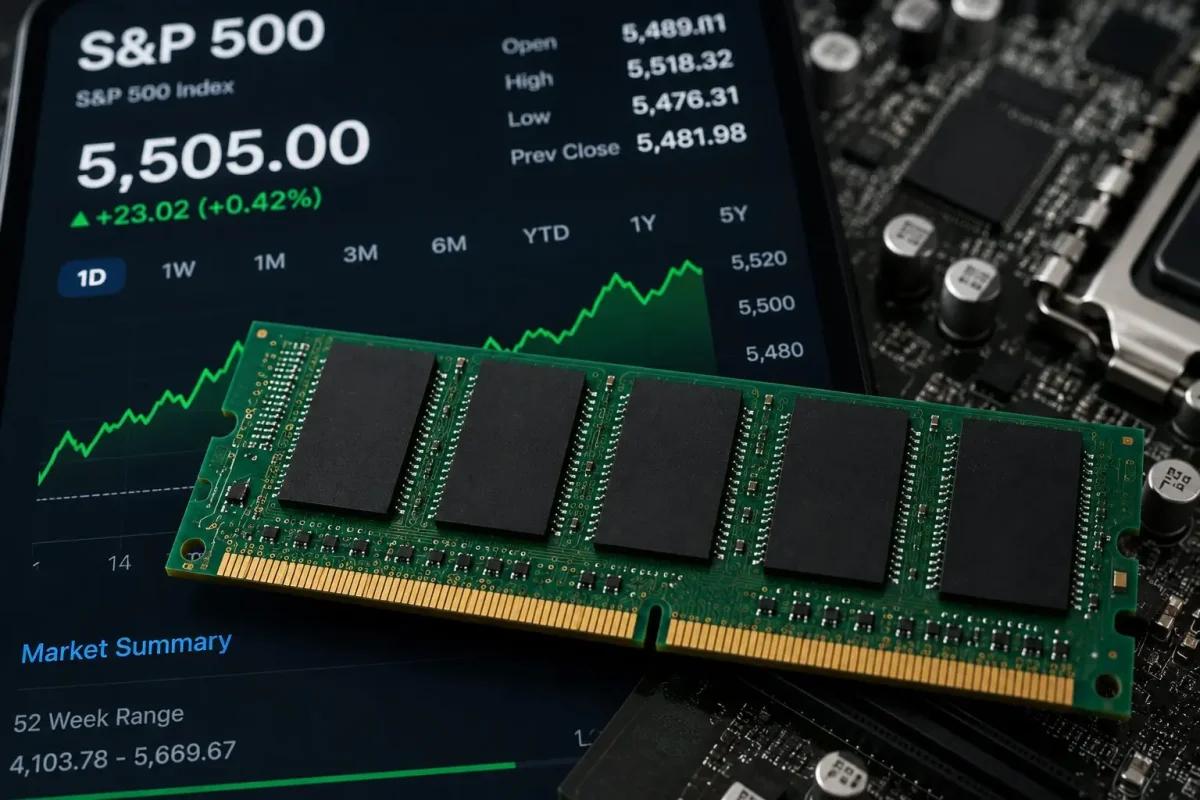
NEW YORK, July 16, 2026 – The S&P 500 slipped 0.51% on Thursday to close at 7,533.77, a decline driven primarily by a sharp selloff in semiconductor stocks that overshadowed a wave of positive earnings reports from a broad swath of companies. Despite nearly three-quarters of the index's constituents ending the day in positive territory, the benchmark index was dragged lower by a 4.3% plunge in chip stocks, which now represent over 20% of the S&P 500's market capitalization.
The technology sector fell 1.8%, while the broader market's earnings momentum remained robust. According to market strategist Paul Nolte, the chip sector's outsized weighting created a drag of at least 0.86 percentage point on the index, more than 1.7 times the actual decline. Excluding the chip drag, the rest of the market contributed a positive 0.35 percentage point to the index's performance, underscoring the dichotomy between concentrated index leadership and expanding profit leadership.
Earnings Season Kicks Off with Strong Beats
Four major companies outside the technology sector reported results that surpassed analyst expectations, providing a glimpse into the broader earnings landscape. UnitedHealth Group (NYSE:UNH) posted adjusted EPS of $6.38 versus the consensus estimate of $4.90, a 30.2% beat, and raised its full-year 2026 adjusted EPS forecast to $19.50-$20.00. The company's medical-cost ratio improved to 86.70%, ahead of the anticipated 88.47%, and its shares rose 1.2%.
Morgan Stanley (NYSE:MS) reported record quarterly revenue of $21.35 billion, with investment banking revenue surging 58% and equity trading revenue climbing 69%. The financial giant's adjusted EPS of $3.46 beat the $2.94 consensus by 17.7%, and its stock edged up 0.4%. All six leading U.S. banks have now surpassed quarterly profit forecasts, with FactSet Research Systems (NYSE:FDS) projecting sector earnings growth of 6.6%, up from a 5.2% estimate in March.
GE Aerospace (NYSE:GE) and Johnson & Johnson (NYSE:JNJ) also delivered earnings beats, though their shares declined. GE's adjusted EPS of $2.02 topped the $1.86 estimate by 8.6%, but the stock dropped 4.1% as management continued to highlight production constraints. CEO Larry Culp noted that the company's repair shops were “wildly oversubscribed.” Johnson & Johnson's adjusted EPS of $2.90 beat the $2.85 consensus by 1.8%, but its shares fell 2.7% after its medtech division reported sales $40 million short of analyst expectations.
Market Concentration and Sector Dynamics
The divergence between the chip-driven index decline and the broad-based earnings beats highlights a key risk for cap-weighted investors. With semiconductor stocks now exceeding 20% of the S&P 500, any sector-specific weakness can disproportionately impact the index, even as the majority of companies perform well. This concentration effect has been a recurring theme in 2026, as technology and chip stocks have driven much of the market's gains.
Growth projections remain mixed across sectors. LSEG forecasts a 24.8% year-over-year increase in S&P 500 earnings, with technology expected to jump 65.5%. FactSet projects energy sector growth at 122.9%, driven by rising oil prices, and utilities at 13.4%. The S&P 500 rose 1.2% last week, while the Nasdaq advanced 1.7%, but both are down roughly 0.5% and 1.5% respectively through Thursday of this week.
Outlook and Key Events Ahead
Next week's earnings calendar expands significantly, with General Motors (NYSE:GM) reporting on Tuesday, July 21, followed by AT&T (NYSE:T) on Wednesday, Lockheed Martin (NYSE:LMT) and Union Pacific (NYSE:UNP) on Thursday, and American Express (NYSE:AXP) on Friday, July 24. These reports will provide further insight into the health of the consumer, industrial, and financial sectors.
Risks remain, including the limited sample size of early reports and the potential for future warnings to reverse the positive trend. The chip proxy used to calculate the drag may also misattribute results due to variations in the composition and weightings of the SOX index. Guidance will be the next key indicator; broader upgrades to estimates would signal expansion, while mixed stock reactions would reinforce the dominance of index concentration.