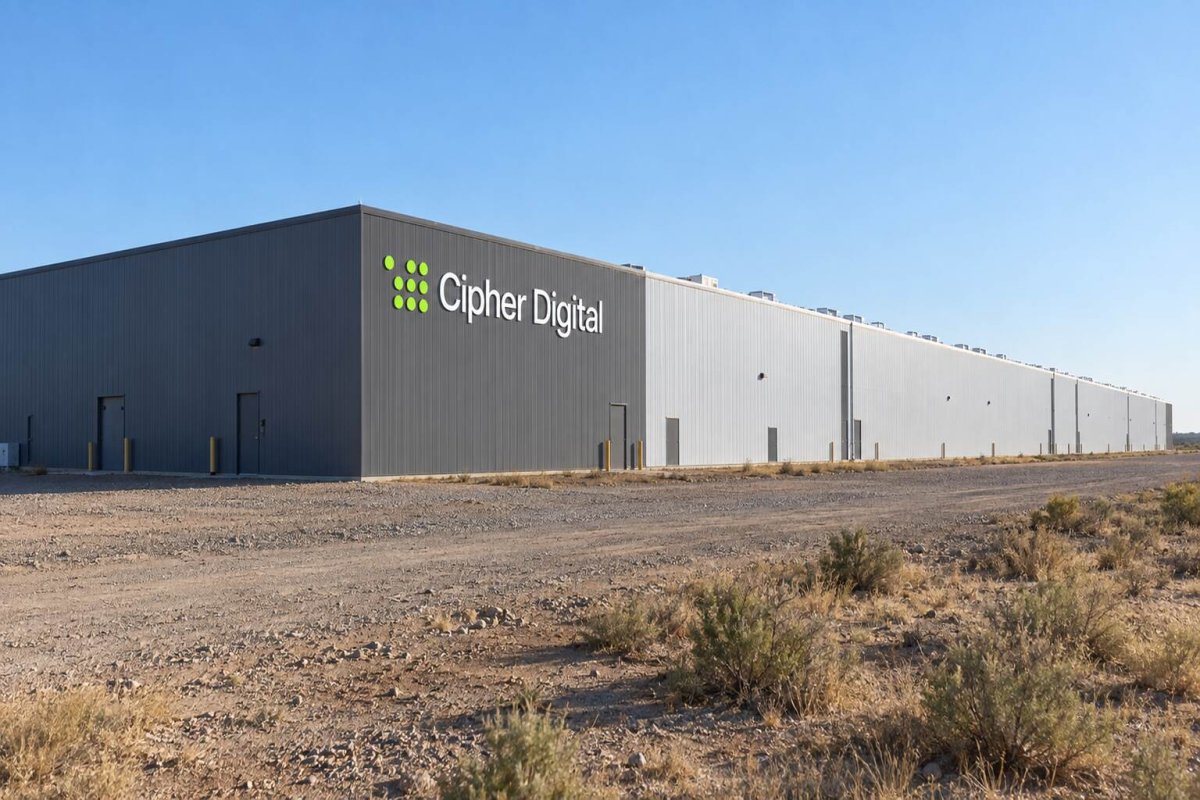
Cipher Digital (ticker: CIFR) shares extended their rally for a second day, climbing 16.4% from Tuesday's close after the company disclosed how its proposed Texas data-center projects were categorized in the Electric Reliability Council of Texas's (ERCOT) new Batch Zero process. The stock closed Wednesday at $16.72, up 10.8%, and added another 5.1% in premarket trading Thursday to reach $17.57, according to market data.
The catalyst goes beyond the general AI infrastructure bid. Cipher revealed that 3.2 gigawatts (GW) of its proposed demand entered Batch Zero, ERCOT's streamlined review for large loads of at least 75 MW. Of that total, 1.1 GW—spanning the Stingray and Colchis projects—received conditional base-load status, meaning they are treated as base load for study purposes, subject to verification. The remaining 2.1 GW, including Mikeska, Apollo, Stingray Phase II, and McLennan, remains classified as conditional studied load, still undergoing system studies with no grid-connection authorization or power-on dates.
The distinction is not merely semantic. ERCOT created Batch Zero to evaluate large loads collectively, aiming to identify grid capacity and necessary transmission upgrades. After a state-ordered verification, ERCOT began sending information requests to conditionally included projects, according to its Sept. 9 market notice. Final designations are expected following an audit in December, which investors see as the next major checkpoint.
Wednesday's trading volume surged to 62.7 million shares, roughly double the three-month average, signaling that the market assigned tangible value to a clearer route through Texas's congested grid queue. However, the classification does not guarantee that all six sites will connect, secure tenants, or begin generating revenue. It merely positions them for further study and potential grid access.
Cipher is transitioning from bitcoin mining to long-duration data-center leases, a capital-intensive shift. Its second-quarter report showed $25 million in revenue and negative $30 million in adjusted EBITDA. The company noted that Black Pearl began delivering capacity and earning rent two months ahead of schedule, demonstrating some progress in converting development pipeline into operating assets.
The balance sheet underscores the scale of the challenge. As of June 30, Cipher held $832 million in cash and $3.19 billion in restricted cash, much tied to project structures, alongside $6.02 billion in long-term debt principal. During the first half, the company used $152 million in operating cash flow and $797 million in investing activities, while financing provided $2.84 billion, according to its quarterly SEC filing.
Using 414.3 million shares outstanding at June 30, the $17.57 premarket quote implies an equity value near $7.3 billion—an approximation given potential share count changes. This valuation already prices in a successful multi-gigawatt buildout, even though many sites lack final grid status and announced tenants. The market is betting on scarcity: large, power-ready data-center campuses are hard to assemble, and 1.1 GW of conditional base-load treatment is a meaningful asset.
Cipher is also developing natural-gas lateral pipelines that could support up to 2.5 GW of on-site generation before the end of 2027, offering an alternative power source. Yet that plan requires construction, suppliers, permits, and customers—all of which carry execution risk. The counterargument is timing: conditional grid treatment can sit years ahead of rental income, while interest costs, construction expenses, and potential share dilution arrive sooner.
December's Batch Zero outcome is the next dated catalyst. Beyond that, investors will need site-level power dates, tenant commitments, construction budgets, and financing terms. These disclosures will determine whether 3.2 GW becomes a cash-flow pipeline or remains a large number on a planning document. For now, the market has rewarded a step toward clarity, but the harder test lies ahead.