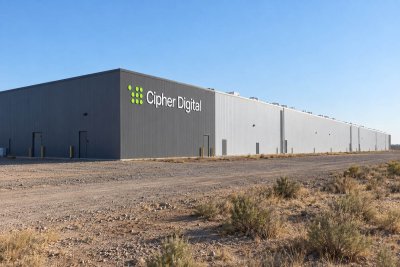
Cipher Mining Inc. (NASDAQ: CIFR) saw its shares slide 5.7% on Thursday, closing at $15.94, as investors appeared to differentiate between the company's ambitious power development plans and the reality of contracted, revenue-generating capacity. The selloff, accompanied by elevated trading volume of 47.1 million shares—roughly 56% above the recent average—signals growing scrutiny of the bitcoin miner's transition into a large-scale AI infrastructure developer.
Market Reaction and Two-Day Decline
The stock traded between $15.28 and $16.46 after opening at $16.05, according to Yahoo Finance's daily history. This marks a cumulative decline of 13.9% over two sessions, following Monday's close of $18.51. No single company disclosure explains the retreat, but the market's reaction suggests that a valuation of approximately $6.6 billion leaves little margin for error as Cipher pivots from bitcoin mining to capital-intensive, long-duration AI data center projects.
What the 2.5 GW Announcement Actually Promises
On September 3, Cipher announced it had begun developing lateral pipelines from several sites to nearby natural-gas supplies. The company plans to collaborate with power providers who would build and operate onsite generation, with new power targeted before the end of 2027. Cipher also stated it would continue pursuing grid connections for those generation assets.
This strategy could be valuable: self-supplied generation may reduce the wait for grid interconnection and make sites more attractive to hyperscale tenants. However, the announcement did not identify power providers, pipeline routes, generation costs, financing structures, or new tenant commitments. The capacity and timing statements were explicitly forward-looking, and the lack of concrete details appears to be weighing on investor sentiment.
Scale Comparison and Economic Reality
The scale difference is revealing. Cipher reported 907 MW of operating and contracted capacity in its June investor presentation. The proposed 2.5 GW of onsite generation is nearly 2.8 times that figure. Yet the units are not economically interchangeable: power at a site becomes revenue only after permits, generation equipment, data-center construction, financing, and a lease all come together. Investors should also avoid simply adding the 2.5 GW to Cipher's existing site pipeline, as the company says the gas laterals span multiple current locations.
Financial Position and Project Funding
Cipher ended June with $831.8 million of cash and cash equivalents, but also showed $3.73 billion of restricted cash and $5.45 billion of long-term borrowings, net of issuance costs, in its second-quarter 10-Q. These figures reflect the project-finance model behind its expansion: the headline cash total is not a fungible corporate war chest, and much of it is tied to specific builds and debt obligations.
That does not mean the model is unproven. Cipher said the initial Black Pearl capacity was delivered to its tenant in August, two months ahead of schedule, and rent began. It also said the Stingray project was fully funded through substantial completion after a bond offering. These are tangible execution points, not slide-deck capacity.
Quarterly Financials Highlight Transition Gap
The second-quarter update showed the gap between today's income statement and the future data-center thesis. Quarterly revenue was $24.8 million, all from bitcoin mining and down from $43.6 million a year earlier. Adjusted EBITDA was negative $30 million, and the operating loss was $78.5 million. A $150.5 million warrant fair-value charge helped push the net loss to $267.5 million, so the bottom line overstates the operating burn, but it does not erase the financing burden.
What Would Make the Plan Worth More
The bullish case is that Cipher has already converted two large Texas sites into long-term hyperscale campuses, delivered initial capacity early, and attracted project debt against contracted rent. If the same playbook works on gas-enabled sites, securing power ahead of grid availability could be a genuine competitive advantage.
The next valuation-changing disclosures are not another gross-gigawatt target, but rather signed power-provider terms, named sites and permit milestones, generation capex and fuel-cost assumptions, tenant leases, funding sources, and a credible schedule from available gas to rentable IT capacity. Investors also need clarity on which megawatts are incremental to the current pipeline rather than an alternative supply route for the same land.
At $15.94, CIFR is no longer valued like a bitcoin miner with optional data-center upside; it is valued like a developer expected to turn a large portfolio into contracted infrastructure. Thursday's 5.7% fall does not disprove that transition, but it does put the burden back where it belongs: on funded, permitted, and leased megawatts rather than announced power potential.