Cipher Digital (NASDAQ:CIFR) experienced a sharp selloff on Tuesday, with shares closing down 13.0% at $16.095, erasing approximately $998 million in equity value. The decline, which saw trading volume surge to 53.1 million shares—nearly double the three-month daily average—underscores growing investor concerns about the company's valuation and its substantial project backlog.
The drop came amid a global bond selloff that pushed long-term U.S. Treasury yields higher, with the 10-year yield hovering around 4.69% early Wednesday. Higher discount rates tend to disproportionately affect long-duration assets, such as data-center projects, which are a key component of Cipher's business model. No specific company news accounted for the decline, suggesting the move was largely driven by macroeconomic factors.
Tuesday's decline was more severe than that of its peers. TeraWulf (NASDAQ:WULF) fell 11.25%, IREN Limited (NASDAQ:IREN) dropped 6.46%, and MARA Holdings (NASDAQ:MARA) declined 7.77%. Cipher's relative trading volume was also the highest among the group, indicating heightened investor attention.
Valuation Gap Under Scrutiny
The selloff highlights a notable valuation discrepancy. Cipher's equity market value stands at $6.68 billion, compared with $11.4 billion in contracted lease revenue, implying a market value of just 59 cents per contracted dollar. However, analysts caution that backlog is not the same as cash in hand, as construction is a prerequisite for revenue generation.
The company's second-quarter results, reported earlier this month, showed revenue of $24.84 million, a 43% decline year-over-year and 23.6% below consensus estimates. The net loss widened to $267.5 million, including a $150.5 million noncash warrant remeasurement charge. Adjusted EBITDA swung to a loss of $30.0 million, compared with a positive $32.3 million in the same period last year.
Cash Position and Financing
Cipher maintains a significant cash cushion, with $831.8 million in cash and equivalents as of June 30. However, an additional $3.19 billion in restricted cash is largely tied to project financing and construction, limiting its availability for general corporate purposes. The company also has $810 million in Stingray secured notes allocated for project development.
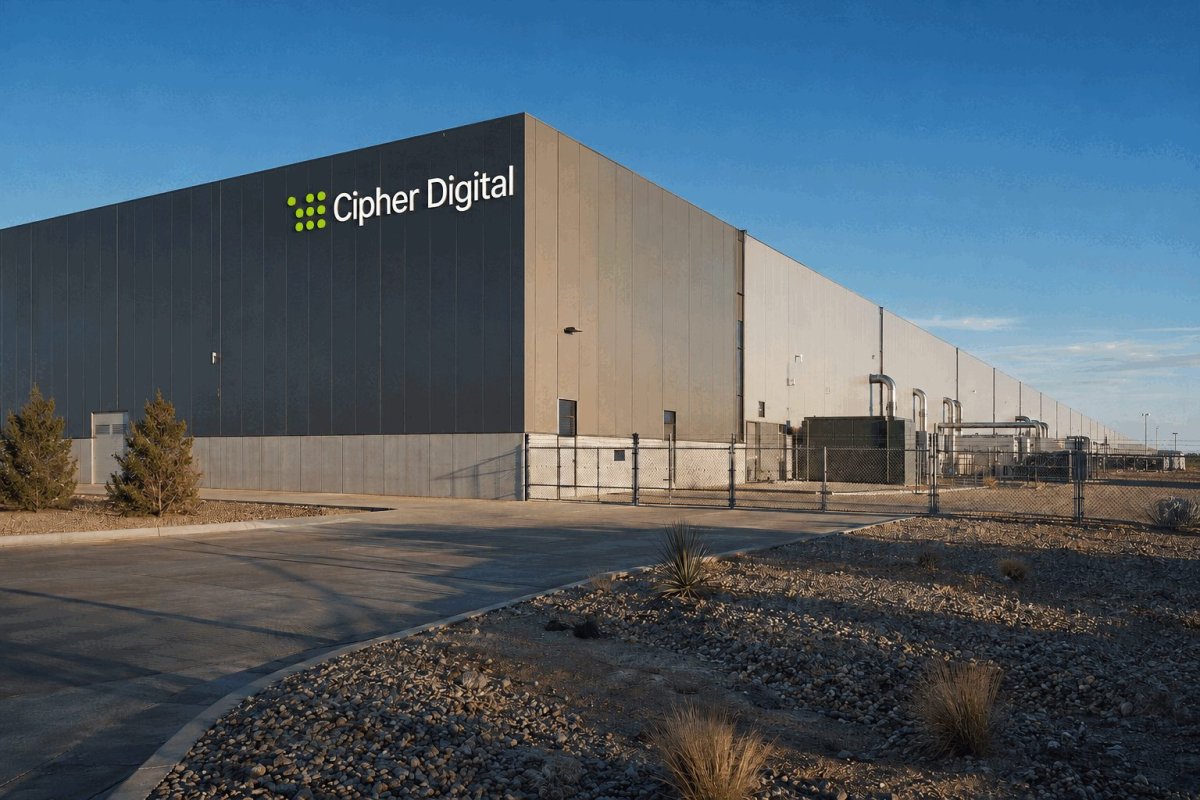
Despite the current challenges, Cipher is making progress on its pipeline. The company began delivering capacity at its Black Pearl facility in early August, two months ahead of schedule, and has started generating rental income. CEO Tyler Page expressed pride in delivering the first HPC data center capacity ahead of schedule.
The company has also secured a site option for Apollo, a potential 900-megawatt location outside San Antonio, though it remains subject to ERCOT's interconnection study process. This option expands Cipher's project pipeline but does not provide a fixed timeline for grid connection.
Wall Street Remains Optimistic
Despite the recent setback, Wall Street analysts maintain a generally positive outlook. The consensus price target among 18 analysts is $26, implying a potential upside of 61.5% from Tuesday's closing price. However, two firms lowered their price targets following the earnings report, reflecting some caution.
Recent analyst actions include JPMorgan lowering its target to $22, KBW to $28, while Macquarie and Rosenblatt maintained targets of $35 and $30, respectively. Chardan also maintained a $32 target. These targets are based on analyst opinions and are not guaranteed outcomes.
The magnitude of Tuesday's reset is notable, with losses amounting to roughly 40 times Cipher's most recent quarterly revenue. This suggests a significant duration adjustment rather than a minor earnings revision. Key risks include construction delays, rising costs, tenant concentration, and grid approval issues, which could reduce returns. Increased yields may also elevate financing expenses.
Investors will be watching for signs of cash rent generation from delivered capacity, the status of remaining Black Pearl halls, and the timeline for Stingray. In the meantime, Cipher's valuation is likely to remain sensitive to the balance between contracted scale and funding risk.