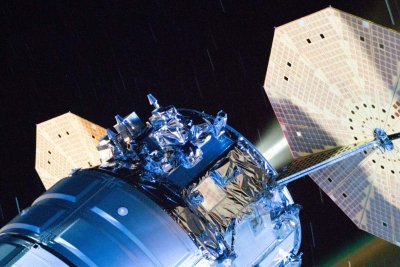
Starfish Space's Otter 24C spacecraft successfully reached low Earth orbit on October 1, marking the beginning of NASA's SSPICY (Spacecraft Inspection of Inactive Objects) mission. The 335-kilogram vehicle launched at 11:32 a.m. PDT aboard SpaceX's Transporter-18 rideshare mission, transitioning the project from a funded plan to an in-orbit engineering test.
The SSPICY mission, initiated by NASA as a Phase III small-business technology project in 2024, represents the agency's first funded commercial space debris inspection mission. Over the next several months, Starfish Space will commission the spacecraft before commencing inspections of up to four inactive, U.S.-origin objects in 2027. The mission's primary goal is not debris removal but rather to test the sensing, navigation, and propulsion systems necessary for future capture or repair operations.
Technical Architecture
Otter 24C integrates four core technologies—Manta, Nautilus, CETACEAN, and CEPHALOPOD—on a spacecraft bus supplied by Astro Digital. CETACEAN employs stereo cameras and other sensors to estimate a target's relative position, motion, and attitude, while CEPHALOPOD translates these measurements into stepwise approach and abort decisions. This division is critical because inactive satellites cannot share navigation data or cooperate with the inspector.
Ground tracking can guide the early transfer phase but cannot close the final navigation loop. As the target grows in Otter's field of view, camera geometry becomes more useful, and flight software must distinguish real motion from lighting changes and uncertain shape. Safe abort logic is as important as approach accuracy.
Manta, a multi-jointed boom, provides six degrees of freedom for thruster pointing, enabling efficient orbit changes between targets via low-thrust electric propulsion. However, this efficiency comes at the cost of time, as electric propulsion produces far less thrust than chemical engines. Nautilus, a mechanical gripper designed for spacecraft without prepared docking fixtures, is not part of SSPICY's demonstration goals—docking remains outside the mission's scope.
Mission Profile and Objectives
The planned stand-off distance for inspections is hundreds of meters, allowing Otter to assess surface condition, geometry, and orbital behavior. Earlier NASA planning identified spin rate and spin axis as useful measurements, helping engineers judge whether a later capture attempt would be safe. Inactive spacecraft present a harder navigation problem than healthy clients, with unknown attitudes, potential tumbling, and surfaces degraded by radiation and thermal cycling.
Owner consent for the visits reduces legal and operational uncertainty, but the targets remain technically uncooperative, sending no useful rendezvous telemetry. Results from these selected targets may not transfer directly to foreign objects, fragments, or eccentric orbits.
The need for such inspection capabilities is growing. The European Space Agency's 2026 environment report indicates more than 4,000 payloads entered orbit during 2025, and too few satellites leave congested regions after service. ESA's modeling suggests active removal is needed alongside prevention and end-of-life disposal. SSPICY addresses only the inspection layer, but operators need reliable condition data before choosing among repair, relocation, and disposal.
Previous Testing and Future Implications
Starfish Space has tested parts of this architecture in orbit, but the record is incomplete. The Otter Pup 1 prototype failed to dock with its intended target after a 2023 launch, though it later guided within one kilometer of a different space tug, demonstrating tracking and approach capabilities. Otter 24C is the company's first full-size vehicle, with a broader mission requiring travel among several objects, repeated relative-navigation solutions, and propellant conservation.
Scaling up changes more than payload capacity; the larger vehicle has different inertia, thruster authority, and structural behavior. Successful commissioning will be essential before inspections begin, and NASA has not yet reported that this phase is complete. The October 1 launch confirms delivery to orbit but not spacecraft health or autonomous rendezvous performance.
As the space industry evolves, the ability to inspect inactive satellites safely and reliably will become increasingly important. While SSPICY does not demonstrate capture or removal, it lays the groundwork for future servicing missions, potentially reducing reliance on ground-based estimates and enabling more informed decisions about satellite end-of-life management.