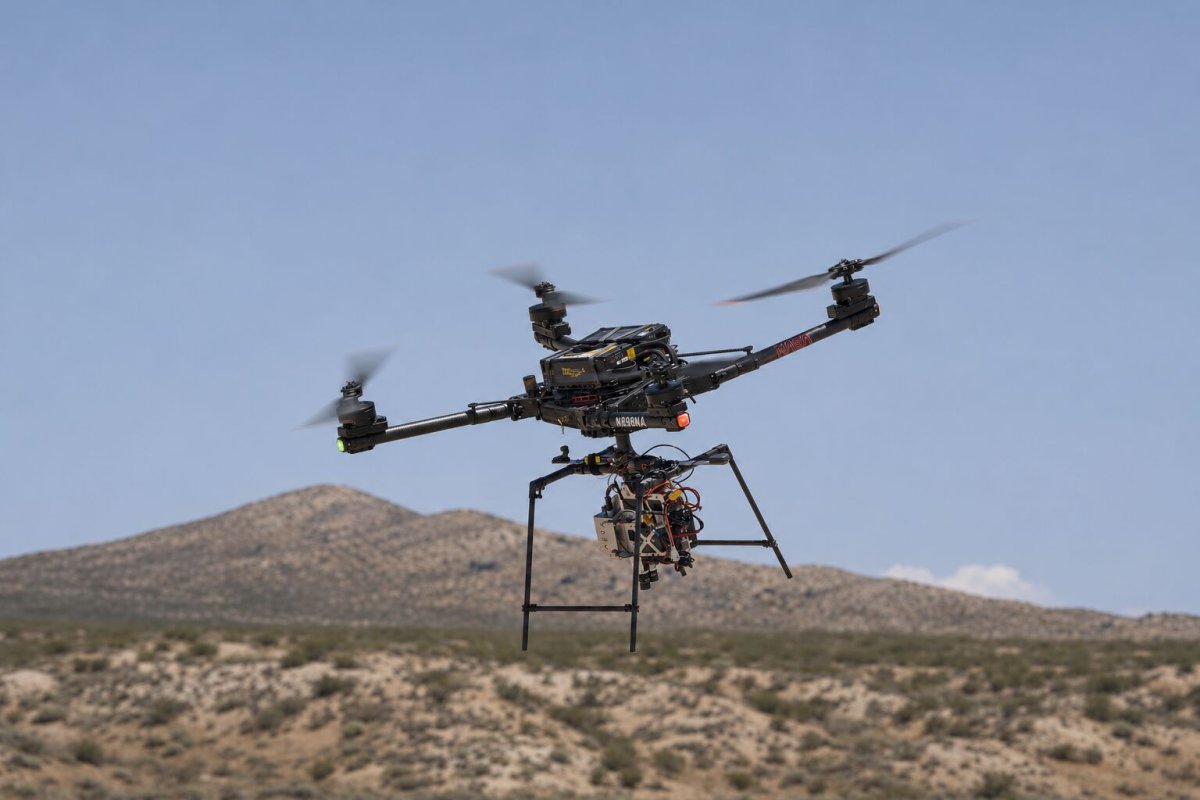
NASA has taken a significant step toward safer spacecraft landings on the Moon and Mars with a successful drone test of its SPLICE guidance system. The demonstration, which took place on August 27 at Rogers Dry Lake, California, simulated lunar descent and landing maneuvers, the agency confirmed in a November 4 update.
The SPLICE system, which stands for Safe and Precise Landing – Integrated Capabilities Evolution, is designed to help spacecraft identify safe touchdown zones in challenging terrain. It combines sensors, computing hardware, and software to assess landing areas in real time, potentially diverting the vehicle if a target is deemed unsafe.
During the test, an Alta-X drone carried the SPLICE payload through a sequence that mimicked the final stages of a lunar landing. The system successfully demonstrated its ability to see the ground, map it, and choose a safe landing site, according to NASA Armstrong Flight Research Center officials.
SPLICE integrates three key technologies: camera-based navigation that matches live surface images with orbital maps, Doppler lidar for measuring speed and altitude, and a hazard-detection lidar that scans the terrain to build a three-dimensional model. The hazard software then identifies potential dangers like steep slopes and large rocks, guiding the spacecraft to safer ground.
"Pinpointing a spacecraft's location does not by itself establish that the ground beneath it is safe," a NASA project guide notes, highlighting the importance of real-time hazard assessment.
One of the technical challenges addressed by the program is motion compensation during descent. Since the vehicle is moving while the laser scans, algorithms must generate accurate elevation maps without requiring the spacecraft to hover. A January 2026 conference paper archived by NASA describes a motion-compensation algorithm that has been tested in helicopter flights, providing engineering context for this critical capability.
The November flight report, however, does not disclose specific numerical touchdown error margins, the number of successful diversions, or any lunar qualification thresholds. The published evidence indicates progress in terrestrial flight testing but does not measure performance during an actual lunar or Martian descent.
This demonstration represents a milestone in NASA's efforts to enable missions to scientifically valuable but hazardous terrain, such as areas near boulders or shadowed craters. The technology could ultimately support crewed and robotic missions to the Moon under the Artemis program and future Mars exploration.
For investors, the advancement of space technologies often benefits companies involved in aerospace and defense. While NASA's SPLICE program is government-funded, private sector partners and suppliers in the space industry may see long-term opportunities. Key players include Lockheed Martin (LMT), Northrop Grumman (NOC), and Boeing (BA), as well as emerging space-focused firms like Rocket Lab (RKLB).
As NASA continues to refine SPLICE, the agency is building a foundation for safer, more precise landings beyond Earth. Each test brings the technology closer to operational readiness, promising to expand humanity's reach into the solar system.