NASA's SPHEREx space telescope has taken a significant step toward democratizing infrared astronomy with the public release of its first major data product. Announced on November 12, 2026, Data Release 1 (DR1) is now accessible through the NASA/IPAC Infrared Science Archive (IRSA), offering researchers worldwide a comprehensive view of the infrared sky.
A New Baseline for Infrared Surveys
DR1 introduces an All-Sky Cube that spans wavelengths from 0.75 to 5.0 micrometres, providing a three-dimensional map of the sky where two axes represent celestial coordinates and the third represents wavelength. This spectral cube is divided into 12,288 sky tiles, each with a 512 × 512-pixel grid at a pixel scale of 12.9 arcseconds. The data includes 102 channel slots, although channels 51 and 52—adjacent to the instrument's beam splitter—are intentionally empty to maintain numbering consistency.
The release also includes reprocessed observations from the first two sky surveys, aligned with the improved pipeline and calibrations used for Quick Release 3 (QR3), which covers Surveys 3 and 4. IRSA advises researchers to use DR1 and QR3 for new projects but cautions against merging them with older QR2 data due to calibration changes. QR2 downloads will remain available through February 2027.
Instrument Design and Data Characteristics
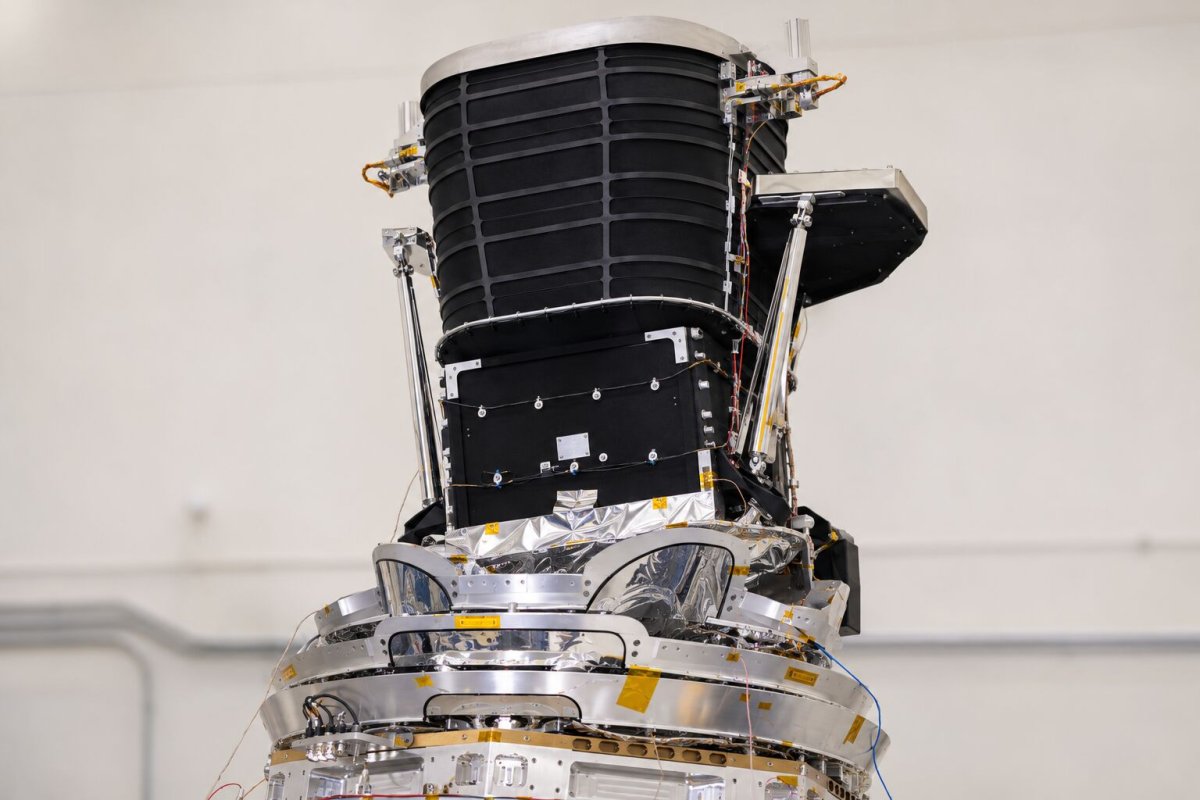
SPHEREx employs a compact telescope with a 20-centimetre effective aperture. Its instrument features six detector arrays behind filters that vary in wavelength across the detector. By repointing the spacecraft, the same celestial source is observed at different positions, allowing successive wavelength measurements to build a spectrum. Three nested conical shields protect the cooling system and optics from solar and terrestrial radiation.
A model of zodiacal light—the diffuse glow from interplanetary dust—has been subtracted from the cube, while individual spectral images retain this foreground. IRSA warns that atmospheric emission, particularly helium at 1.083 micrometres, can introduce stripes in the data. The archive provides browsable PNG maps for visualization, but researchers should rely on the FITS cubes for quantitative analysis.
Scientific Goals and Public Participation
The release supports three primary science objectives: probing cosmic inflation through the large-scale distribution of matter, tracing the history of galactic light production, and studying water and other ices in star-forming regions. These are research goals, and deriving cosmological results or identifying specific chemical signatures requires rigorous analysis of the measurements and their uncertainties.
Public access enables researchers beyond the mission team to contribute. IRSA's SPHEREx archive page offers tools such as the Data Explorer, spectral-image cutouts, mosaic builders, and spectrum extraction utilities. Scientists can examine specific sky patches without downloading the entire survey.
A catalog of reliably measured individual objects is planned separately. The mission team's schedule targets August 2027 for the first High Reliability Source Catalog. DR1 currently provides images and cubes; the catalog remains forthcoming.
Market and Research Implications
While this release is not directly tied to publicly traded companies, it underscores the growing role of open data in scientific research. The availability of such extensive datasets could accelerate discoveries in cosmology and astrochemistry, potentially influencing future space missions and instrumentation. For investors in space technology and data analytics, the trend toward open-access scientific data may signal opportunities in cloud computing, data storage, and analysis tools.
The SPHEREx DR1 release represents a milestone in infrared astronomy, offering a rich resource for the global research community. As the mission continues, further data releases and the eventual source catalog will deepen our understanding of the universe's history and composition.