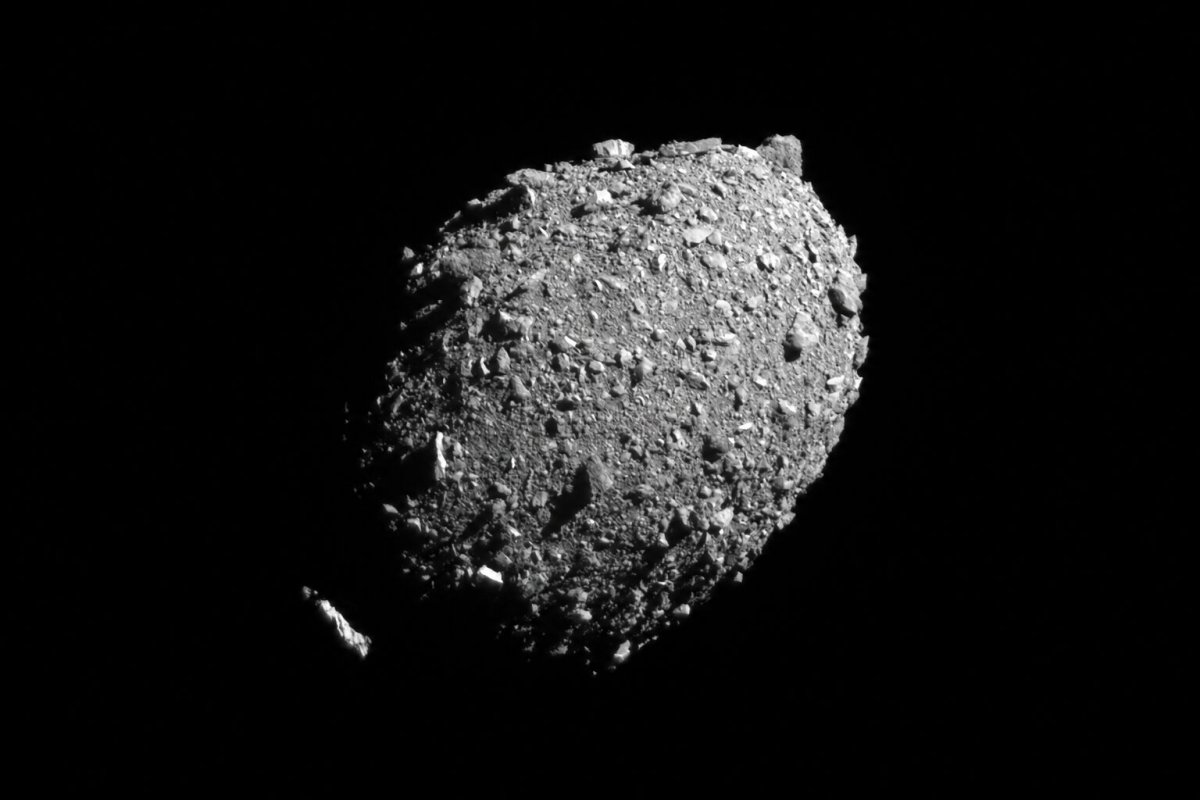
The European Space Agency's Hera mission continues to deliver groundbreaking insights into the aftermath of NASA's Double Asteroid Redirection Test (DART). On November 17, 2026, ESA released a new set of observations that combine thermal infrared imaging with visible light and spectral data, providing an unprecedented look at the shadowed regions of Dimorphos, the asteroid moonlet that was deliberately struck by DART in September 2022.
Three Cameras, One Mission
Hera is equipped with three primary instruments that work in tandem to characterize the Didymos binary asteroid system. The Asteroid Framing Camera (AFC) captures monochrome images in visible light, essential for navigation and detailed terrain analysis. HyperScout H samples reflected sunlight across 25 spectral bands in the red to near-infrared range, enabling scientists to compare surface mineralogy with laboratory meteorite samples. The third instrument, Japan's Thermal Infrared Imager (TIRI), records heat emitted from the surface, making it possible to see Dimorphos even when it is almost entirely in shadow.
The latest release from ESA integrates data from all three cameras, offering a multi-faceted view of the asteroid system. At a range of 28.5 kilometers, the AFC provides a resolution of about 2.7 meters per pixel, while TIRI captures thermal emissions in the 8–14 micrometer band. These observations are part of a coordinated effort to understand the physical properties of Dimorphos and the effects of the DART impact.
Thermal Imaging Reveals Cooling Patterns
JAXA, which operates TIRI, has also released a thermal sequence recorded on October 28–29 (Japan Standard Time), showing Dimorphos as it cools while entering Didymos's shadow. Another TIRI image from October 31, taken from 57 kilometers away, shows both asteroids. These thermal observations are crucial for estimating thermal inertia—a material's resistance to temperature changes—which in turn helps constrain grain size and porosity. Dimorphos appears cooler in the October 31 image because Didymos partially shadows it, and analysis of Didymos's surface temperature is ongoing.
TIRI's uncooled detector, with a resolution of 1024 × 768 pixels, is equipped with a filter wheel that supports both broad thermal mapping and six narrow spectral bands for material studies. The instrument's calibration range spans 153 to 423 Kelvin, and it weighs just 3.94 kilograms. These specifications, detailed in a paper by Okada et al. published on November 5, 2025, highlight the instrument's capabilities for planetary defense research.
Connecting Thermal Data to DART's Impact
DART's collision with Dimorphos on September 26, 2022, shortened the moonlet's orbital period around Didymos by approximately 33 minutes. Understanding the efficiency of this kinetic impact requires detailed knowledge of the target's mass, density, strength, and internal structure. Hera's measurements, particularly TIRI's thermal data, are designed to provide that context. By measuring how quickly the surface heats and cools, scientists can infer physical properties that influence impact effects.
JAXA's operations plan calls for coordinated observations by all three cameras over a full rotation of Didymos, with thermal imaging playing a key role. The plan also schedules the deployment of the Juventas and Milani CubeSats in January 2027. Juventas will use radar to probe the internal structure of Dimorphos, while Milani will analyze surface composition. Together, these complementary measurements aim to explain the outcome of the DART experiment and refine future planetary defense strategies.
Upcoming Releases
ESA has announced that additional detailed images of both asteroids will be released on November 25. The ongoing analysis of thermal data, combined with visible and spectral observations, promises to yield deeper insights into the nature of these small bodies and the effectiveness of asteroid deflection techniques.
