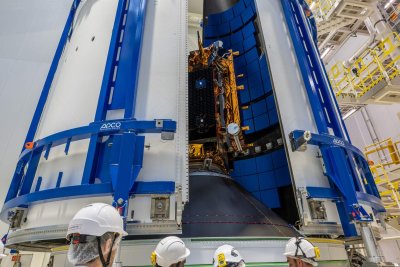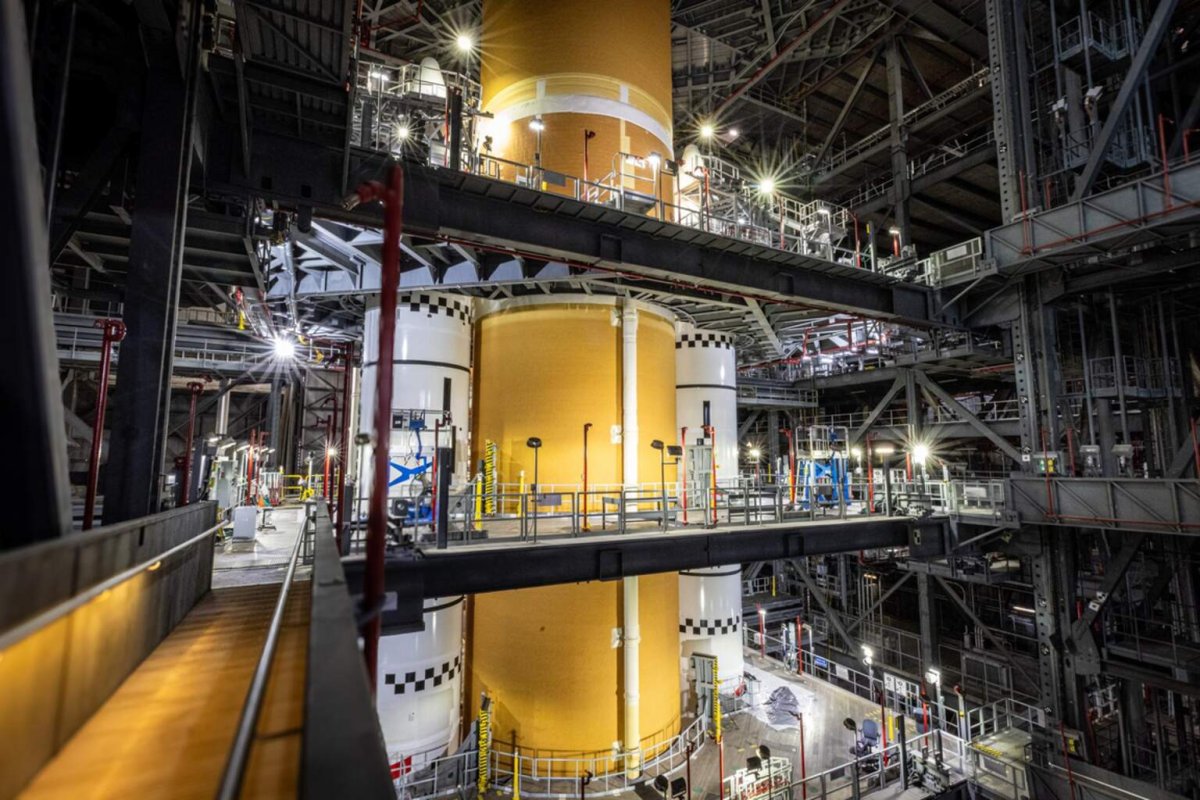
NASA has achieved a major integration milestone for its Artemis III mission, joining the Space Launch System's (SLS) massive core stage with its two solid rocket boosters at the Kennedy Space Center in Florida. The agency confirmed the completion of this assembly—known as the "short stack"—on October 28, 2026. The 212-foot-tall core stage now stands between the boosters in High Bay 3, awaiting a series of tests before it rolls out to Launch Pad 39B.
Critical Fueling Test on the Horizon
The next major step will be a pad test that loads cryogenic propellants into the core stage alone. This test will give engineers an early opportunity to practice filling two tanks with very different volume requirements. According to NASA specifications, the liquid hydrogen tank holds 537,000 US gallons, while the liquid oxygen tank holds 196,000 US gallons, for a combined nominal capacity of 733,000 gallons. Hydrogen thus accounts for approximately 73% of the total volume, about 2.7 times the liquid volume of oxygen. However, the October 28 update did not specify the fill quantities or duration for this upcoming test.
This tanking exercise is a key part of the broader launch campaign. Artemis III is planned as a 14-day Earth-orbit mission that will involve the Orion spacecraft and two commercial lander test vehicles. A successful tanking test would not, however, validate the landers' docking or life-support systems for flight. Those capabilities remain untested and represent separate schedule dependencies.
Beyond the Core Stage: Mission Architecture
Artemis III will also feature a significant change to the hardware above the core stage. NASA's mission design replaces the usual cryogenic upper stage with a non-propulsive spacer that preserves the upper stage's dimensions and connection points. Orion's service module will then perform the orbit-circularization maneuvers. The Orion spacecraft itself has been progressing through its own testing sequence. The European Space Agency (ESA) confirmed in August that its crew and service modules had been connected at Kennedy, following propulsion and life-support leak checks on the service module.
NASA's October 23 flight plan outlines two distinct docking campaigns. Blue Origin's Blue Moon Mark 2 test vehicle would launch first, with the capability to loiter in orbit for up to 30 days, providing scheduling flexibility before Orion follows. Astronauts would enter Blue Moon for approximately two days of cabin and life-support evaluations. Later, the Starship demonstration would have a narrower scope: Orion would dock for up to two hours without astronauts entering Starship, while teams evaluate communications, software, and vehicle control.
Operational Challenges and Timeline
"We're launching three spacecraft on three different rockets and testing how they operate together," said Jeremy Parsons, NASA's Artemis program manager, in an October 23 statement. His comments underscore the operational complexity that extends far beyond the SLS assembly milestone. The pad loading test cannot establish that interoperability. The program still targets a 2027 launch, with SpacePolicyOnline reporting NASA's mid-2027 objective and the separate lander launch sequence. NASA's latest assembly notice supplies no firm tanking date or launch day.
Other rocket hardware still has a delivery checkpoint. NASA's October 13 status report placed shipment of the spacer and two adapters in early 2027. The next dated hardware question is whether those components arrive on schedule after the short-stack testing. As of now, the assembly milestone and the planned tanking exercise do not demonstrate that all three spacecraft can meet their orbital timelines. Cryogenic loading could reveal leaks or require countdown changes before flight, and commercial lander readiness remains a separate schedule dependency.
Key Data Points
- Core stage height: 212 feet
- Liquid hydrogen capacity: 537,000 US gallons
- Liquid oxygen capacity: 196,000 US gallons
- Combined tank capacity: 733,000 US gallons
- Hydrogen volume share: 73.3% (calculated)
- Oxygen volume share: 26.7% (calculated)
- Artemis III mission duration: 14 days planned
- Blue Moon loiter capability: Up to 30 days
- Blue Moon crew evaluation: Approximately 2 days
- Starship docking duration: Up to 2 hours
- Spacer and adapter shipment: Early 2027 (target)
While the short stack assembly marks progress, significant hurdles remain. The upcoming fueling test will be a crucial rehearsal for the countdown team and ground equipment, but it is only one part of a much larger, interconnected campaign that will ultimately determine whether NASA can keep Artemis III on track for its 2027 launch window.