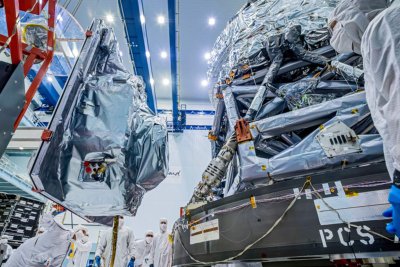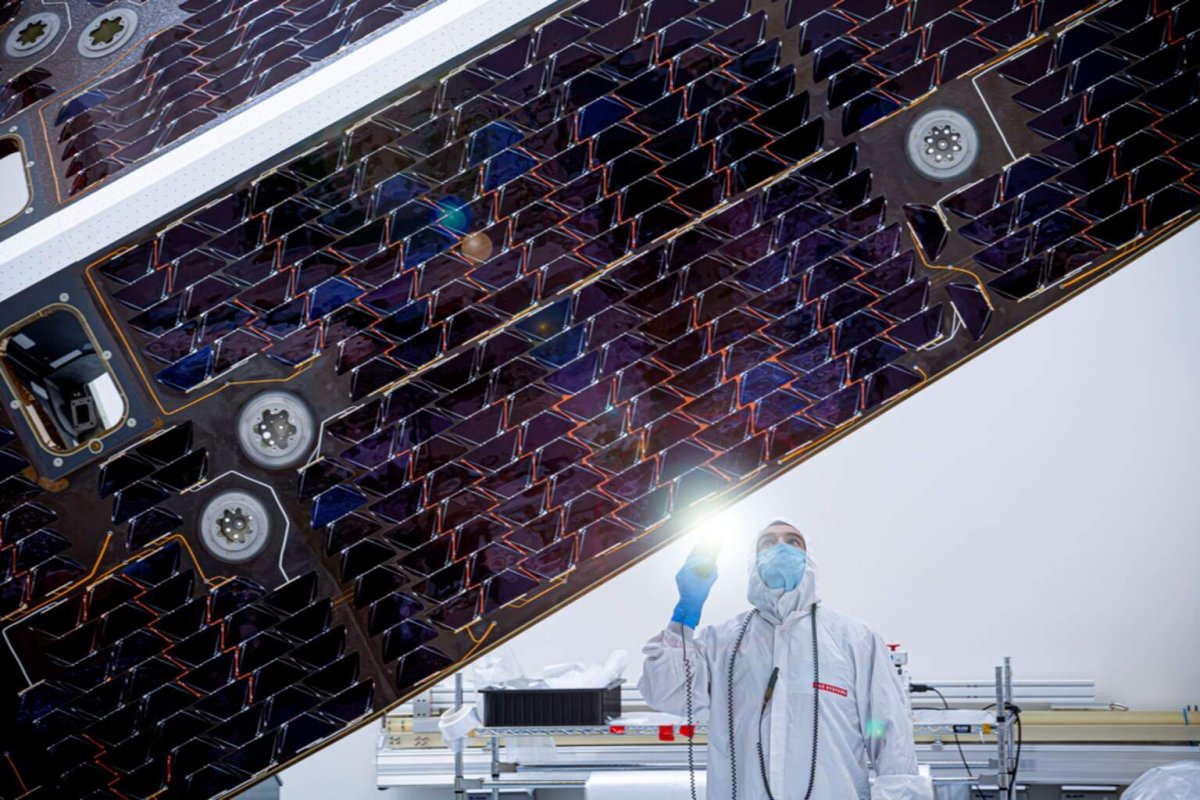
NASA announced on Monday that it has successfully completed testing of the solar array for its Near-Earth Object (NEO) Surveyor mission, a critical milestone in the development of the asteroid-hunting spacecraft. The tests, conducted at BAE Systems' facility in Boulder, Colorado, validate the performance of the largest component of the spacecraft, which integrates the sunshade and the entire solar power supply in a single structure.
The innovative design combines electricity generation with protection from solar radiation, a dual-purpose approach that is essential for the mission's infrared detectors. These detectors, situated behind the shade, must remain at extremely cold temperatures to accurately measure the heat emitted by asteroids. The system relies on passive cooling, a strategy that avoids the finite cryogen supplies that constrained earlier infrared surveys, according to UCLA's mission team, which is responsible for the scientific operations.
Mission Objectives and Timeline
The NEO Surveyor mission has a baseline requirement to find and characterize at least two-thirds of potentially hazardous asteroids larger than 140 meters within five years of operations. A more ambitious goal of exceeding 90% completeness would require an extended mission duration of 10 to 12 years, as outlined in the published mission requirements from UCLA.
The successful completion of the solar array tests marks the culmination of several months of work. Solar cells were installed in January, followed by environmental testing in March. The sunshade arrived at BAE Systems' Boulder facility in May, ahead of schedule. NASA reports that all functional and performance tests are now complete, and Sun and temperature sensors have been integrated into the system.
Technical Specifications
According to NASA's hardware description, the solar array can generate up to 2 kilowatts of power, which charges the batteries that supply electricity to all spacecraft systems. The array consists of 864 solar cells arranged in two panels with a 23.5-degree joint angle. The sunshade stands 6 meters tall and has a base width of 2.4 meters, shielding the telescope's 0.5-meter aperture from solar glare.
Infrared measurements are crucial because they address a weakness in visible-light searches: a large, dark asteroid can appear similar to a smaller, reflective object when observed in reflected sunlight. By measuring heat, the telescope can distinguish between size and reflectivity, providing more accurate estimates of an asteroid's dimensions and temperature. The spacecraft will use two infrared detector arrays, each producing 16-megapixel mosaics of the sky, to observe the same region in two different wavelengths, enhancing the accuracy of size and temperature estimates.
Operational Strategy
The passive cooling approach is a key factor in the mission's long-term viability. By operating in the Sun-Earth L1 Lagrange point environment, the detectors can be kept cold without consumable cryogens or expensive cryocoolers, eliminating the risk of running out of coolant and thus removing a major constraint on the mission's operational life.
To achieve the mission's goals, repeated observations are necessary. The science team's processing plan, adapted from the NEOWISE software, will distinguish moving objects from background stars and galaxies. The observing schedule is designed to gather enough measurements to confirm the existence of asteroids, as a single detection is insufficient.
Data processing and archiving will be handled by Caltech's IPAC center, which plans to distribute images and extracted sources through the NASA/IPAC Infrared Science Archive. The mission will also collaborate with the Minor Planet Center and NASA's Planetary Data System to release detections and physical measurements to the scientific community.
Risks and Next Steps
While the ground tests are a significant achievement, they do not guarantee the system's performance during launch or in the harsh space environment. The extended survey goal of 10-12 years also depends on operations beyond the five-year baseline, and NASA's update does not provide measured in-orbit sensitivity or discovery rates.
IPAC lists the mission's launch as no later than June 2028, but NASA's October 26 update does not specify a date for the next observatory integration milestone. It remains unclear when the tested sunshade will be integrated with the complete telescope. The NEO Surveyor mission represents a critical step in planetary defense, and its successful development is closely watched by the scientific and investment communities.