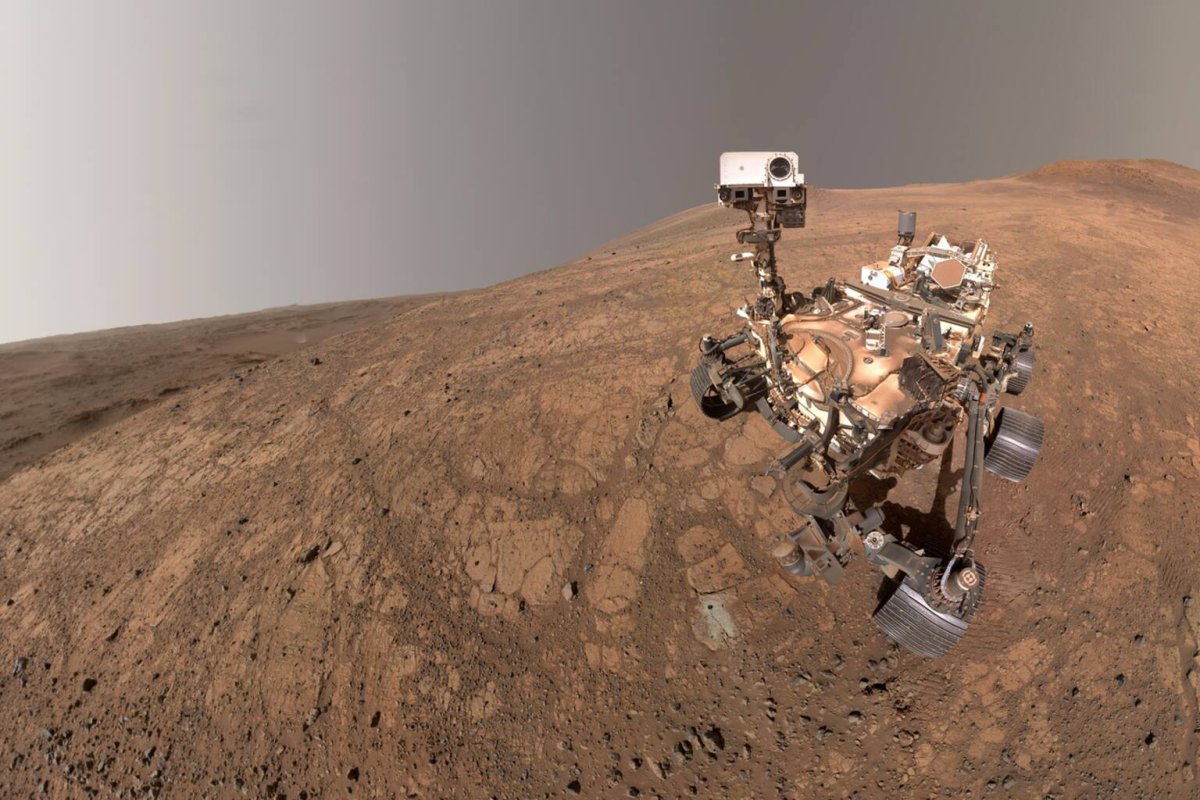
NASA's Perseverance rover, which has been exploring the Martian surface since 2021, has delivered a new dataset that could significantly influence the design of future spacesuits and habitats. A study announced on Monday, October 26, 2026, reveals the presence of ultrafine dust particles, ranging from 100 to 300 nanometers in size, on calibration materials carried across the Red Planet. The findings, spanning 1,645 Martian days (or sols), provide a material-by-material breakdown of dust adhesion that engineers can now use to refine their designs.
The research, scheduled for publication in the Proceedings of the National Academy of Sciences on October 27, focuses on the issue of selective adhesion—why certain dust grains stick to some surfaces more than others. Measurements from the rover's PIXL and SHERLOC instruments show that dust on Teflon and Vectran surfaces averaged about 2 micrometers in diameter, while on other materials, such as basaltic glass and additional Teflon samples, the reported grain sizes extended down to 0.1–0.3 micrometers. These are distinct statistical measures—an average versus a lower-end range—so they do not directly indicate which material performs better.
Electrical charging appears to be a key factor influencing which grains adhere to each surface, according to the study's authors. The smallest particles, some as tiny as 100 nanometers, have persisted through years of driving and drilling on Mars. This persistence suggests that cleaning tests for future missions should focus not only on the material removed but also on the residual dust that remains, which could pose challenges for equipment longevity and crew safety.
The materials studied are already integral to spacesuit design. Vectran, a cut-resistant fabric, is used on glove palms, while Teflon is applied to glove backs and gauntlets. The SHERLOC instrument also carries swatches of visor material and a coated Teflon sample. Lead author Scott VanBommel of Washington University in St. Louis noted, "The larger clumps, the Martian dust bunnies, get shaken off over time," but the ultrafine fraction clings tenaciously. Lindsay Hays, acting director of NASA's planetary science division, said the measurements could help engineers "improve our existing designs."
The measurement method is as innovative as the findings. PIXL's chemical maps have a spatial resolution of about 100 micrometers, yet the instrument's X-ray spectra are sensitive to thin coatings, allowing researchers to analyze deposits far smaller than the mapped area. The Teflon target on PIXL serves as an ideal blank because its own composition produces no detectable elemental signal, so any chemistry detected comes from adhering dust. This technique repurposes existing calibration hardware, avoiding the need for a separate dust-collection payload.
Complementary observations from the SHERLOC instrument, documented in a 2026 Lunar and Planetary Science Conference paper, track material changes at roughly 180-sol intervals. These checks monitor Raman signals and fluorescence, providing a second engineering record of how candidate fabrics age while accumulating dust. The rover's MEDA weather station and Mastcam-Z camera also contribute atmospheric data, including dust storm activity and optical depth, which can help place surface deposits within the context of changing environmental conditions.
Despite the wealth of data, the study has limitations. Surface retention does not directly translate to an astronaut's inhaled dose or a coating's cleaning efficiency. The National Academies' 2026 Mars science strategy highlights gaps in understanding dust lifting, surface properties, and near-surface winds, complicating extrapolation from a rover's deposits to other landing sites. For cleaning trials, the practical comparison would involve pairing each material's initial deposit with its residue, measuring both grain sizes and retained quantities separately.
As NASA prepares for future crewed missions to Mars, these findings underscore the importance of addressing the ultrafine dust challenge. The concrete question for follow-on engineering tests is how much of the 100–300-nanometer fraction survives repeated cleaning of each candidate material. This study provides the foundational data needed to answer that question and ensure that future explorers are equipped with materials that can withstand the harsh Martian environment.
