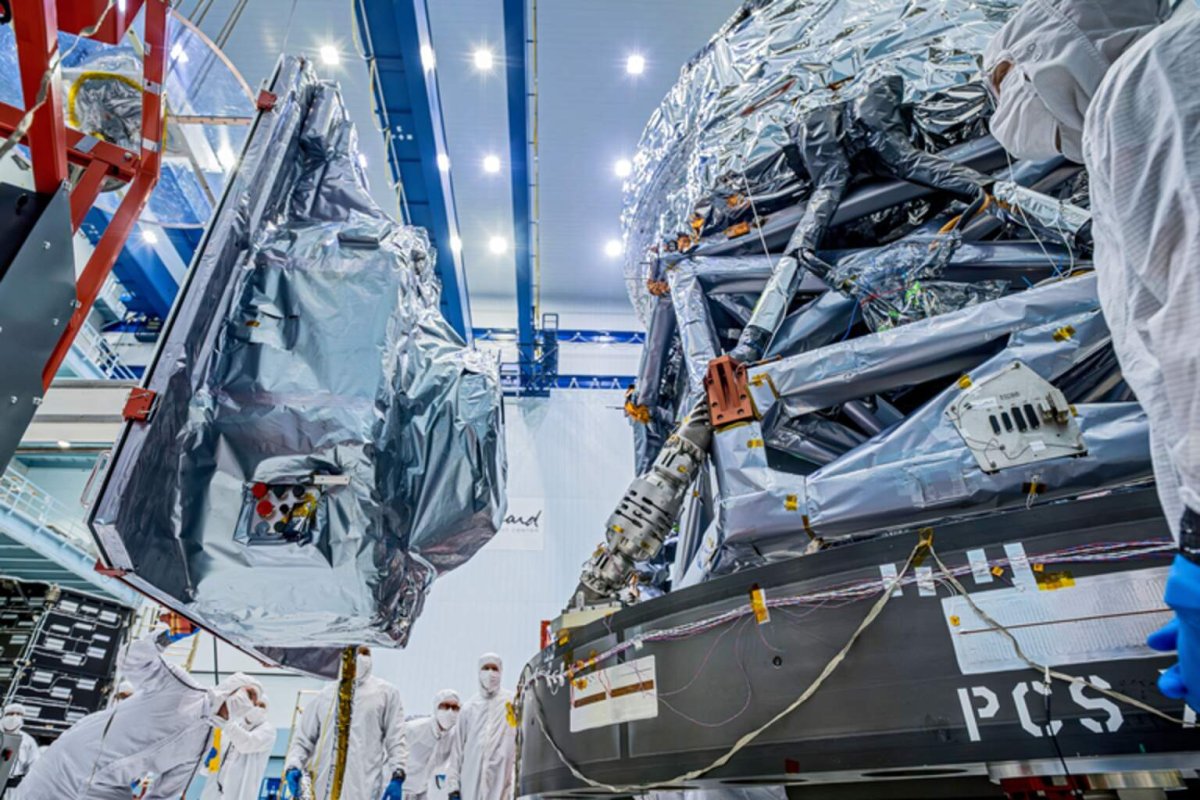
NASA's Nancy Grace Roman Space Telescope has officially entered its final science commissioning phase, marking a key step toward its upcoming wide-field infrared survey. The agency confirmed the milestone on October 22, following successful checks of the observatory and its primary instrument. This transition places the telescope on track for its five-year prime mission, with calibration now taking center stage.
Calibration and Instrument Details
The Roman telescope's Wide Field Instrument (WFI) is a technological marvel, featuring 18 detectors that together provide a field of view of 0.281 square degrees in a single pointing. This vast infrared footprint is roughly 218 times larger than that of the Hubble Space Telescope's infrared camera, while maintaining similar angular resolution. The instrument incorporates over 300 million pixels across its detectors, supports eight imaging filters, and includes two elements for dispersing light into spectra, covering wavelengths from 0.5 to 2.3 micrometers.
Calibration is a critical and time-consuming phase. The Space Telescope Science Institute (STScI) has outlined a provisional calibration plan that allocates approximately 113 days of the five-year mission—about 6% of the total time—to ensure the instrument's performance is fully understood. These allocations are subject to revision based on actual flight measurements, as engineers refine their understanding of the telescope's behavior in space.
Engineering Milestones
“We’ve established that the observatory is fully functional,” said Julie McEnery, Roman’s senior project scientist at NASA Goddard. The telescope has demonstrated its ability to point accurately, take exposures, and move data through its systems. Engineers are now scrutinizing the finer details of the images it produces. Tests in crowded star fields and dusty regions have alleviated concerns about the telescope's guidance system, which relies on individual guide stars to maintain precise pointing. This is crucial to avoid misinterpreting variations in sharpness or brightness as changes in celestial objects.
The calibration plan addresses several sources of measurement error, including pixel sensitivity, instrumental noise, and count-rate nonlinearity. STScI's detector documentation treats these effects holistically, as they interact to influence the final calibrated images and spectra. A sharp exposure alone is insufficient; each detector's response must be meticulously characterized.
Ground Processing and Division of Labor
Ground processing is organized with clear responsibilities. Caltech/IPAC's Science Support Center will handle spectroscopic and microlensing data processing, in addition to coronagraph tasks. The spectroscopy system will extract and calibrate spectra, while the microlensing system will generate brightness histories and identify events in the Galactic Bulge survey.
Roman launched on August 30 aboard a Falcon Heavy rocket, as reported by Space.com. The latest milestone advances the post-launch preparation, though routine science operations still depend on completing the remaining characterization and calibration work.
Evidence and Future Outlook
Key evidence from NASA and STScI confirms the telescope's readiness. NASA's October 22 update stated that some systems are exceeding requirements, though specific details were not disclosed. The update also did not provide a firm date for the start of routine science operations or numerical image-stability results across the camera.
STScI notes that some calibration products will require accumulated science observations, implying that refinement will continue even after commissioning. Survey data itself will help track instrument response and build more precise corrections over time.
Potential risks remain, including detector behavior or pointing instability that could necessitate additional calibration observations and alter the observing allocation. STScI emphasizes that the plan is under review and subject to change based on measured performance in orbit.
As Roman embarks on this final commissioning phase, the astronomical community eagerly anticipates the groundbreaking observations this powerful telescope will deliver, from dark energy studies to exoplanet characterization.