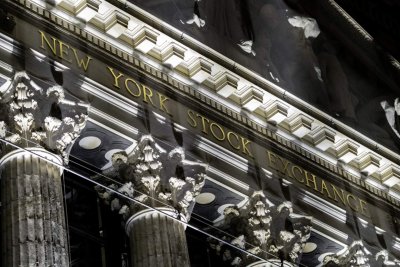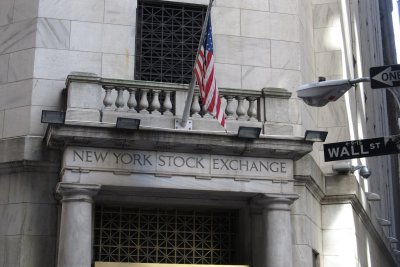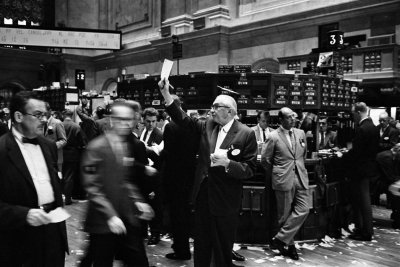
The S&P 500 closed Monday at 7,807.24, down 4.30 points, or 0.06%, leaving the benchmark just 11.69 points — 0.15% — below its October 6 record close. The narrow loss, however, came on unusually light trading: index volume totaled 2.26 billion shares, roughly 55% below the three-month average, complicating the signal from the close.
Market participation was further limited by the federal holiday, which kept cash Treasury trading closed. Brent crude, meanwhile, gained 1.8% as geopolitical tensions flared. Bond-market price discovery is set to resume Tuesday, coinciding with the start of bank earnings season.
Under the surface, performance diverged sharply. The Dow Jones Industrial Average added 0.38%, while the Nasdaq Composite dropped 0.44% and the Russell 2000 fell 0.45%, leaving smaller companies behind blue chips once again. The S&P 500 slipped 0.07% from its opening price after briefly trading above Friday’s close.
Participation and Sector Rotation
Breadth was healthier than the headline index suggested. According to the Associated Press, 60% of S&P 500 constituents advanced in a late-session count, and eight of 11 sector gauges finished higher even as the benchmark edged lower. Energy led with a 1.44% gain, followed by consumer staples at 1.16%, communication services at 0.94%, and financials at 0.58%. Industrials slipped 0.06%, consumer discretionary lost 0.51%, and technology lagged with a 1.22% decline.
Among individual movers, Meta Platforms (NASDAQ:META) climbed 3.38%, bolstering communication services, while Nvidia (NASDAQ:NVDA) fell 1.29%, contributing to technology’s weakness. Fair Isaac (NYSE:FICO) jumped 10.4%, the S&P’s largest gainer. Ciena (NYSE:CIEN) sank 10.3% amid a broader optical-networking selloff, a move that Investing.com noted had no accompanying company announcement or analyst action, offering little fundamental insight.
Earnings Focus and Analyst Actions
Magdalena Ocampo, a market strategist at Principal Asset Management, emphasized the earnings test ahead, writing that “future gains [are] more reliant on earnings delivery rather than potential.” Monday’s split performance underscored that market leaders are no longer moving in lockstep.
Analyst actions created notable counterweights within technology and communications. Salesforce (NYSE:CRM) rose 2.03% after Bank of America (NYSE:BAC) upgraded the stock from Underperform to Buy. Adobe (NASDAQ:ADBE) fell 1.70% after Wells Fargo (NYSE:WFC) cut it to Underweight. Other updates included T-Mobile US (NASDAQ:TMUS) reiterated at Outperform by Raymond James (NYSE:RJF) and Tyler Technologies (NYSE:TYL) maintained at Overweight by Wells Fargo.
Cross-Asset Signals
Oil was the strongest cross-asset signal. Brent settled at $106.65 a barrel following weekend attacks on Riyadh’s international airport. The dollar index strengthened 0.38% to 102.60, while gold futures eased 0.55% to $4,193.10 an ounce and the euro fell 0.43% to $1.1157.
The Treasury curve last showed 4.80% for two-year notes and 5.24% for ten-year notes on Friday, a 44-basis-point slope that saw no Monday reaction to oil given the bond-market holiday. SIFMA’s calendar listed October 12 as a full closure.
Holiday turnover limits how much conviction can be assigned to Monday’s close. The S&P volume measure was just 45% of its recent average, yet the Dow-Nasdaq performance spread widened to 0.82 percentage point by the bell. Risks remain: a fresh oil spike could push Tuesday’s reopened Treasury market toward higher yields and pressure long-duration stocks, while softer crude or strong bank guidance could validate the S&P’s broad underlying advance.
Price discovery restarts before Tuesday’s opening bell, with JPMorgan Chase (NYSE:JPM), Citigroup (NYSE:C), Wells Fargo (NYSE:WFC), and Goldman Sachs (NYSE:GS) all reporting on October 13. The BLS then releases September CPI at 8:30 a.m. EDT on Wednesday.