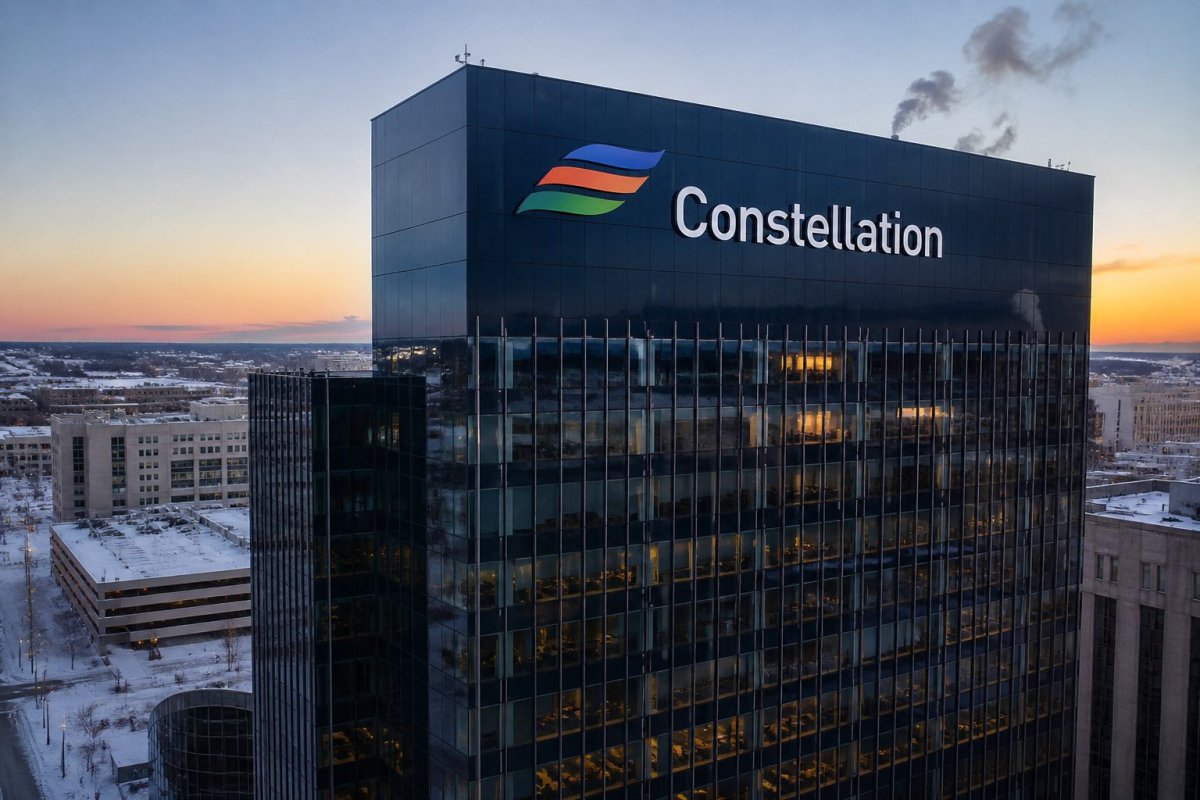
Constellation Energy Corporation (CEG) shareholders have endorsed all 11 board nominees and approved executive compensation, while overwhelmingly rejecting a proposal for a diversity, equity, and inclusion (DEI) report, according to a filing released on Friday. This governance victory provides management with a solid foundation ahead of the company's first-quarter earnings report scheduled for May 11.
The shareholder vote comes at a pivotal moment for the Baltimore-based power producer, which sits at the center of a critical debate in the energy sector: how much continuous power will artificial intelligence data centers actually require, and how quickly can suppliers secure these contracts? The outcome of this debate could shape the company's growth trajectory for years to come.
Constellation's stock closed at $307.81 on Friday, down approximately 1.7% for the session, reflecting market caution ahead of the earnings update. The company's next major catalyst is the first-quarter 2026 earnings call on May 11 at 10 a.m. EDT, where investors will scrutinize capital expenditure plans, new contract announcements, and progress on the integration of Calpine.
In March, Constellation outlined ambitious plans: $3.9 billion in capital spending, a share repurchase authorization increase to $5 billion, and over 5,650 megawatts of long-term clean-energy deals secured. The company's total fleet capacity stands at 55 gigawatts, encompassing nuclear, natural gas, oil, geothermal, hydro, wind, and solar assets. Constellation reports serving approximately 2.5 million customer accounts across the United States, with enough generation capacity to power roughly 27 million homes.
CEO Joe Dominguez articulated a strategy in February centered on nuclear and flexible generation. "We're pairing the grid's most reliable power with flexible resources," he stated, emphasizing the company's focus on electrification and data economy demand. Analysts have taken note, with Melius Research analyst James West telling Reuters that "Constellation Energy stands out as a supplier for booming data center energy demand in 2026," citing the company's natural gas assets and stronger position in the ERCOT market.
The broader market context adds weight to Constellation's story. Barron's reported a 5.4% jump for Constellation in a recent session, alongside gains for Talen Energy, NRG Energy, and Public Service Enterprise Group. Evercore ISI attributed the uptick to AI data-center spending by large technology firms and the resulting demand for dispatchable power—electricity that can be deployed to the grid as needed.
However, sell-side analysts have not been uniformly bullish. On May 1, JPMorgan trimmed its Constellation price target from $400 to $386, while Scotiabank lowered its target from $481 to $441 on April 29, though it maintained a Sector Outperform rating. Both targets remain above the current share price, but the cuts highlight the stock's sensitivity to guidance shifts and the pace of contract signings.
Evercore ISI notes that while Constellation is positioned for growth in AI, data centers, reshoring, and electrification, the actual scale and timing will depend on contract execution and policy developments. Some analysts have flagged delays in deal closures, ongoing regulatory uncertainties, and the absence of another major hyperscaler contract—hyperscalers being the large cloud-computing clients such as major tech platforms.
The May 11 earnings call now carries heightened significance beyond a routine quarterly check. With the shareholder vote behind them, investors will be looking for concrete evidence: data-center demand materializing in results, progress on Calpine integration, and updates on nuclear restart plans entering the earnings picture. The outcome will likely determine whether Constellation can maintain its position as a bellwether for AI-driven power demand in the months ahead.