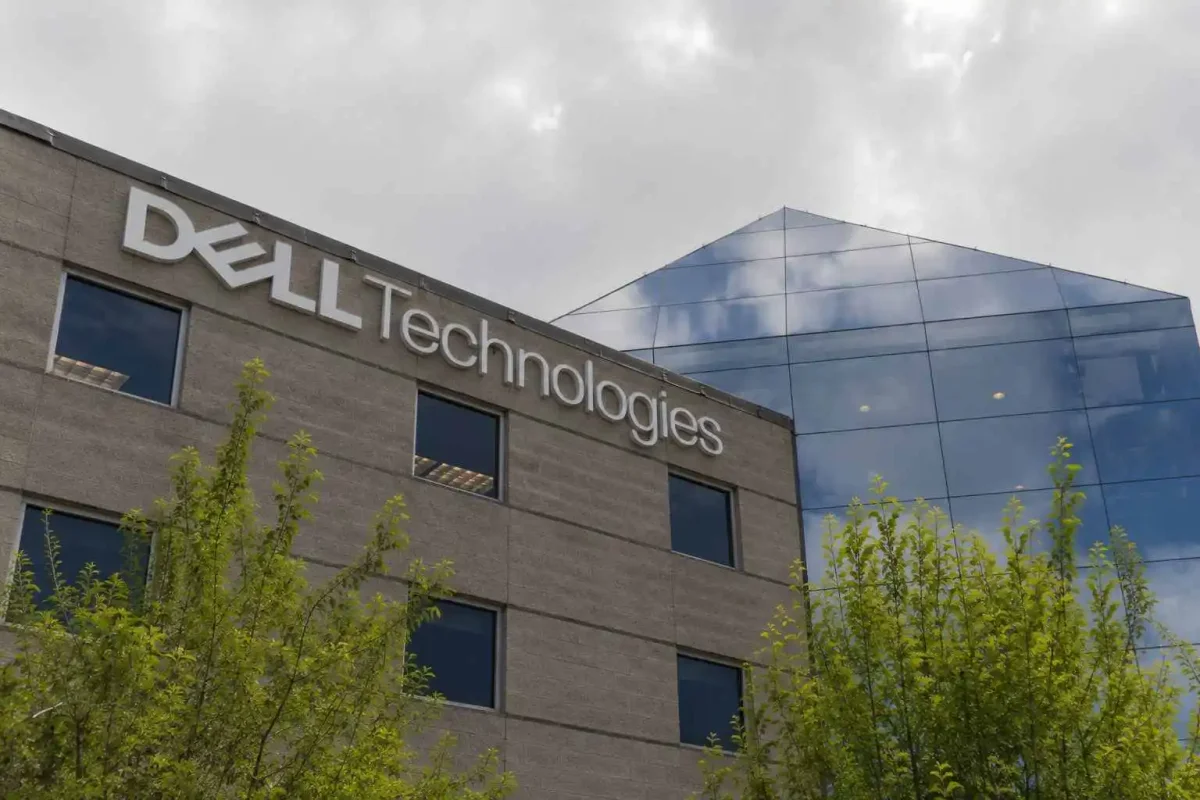
Dell Technologies (NYSE:DELL) saw its shares advance 2.0% to $476.81 in late-morning trading on Wednesday, after touching a session high of $485.33. The move comes as the company's artificial intelligence server backlog reached $51.3 billion, representing 117% of the additional revenue required to meet its fiscal 2027 server sales goal of $60 billion.
The substantial order book shifts the investor conversation from demand visibility to profitability. While order visibility remains robust, the focus now turns to margin expansion and competitive dynamics. Dell reported $16.1 billion in AI server revenue for its fiscal first quarter, leaving $43.9 billion needed to reach the full-year target. The backlog of $51.3 billion exceeds that gap by $7.4 billion, providing a cushion of roughly 17%.
However, the backlog conversion is not guaranteed. Shipment schedules, component availability, and customer adjustments could alter the trajectory. Dell has identified memory as the primary supply constraint, and Chief Operating Officer Jeff Clarke noted that the AI opportunity "shows no signs of slowing."
Profitability Under Scrutiny
Profit performance has been less impressive. Dell's AI server operating income aligned with its mid-single-digit margin target, while the broader infrastructure division posted a 10.5% operating margin. This is a key concern for investors, as the company's valuation implies robust earnings growth.
Analysts project fiscal 2027 non-GAAP EPS of $18.48, a 79% increase from the current year. At the current share price, that translates to a price-to-earnings multiple of roughly 26 times, which does not factor in a significant decline in AI server market share. The company's own guidance for fiscal 2027 EPS is $17.90, implying a 74% growth rate.
Peer Comparison Highlights Differences
Dell's competitors are also reporting strong AI demand, though their financial metrics differ. Hewlett Packard Enterprise (NYSE:HPE) disclosed an AI backlog exceeding $6.3 billion, with its Cloud & AI unit delivering a 12.4% operating margin. Super Micro Computer (NASDAQ:SMCI) announced preliminary quarterly orders surpassing $60 billion, but its gross margin is estimated between 15% and 17%, and results remain unaudited.
These figures suggest no industry-wide slowdown, but the key issue is allocation: which supplier secures each system and at what profit margin. Dell's mid-single-digit AI server margin is lower than HPE's cloud and AI margin, reflecting different product mixes and customer bases.
Analyst Sentiment and Price Targets
GF Securities analyst Evan Lee reiterated a Hold rating and lowered his price target to $403 from $445, citing expected competitive pressures starting with the Rubin platform. This implies a potential decline of 15.5% from the current price. Other analysts remain more optimistic: Citigroup maintains a Buy with a $515 target, Evercore has an Outperform at $500, and BofA Securities also has a Buy at $500. The consensus average target is $472, slightly below the current price.
The valuation tension stems from high profit forecasts. According to FactSet, analysts project fiscal 2028 EPS of $22.36, a 21% increase over fiscal 2027, implying a forward P/E of 21.3 times.
Outlook and Risks
Dell is scheduled to report fiscal second-quarter earnings on September 3. Key factors to watch include backlog conversion, customer concentration, and AI margin performance. Risks include memory supply constraints, shipment timing, dependence on major customers, and intense price competition.
While the $60 billion target appears well-supported by current orders, the next re-rating will require improved unit economics rather than just a larger backlog. Investors will be looking for evidence that Dell can maintain its market share while expanding profitability.