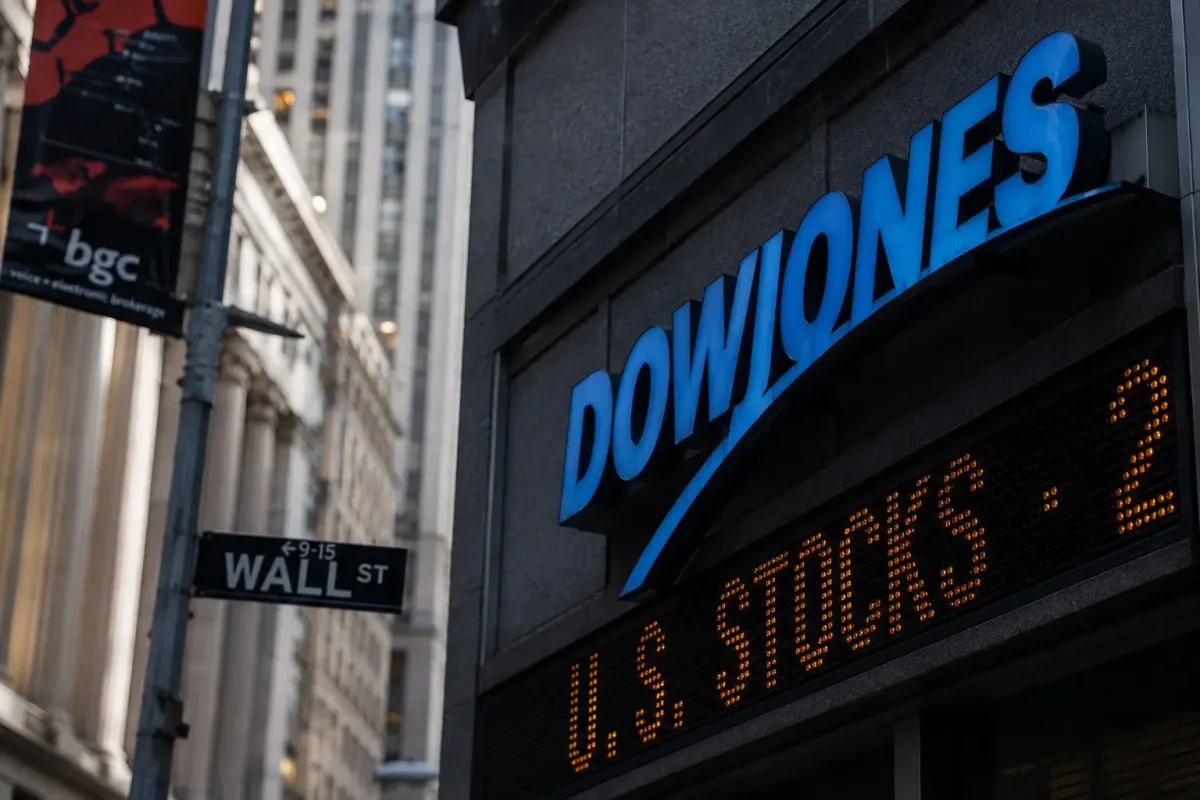
U.S. equities closed Thursday with the Dow Jones Industrial Average suffering its steepest decline in weeks, shedding 453.64 points, or 0.83%, to settle at 53,895.48. The drop ended a five-session winning streak and highlighted the index's unique price-weighted methodology, which amplified losses in a handful of high-priced components.
While the Dow's slide appeared severe, the broader market showed relative resilience. The S&P 500 finished down just 0.18%, and the Nasdaq Composite edged lower by 0.04%, underscoring the divergence driven by the Dow's calculation method. Unlike market-cap-weighted indexes, the Dow assigns weight based on share price, meaning a $1 move in any stock shifts the index by approximately 5.94 points.
By mid-afternoon, six stocks had subtracted roughly 407 points from the Dow, representing 81% of the index's 503-point decline at that time. Goldman Sachs (NYSE:GS) led the drag, falling $27.83 to shave 165 points off the index, accounting for about one-third of the late-session loss. Other significant contributors included UnitedHealth (NYSE:UNH), down $9.60 (-57 points), Boeing (NYSE:BA), down $8.33 (-49 points), and Caterpillar (NYSE:CAT), down $8.31 (-49 points). Honeywell International (NASDAQ:HON) and Salesforce (NYSE:CRM) each subtracted 43 points.
Partially offsetting these losses, Microsoft (NASDAQ:MSFT) gained $10.72, adding 64 points, while Chevron (NYSE:CVX) rose $3.06 (+18 points) and Walt Disney (NYSE:DIS) gained $2.67 (+16 points). Despite these gains, weakness in financial and industrial names outweighed the positive contributions, with 22 of the Dow's 30 components trading lower at the time.
The decline, however, represented only a fraction of the week's earlier gains. The Dow remained up 2.7% from last Friday's close and stood about 0.8% below its all-time high reached on Wednesday. Thursday's pullback gave back approximately 24% of the gains accumulated from Monday through Wednesday.
Analysts remain constructive on several of the key movers. Salesforce holds a consensus 'overweight' rating with a median target of $233.00, implying a 25.5% upside from its reference price of $185.71. Boeing is rated 'buy' with a target of $277.50, suggesting 19.0% upside. Disney also carries a 'buy' rating with a $129.50 target (+24.0%), and Microsoft is rated 'buy' with a $550.00 target (+10.2%).
Fundamentals continue to support equities, with 84.8% of the 382 S&P 500 companies that have reported earnings as of Wednesday surpassing expectations, well above the historical average of 68%. This robust earnings season has provided a buffer against broader market volatility.
Investors now turn their attention to labor data, with Friday's nonfarm payrolls report expected to show 83,000 new jobs, up from June's 57,000. Economists project the unemployment rate to hold at 4.2% and monthly wage growth to rise 0.3%. This week's economic releases have been mixed, with ADP private payrolls coming in at 44,000 versus a forecast of 75,000, while the ISM services gauge matched expectations at 54.1. Initial jobless claims fell to 199,000, and productivity for Q2 rose 1.4%.
Oil prices also influenced sentiment, with U.S. crude settling up 2.75% at $77.29 and Brent gaining 3.83% to $82.49. Robert Bernstone of SummitTX Capital attributed the move to "a little bit of headline fatigue" surrounding geopolitical tensions in Iran. Rising energy costs could reignite inflation concerns ahead of next week's consumer price index, producer price index, and retail sales reports.
Market strategists caution that August often brings heightened volatility. Clark Bellin of Bellwether Wealth noted that "August is typically a volatile month for stocks," while risks remain skewed toward a significant payroll surprise or supply disruptions in the Strait of Hormuz, which could push crude higher and alter rate expectations.