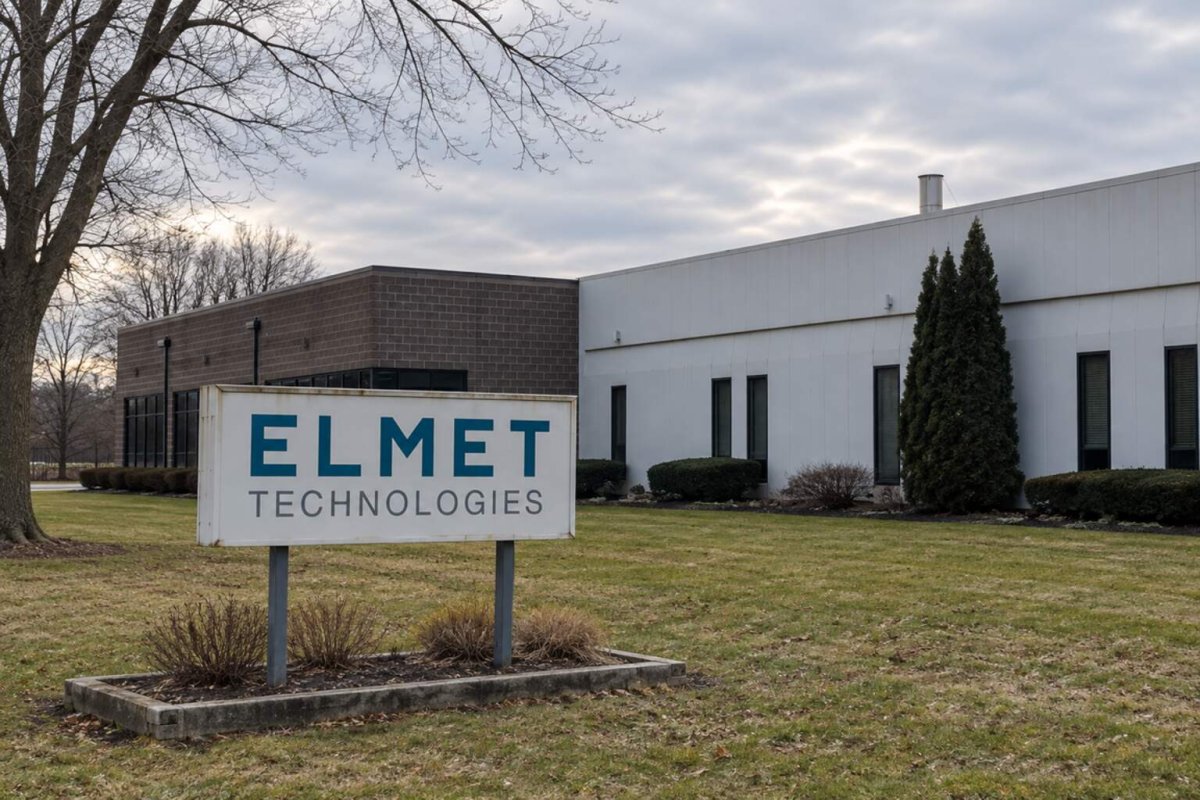
Shares of The Elmet Group Co. surged 31.7% to $21.325 in afternoon trading Monday following the announcement of a major government-backed tungsten supply agreement. The deal pairs a $450 million committed investment from the U.S. Department of War with a Defense Logistics Agency (DLA) contract that carries a ceiling of $2 billion.
While the headline numbers are striking, their implications for shareholders differ significantly. Under the DLA contract, only $150 million is a guaranteed funded commitment. The separate $450 million investment will provide the Department of War with redeemable preferred equity, warrants representing up to 19.9% of Elmet's common stock on a post-transaction basis, one independent director, and one non-voting board observer, according to the company's announcement.
What Elmet Has Actually Secured
Elmet's Sept. 14 agreements include the following components:
- DoW Investment ($450 million): $200 million is due at closing, with later drawdowns to follow. The government receives preferred equity, warrants, and governance rights.
- DLA Contract ($150 million guaranteed): The indefinite-delivery, indefinite-quantity (IDIQ) vehicle can reach $2 billion, but orders above the funded minimum are not assured.
- U.S. Facilities (>$165 million planned): Capacity and infrastructure work in Maine, Michigan, and Ohio.
- Springer Complex (~$150 million planned): A majority-owned venture is intended to restart a Nevada mine and add conversion capacity.
The structure matters because Elmet was a much smaller company before Monday's announcement. It reported $228.5 million of trailing-12-month revenue, $31.8 million of adjusted EBITDA, and $131.5 million of backlog for the period ended July 3. The $150 million guaranteed DLA minimum is about 66% of that trailing revenue, although it will not arrive as one quarter's sales. Elmet's second-quarter release also listed $66.1 million of cash and $4.9 million of marketable securities.
Market Valuation and Dilution Concerns
Using the 30.46 million shares outstanding on July 3 and Monday's 2:55 p.m. price, Elmet's common equity was worth roughly $650 million. That makes the government's full $450 million commitment equivalent to about 69% of the indicated common-market value. It is not a grant to common shareholders: the preferred security's redemption economics and the warrants' eventual exercise terms will determine how much of the upside existing owners retain.
A Large Ceiling, but a Delayed Revenue Path
Elmet Technologies, the company's operating subsidiary, will supply tungsten ores, concentrates, and sodium tungstate to the National Defense Stockpile. The IDIQ contract has a five-year base period through Aug. 30, 2031, and a two-year extension option through Aug. 30, 2033. Reuters independently reported the $2 billion ceiling, the $150 million funded minimum, and the preferred-and-warrant structure.
Elmet explicitly said deliveries will wait until extra supply becomes available. Its plan calls for more than $165 million at existing U.S. plants and roughly $150 million for a majority-owned venture with Blue Moon Metals and Australia's EQ Resources at the Springer Tungsten Complex in Nevada. The mine and mill are expected to restart in the fourth quarter of 2027; the ammonium paratungstate conversion plant is targeted for the second half of 2028. Up to another $150 million is intended for partnerships and investments tied to mines in Australia and Spain, according to the company's capital-deployment outline.
That timetable is the strongest check on the bullish reading. Government capital reduces Elmet's financing burden, and a $150 million minimum provides a meaningful contracted base. But mine restarts, processing construction, and allied feedstock agreements must work before the company can pursue much of the $2 billion ceiling. Meanwhile, warrants covering up to 19.9% of post-transaction common stock create a real dilution overhang after Monday's repricing.
The next evidence will come from closing terms and funded DLA orders, not the ceiling itself. For shareholders, the decisive milestones are the initial $200 million drawdown, the 2027 Springer restart, and the 2028 conversion-plant target. Slippage in any of them would push stockpile revenue farther out; firm orders above $150 million would begin converting the headline opportunity into an operating one.
