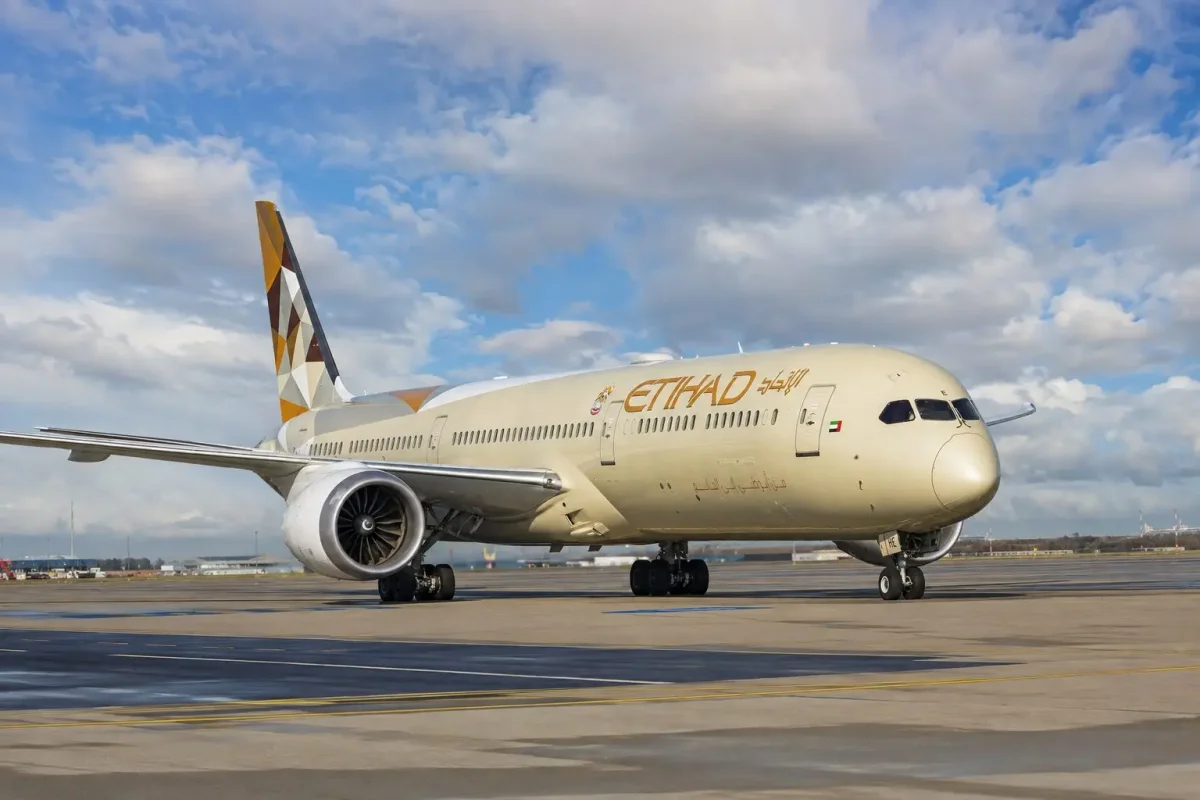
Etihad Airways is poised to significantly expand its African footprint through a series of strategic partnerships, potentially adding up to 23 new feeder routes to its network. The Abu Dhabi-based carrier has identified at least 23 specific feeder locations linked to six new gateway cities across the continent, according to an initial assessment of its partnership agreements.
The planned expansion, which will be implemented through codeshare and interline agreements with Air Peace, Fastjet Zimbabwe, and Africa World Airlines, is designed to boost connectivity as Gulf carriers intensify regional cooperation. Etihad will operate 21 weekly flights under its own-flight programme, with services launching between November 2026 and March 2027.
Partnership Breakdown
The partnership structure reveals a complex web of feeder routes. Air Peace's agreement includes 17 specified destinations beyond Lagos and Accra, with Etihad listing the overall count at 20. Fastjet contributes three destinations past Harare, while Africa World Airlines' agreement would incorporate three separate cities within Ghana. The total of 23 excludes three undisclosed Air Peace destinations and AWA's Lagos, Abuja, and Ouagadougou routes to prevent duplication. The Ethiopian Airlines alliance with Etihad is not included in this count.
This feeder network is crucial for Etihad's long-haul strategy. The ratio of 3.8 partner routes per new direct gateway is significant, as distribution has the potential to expand ahead of long-haul capacity increases. Etihad's programme, covering six destinations, requires 21 weekly flights departing from Abu Dhabi, with any further expansion mostly utilizing partner airlines' aircraft.
Route Launch Schedule
The new Etihad destinations include Asmara (four weekly departures from November 7, 2026), Accra (four weekly from March 24, 2027), Kinshasa (three weekly from March 18, 2027), Lagos (seven weekly from March 18, 2027), and Harare and Lubumbashi (three weekly each from March 24, 2027). The Accra date was moved from March 17 to March 24 following a July partnership announcement.
Chief Executive Antonoaldo Neves stated that demand “is outpacing existing supply,” especially within cargo-focused markets. Etihad will offer bellyhold freight capacity on all six routes, adding a revenue stream beyond passenger traffic.
Competitive Landscape
Etihad's move comes as Gulf carriers expand their African networks. Emirates resumed its fourth daily flight to Johannesburg and introduced a third daily service to Cape Town, while also raising Accra frequencies to 11 times weekly. Qatar Airways has adopted a strategy focused on increasing frequency, adding 39 weekly flights to its African schedule.
Etihad stands out for its optionality rather than immediate seat availability. Its partner network can be assessed ahead of any increase in long-haul services, whereas Emirates and Qatar have moved quicker to bring their planned capacity online.
Market Context
Listed peers provide insight into market sentiment. Air Arabia (DFM:AIRARABIA) acts as the primary comparable among UAE carriers. Turkish Airlines (IST:THYAO) runs a rival hub-based system, and International Airlines Group (LON:IAG) gives an updated reference point for costs. In the week to July 31, Air Arabia rose 0.8% to AED 4.90, Turkish Airlines gained 0.6% to TRY 314.00, and IAG fell 0.5% to 431.90 pence.
Air Arabia’s first-quarter results show that robust load factors do not always shield profits. Revenue edged up 1% as the load factor climbed by two percentage points to 86%, but net profit dropped 22% after airspace closures led to reduced capacity. IAG faced similar challenges, lowering its 2026 capacity forecast to remain unchanged, with operating profit for the second quarter dropping by 16% and fuel and emissions expenses increasing by almost 23%.
Investment Proposition
Etihad’s chief commercial officer Arik De stated “the partner network behind them will already be in place,” forming the heart of the investment proposition. The 2027 launches are positioned as distribution opportunities rather than standalone route gambles.
During the August 3–7 trading period, no new Etihad route will debut. The closest set commercial event is the launch of Fastjet ticket sales on August 24. Updates on fuel, airspace, and operational notices are expected to influence developments before then.
Risks include potential delays in implementing the agreements, and route profitability may be affected by currency controls, airport limitations, insufficient feed, or new disruptions to airspace. Conversion is the key metric, rather than the number of routes. Etihad requires partner feed to boost loads while avoiding fare dilution. The network multiplier is apparent, but the profit multiplier remains unclear.
Neither Etihad nor Fastjet Zimbabwe is publicly listed, and there is no schedule set for an Etihad IPO. Shares in parent Fastjet are available through periodic Asset Match auctions, with the latest auction having no bids and 32 shares offered at £16.