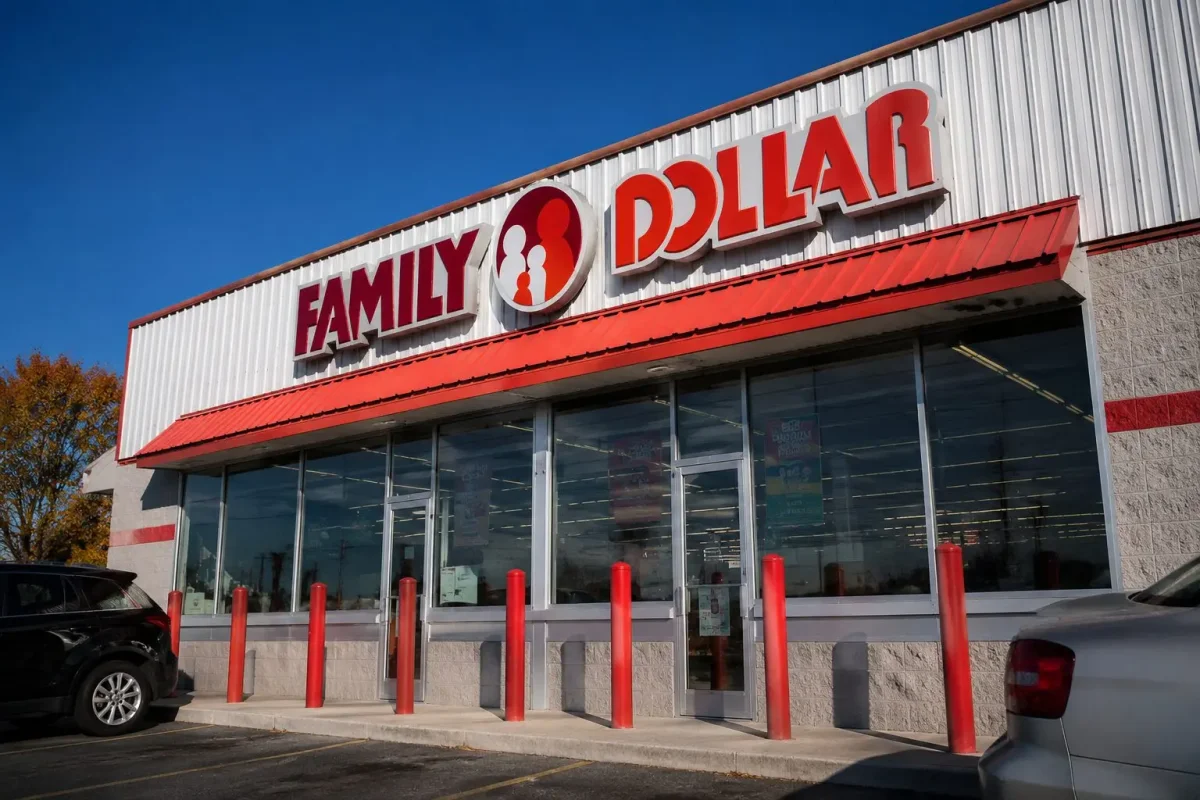
Family Dollar has permanently closed at least 350 U.S. stores since July 2025, according to a location-data analysis by Local Falcon, which compared the chain's public store directory from July 7, 2025, to May 12, 2026, and cross-checked removed locations against Google Maps. The closures are concentrated in the South, Appalachia, and older urban markets, with Texas losing 35 stores, Ohio 28, and Georgia 26. Arkansas saw the steepest decline among states with at least 50 stores at the start of the period, losing 13.9% of its locations, while Idaho, Massachusetts, Montana, South Dakota, Utah, and Wyoming lost none.
The timing of these closures matters because many are not just balance-sheet moves. They are landing in neighborhoods where small-format discount stores provide food, cleaning goods, and basic household items to shoppers who may not have easy access to a supermarket or big-box store. In Warren, Michigan, a Family Dollar on Eight Mile Road was preparing to close, with liquidation signs posted and store fixtures for sale. In Jackson, Mississippi, a Family Dollar at Cooper and Terry roads is set to close by the end of May, with discounts of up to 70% as it clears inventory. Resident Bobby “Bulldog” Rhymes said the loss means longer trips for basics: “Instead of 15 minutes, you’re talking 40 or an hour.”
This marks a live test of Family Dollar's life after Dollar Tree. Dollar Tree completed the sale of the banner to Brigade Capital Management and Macellum Capital Management in July 2025 for $1.0075 billion in cash, ending a long and troubled ownership run. Dollar Tree said at the time that the deal allowed it to focus on its core chain. The new private-equity owners are trying to shrink weak stores while pitching a turnaround.
Family Dollar has framed the cuts as part of a broader reset, not a retreat from value retail. In March, Chairman and Chief Executive Duncan MacNaughton said the company was focused on “simplifying the business” and “improving execution in our stores.” Family Dollar reported about $13 billion in fiscal 2025 revenue, 2.5% comparable sales growth, and $495 million in EBITDA. The company is also developing an extra-small-box store design for dense urban markets, expected to pilot in 2026, with growth possible from 2027. The turnaround includes about 70 initiatives across merchandising, store operations, supply chain, and technology.
The shrinkage follows a plan Dollar Tree announced in March 2024 to close about 600 Family Dollar stores in the first half of that fiscal year and about 370 more as leases expired. Dollar Tree also said it would close about 30 Dollar Tree stores over time after a portfolio review. Analysts had warned that Family Dollar's problems ran deeper than any one owner. Evercore analyst Michael Montani called Dollar Tree's sale “addition by subtraction,” while Mari Shor at Columbia Threadneedle Investments said Dollar Tree's growth target looked “aggressive” in the macro backdrop. Dollar Tree CEO Mike Creedon noted that “everybody is hurting right now,” as inflation pushed more shoppers toward discount chains.
The competitive picture is uneven. Dollar General is still expanding, with plans for roughly 450 new U.S. stores in 2026 and thousands of remodels, while Dollar Tree is trying to sharpen its stand-alone business after shedding Family Dollar. Walmart remains a pricing benchmark for many low-income shoppers, especially in groceries and household staples. Neil Saunders of GlobalData told AP that Dollar Tree “bit off far more than it could chew” with Family Dollar, while Marshal Cohen of Circana said lower-income shoppers could lose a “critical place” to buy value products. The risk is that closing weak stores does not fix weaker loyalty, pricing gaps, or local access issues. Fewer bad stores may help the books, but fewer nearby stores can hurt the customer Family Dollar says it wants to keep.