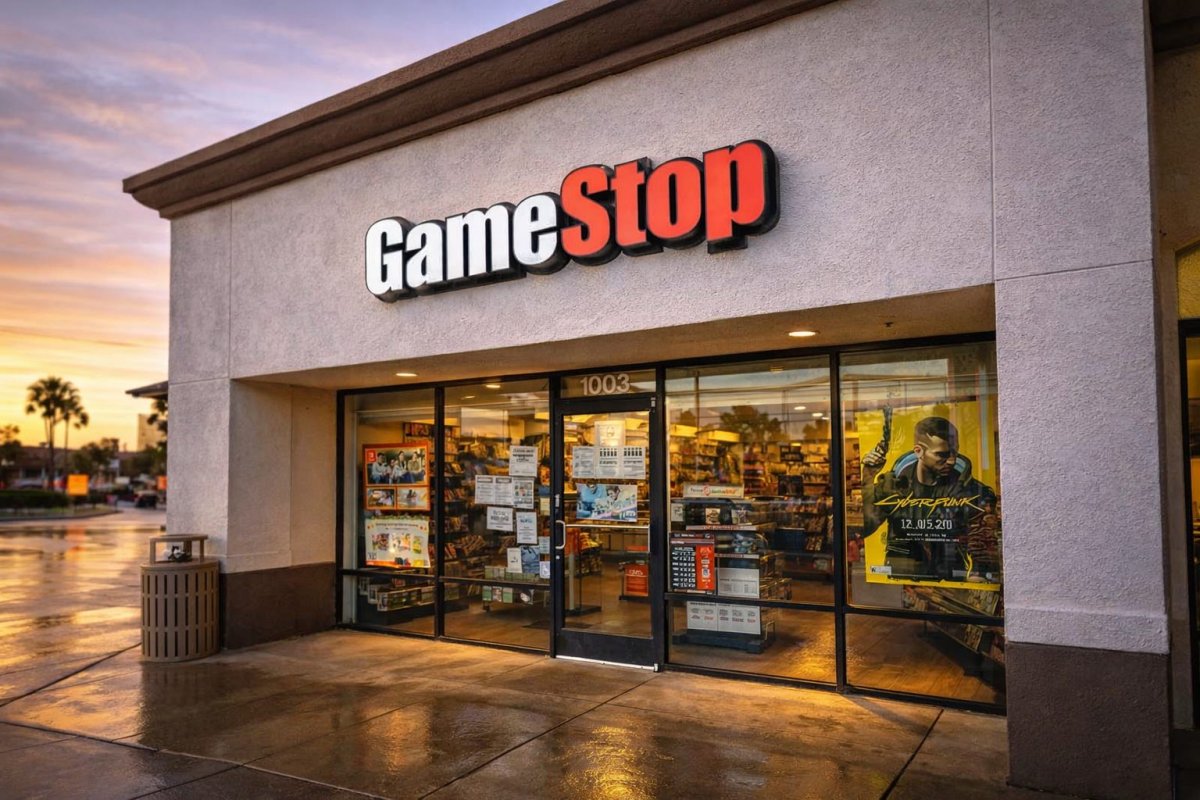
GameStop Corp. disclosed its fourth-quarter financial results for the period ending January 31, 2026, revealing a continued contraction in its core retail business while simultaneously amassing a massive war chest of cash. The video game retailer's latest earnings report highlights a company in transition, with its traditional sales channels under pressure and its balance sheet strengthened by recent financing activities.
Financial Performance Details
For the critical holiday quarter, GameStop's net sales declined to $1.104 billion, representing a 14% decrease from the $1.283 billion reported in the same period last year. Net income experienced a modest reduction to $127.9 million, compared to $131.3 million in the prior-year quarter. Despite the top-line contraction, operating income showed improvement, climbing to $135.2 million from $79.8 million, as the company successfully reduced its overhead expenses to $241.5 million from $282.5 million.
The company's full-year results presented a mixed picture. Annual net sales decreased to $3.63 billion from $3.82 billion in the previous fiscal year. However, net income for the year demonstrated significant growth, jumping to $418.4 million compared with $131.3 million a year ago. This profitability improvement occurred alongside the dramatic expansion of the company's liquid assets.
The Billion Cash Position
The most striking figure in GameStop's filing was its cash, cash equivalents, and marketable securities balance, which swelled to $9.0 billion. This represents a substantial increase from the $4.8 billion reported a year earlier and brings the company's cash reserves nearly in line with its current market capitalization of approximately $10 billion. The accumulation was primarily driven by financing activities, including $4.2 billion raised through convertible notes in fiscal 2025 and $3.45 billion generated from at-the-market share sales in fiscal 2024.
This extraordinary cash position has fundamentally altered how investors perceive the company. Many market participants have shifted their focus away from GameStop's struggling retail operations and now view the stock primarily as a capital allocation story. The substantial liquidity provides CEO Ryan Cohen with significant flexibility to pursue strategic initiatives, with market speculation centered on potential transformative acquisitions.
Changing Business Mix
GameStop's revenue composition continued to evolve during the quarter. Collectibles emerged as an increasingly important segment, generating $365.0 million in revenue and accounting for 33.1% of total sales. This represents notable growth from the $270.6 million (21.1% of sales) reported in the same quarter last year. Meanwhile, the company's traditional hardware and accessories revenue declined to $535.6 million from $725.8 million, and software sales decreased to $203.7 million from $286.2 million.
The collectibles expansion reflects GameStop's strategic pivot toward higher-margin categories as the physical video game market faces structural challenges. Industry giants Microsoft and Sony continue to steer consumers toward subscription services and cloud gaming, diminishing the relevance of physical discs. Additionally, e-commerce platforms like Amazon maintain dominance in online game sales, creating persistent headwinds for GameStop's legacy business model.
International Restructuring
GameStop is actively streamlining its international operations. The company disclosed a new agreement connected to the potential sale of its French business and confirmed ongoing efforts to divest both its French and Canadian operations. Furthermore, GameStop is winding down its presence in New Zealand. These moves signal a strategic retreat from certain international markets as management concentrates resources on core priorities and maintains liquidity for other opportunities.
The company's cryptocurrency exposure diminished during the quarter, with Bitcoin and related receivables declining to $368.4 million from $519.4 million at the end of the previous quarter. This reduction contributed to the overall shift in asset composition toward more traditional liquid instruments.
Market Context and Investor Sentiment
GameStop's unusual financial position—a retailer with cash reserves approaching its market value—has generated considerable discussion among investors and analysts. Notably, investor Michael Burry, who gained fame during the 2008 financial crisis, commented in January that he wasn't anticipating another short squeeze in GameStop shares. Instead, he identified the potential for "transformative acquisition or acquisitions" as the primary investment thesis. Some market observers have expressed skepticism about the collectibles strategy, with Burry previously characterizing it as a "minor incremental driver" at best.
Ahead of the earnings release, options market activity showed a tilt toward bullish positions, suggesting some traders anticipated positive developments. The company's decision not to hold a conference call with investors left shareholders without fresh insights into Cohen's specific plans for deploying the substantial cash reserves or his thoughts on potential acquisition targets.
The broader context remains challenging for GameStop's traditional business. The transition toward digital distribution and subscription models in gaming continues unabated, creating fundamental pressure on physical retail. Against this backdrop, the company's enormous cash position represents both a strategic opportunity and a test of leadership's ability to redeploy capital effectively to generate shareholder value beyond the company's contracting core operations.