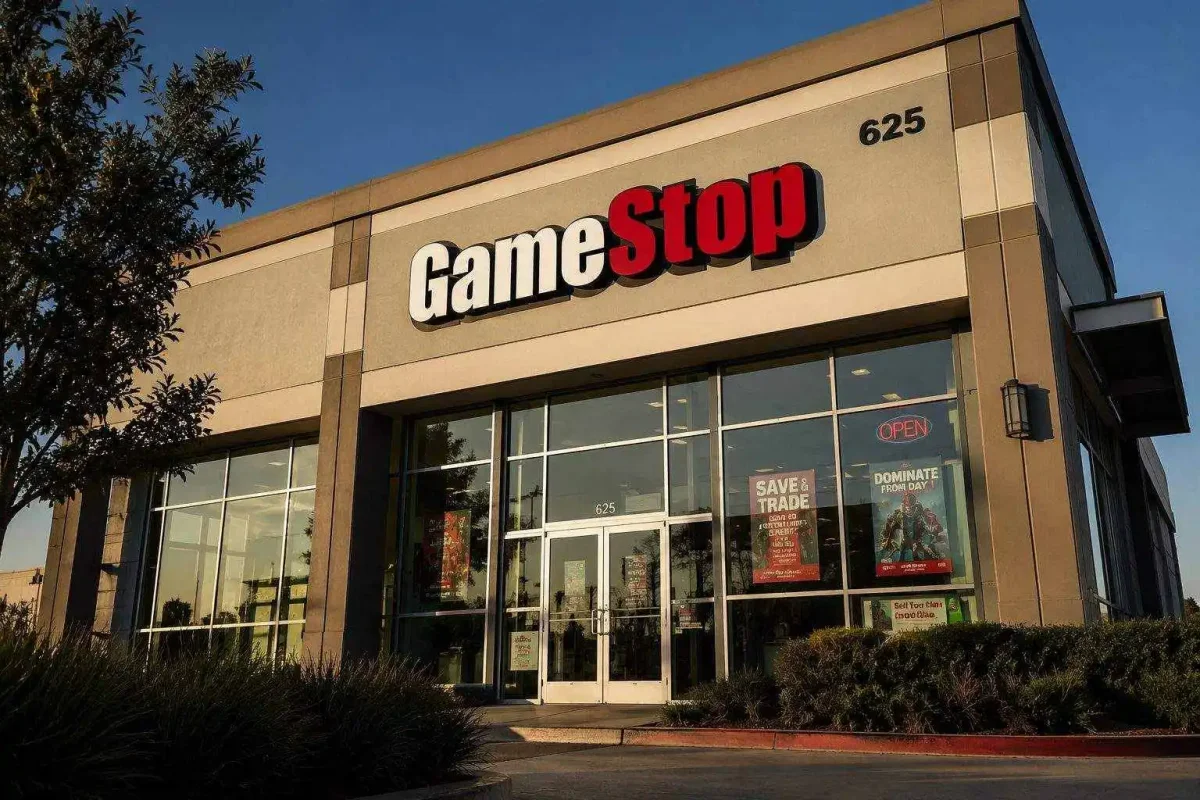
GameStop Corp. (NYSE: GME) shares remained stable in premarket trading Tuesday following the company's execution of a $1.4 billion debt-for-equity exchange. The stock, which closed Monday at $19.06, was last seen at $19.07, reflecting a modest 0.05% uptick ahead of the regular session. The move comes as investors shift their focus to the potential dilution impact on existing shareholders.
The transaction, announced Monday, involves the retirement of $1.4 billion in convertible note principal—representing 33.3% of the company's total $4.2 billion in outstanding notes—without requiring any cash outlay. The exchange covers two series: $400 million of 2030 notes and $1 billion of 2032 notes, both carrying a 0.00% coupon. By eliminating these obligations, GameStop reduces its debt burden while preserving its cash reserves, a strategic move to strengthen its balance sheet.
Dilution Calculations
Initial principal-equivalent calculations suggest that approximately 73.5 million new shares could be issued based on Monday's closing price of $19.06. This figure represents 16.4% of the current basic share count of 448.69 million. In a simplified scenario, existing shareholders would see their ownership diluted by roughly 14.1% post-issue. However, the actual number of shares issued will depend on the average stock price over a 35-trading-day reference period starting August 3, with a minimum price floor in place.
The company cautioned that noteholders participating in the exchange may engage in hedging activities, including buying or selling shares or derivatives, which could significantly influence GameStop's market value in either direction. This adds an element of uncertainty to the final share count and near-term price action.
Balance Sheet Impact
While dilution is a concern, the deal offers tangible balance sheet benefits. As of May 2, GameStop reported $7.40 billion in cash and $970.5 million in marketable securities, totaling $8.37 billion. Following the exchange, the ratio of cash and securities to remaining note principal would improve to approximately 2.99 times, up from 1.99 times prior to the transaction. This enhanced coverage underscores the company's strong liquidity position.
GameStop's $2 billion share repurchase authorization provides a potential counterbalance to dilution. At the current price, the buyback could retire up to 104.9 million shares, equivalent to 1.43 times the net exchange issuance. However, the authorization is discretionary and does not guarantee repurchases, leaving it as optionality rather than a committed hedge.
Operational Performance
Beyond the capital structure changes, GameStop's underlying business showed improvement. First-quarter sales rose 14% to $835.3 million, while gross margin expanded to 40.7% from 34.5% a year earlier. The company posted operating income of $143.3 million, a significant turnaround from a $10.8 million operating loss in the prior-year period. Notably, a large portion of net income—$268.4 million out of $389.6 million—came from unrealized derivative gains and $83.7 million from net interest income, highlighting the importance of its investment portfolio.
Market Reaction
On Monday, GameStop shares experienced a 12.25% decline, a sharp contrast to the broader retail sector, as the SPDR S&P Retail ETF (XRT) gained 1.87%. Trading volume surged to 41.71 million shares, over six times the 65-day average, indicating heightened investor activity and uncertainty around the exchange's terms.
As the reference price period unfolds, market participants will closely monitor the final share issuance and its impact on shareholder value. The company expects the deal to close around September 23. Investors are now weighing the benefits of a stronger balance sheet against the inevitable dilution, a classic trade-off in corporate restructuring.