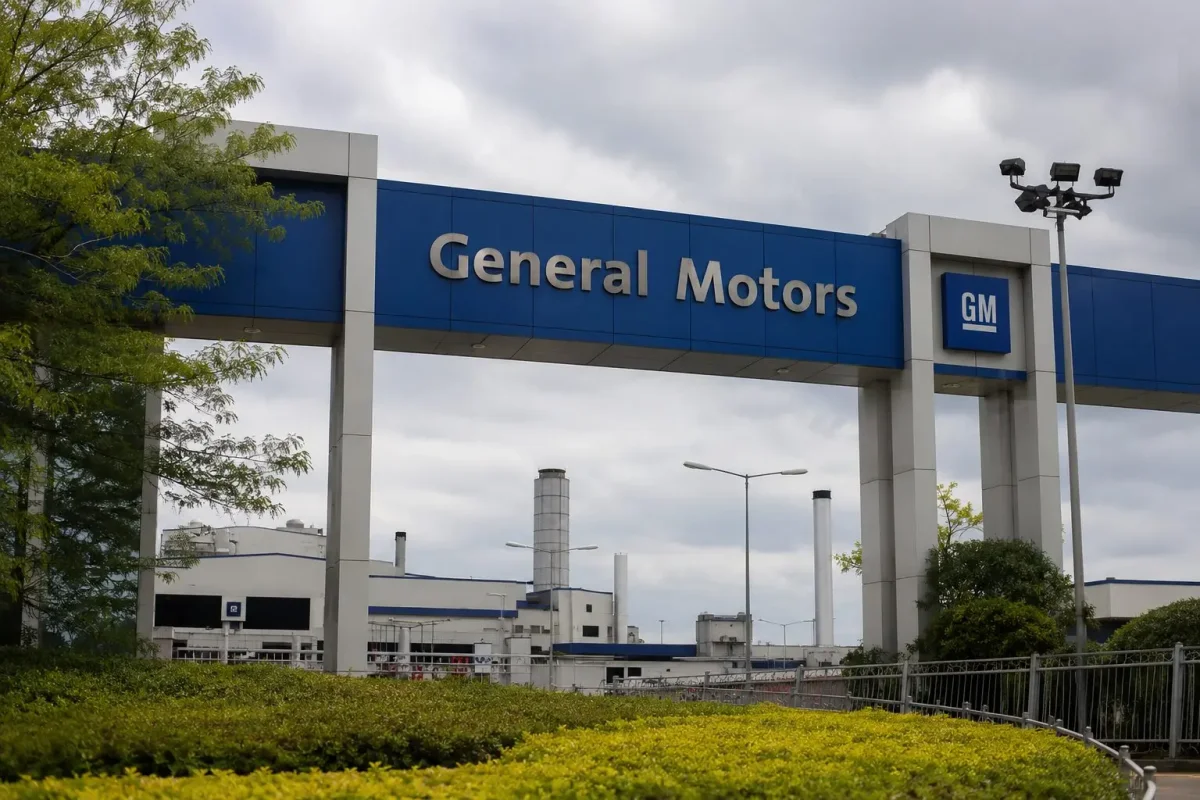
General Motors (NYSE: GM) closed Friday at $88.86, posting a weekly gain of 7.5%, as investors responded positively to robust sales data and the company's improved earnings outlook. The stock remains 3.3% below its 52-week high reached on Wednesday, reflecting a modest pullback after a strong run.
Despite the recent surge, GM's valuation multiple still lags behind its crosstown rival Ford (NYSE: F). GM's market capitalization of $80.9 billion represents 5.4 times its 2026 adjusted EBIT midpoint guidance of $15.0 billion. Ford, with a market cap of $58.5 billion and an adjusted EBIT midpoint of $10.5 billion, trades at 5.6 times. This proxy multiple, which excludes debt, cash, and captive finance balances, shows GM at a roughly 3.3% discount to Ford.
The valuation gap is particularly notable given GM's superior operating performance. In the second quarter, GM generated adjusted operating profit of $3.94 billion on revenue of $48.03 billion, yielding an 8.2% margin. Ford, with nearly identical revenue of $48.3 billion, posted adjusted operating profit of just $2.5 billion, a 5.2% margin. That translates to a $1.4 billion profit advantage for GM.
Stellantis (NYSE: STLA) continues to lag significantly, with a second-quarter adjusted operating margin of only 1.8%, down from prior periods. The company's adjusted operating income of €773 million missed the €914 million analyst consensus, and its shares fell 4.3% on Thursday, underscoring ongoing execution challenges.
GM's outperformance is also reflected in its raised full-year guidance. Management has twice increased its adjusted EBIT outlook, with the midpoint now at $15.0 billion, up from $14.0 billion in January. Adjusted automotive free cash flow guidance was also lifted to a midpoint of $10.5 billion, after second-quarter free cash flow surged 78% to $5.03 billion. Adjusted EPS guidance rose to a midpoint of $13.00.
Demand remains resilient, according to CFO Paul Jacobson, with average U.S. transaction prices around $52,000. J.D. Power estimates the July annualized sales rate at 16.9 million vehicles, the fastest pace of 2026, though affordability is deteriorating. Average monthly payments are projected to hit a record $808, and incentives have risen 8.1% year-over-year. Cox Automotive economist Charlie Chesbrough noted that more affluent buyers are driving the market, a trend that could pose risks if the job market softens.
GM faces headwinds, including projected tariff expenses of $2.5 billion to $3.5 billion and potential additional costs of $1.5 billion to $2.0 billion from materials, chips, and logistics. A softer job market could also pressure the $52,000 price point, making it harder to sustain margins.
Looking ahead, investors will focus on GM's ability to convert its earnings into cash. Achieving the increased free cash flow midpoint would reinforce the valuation argument, while a shortfall could undermine it. The next catalyst is GM's investor event on August 12, with U.S. job openings data due Tuesday and payrolls on Friday providing broader economic context.