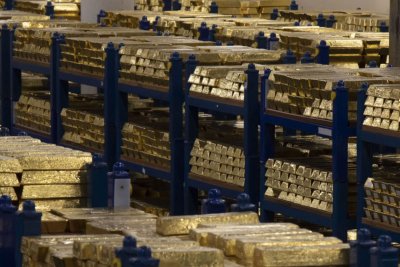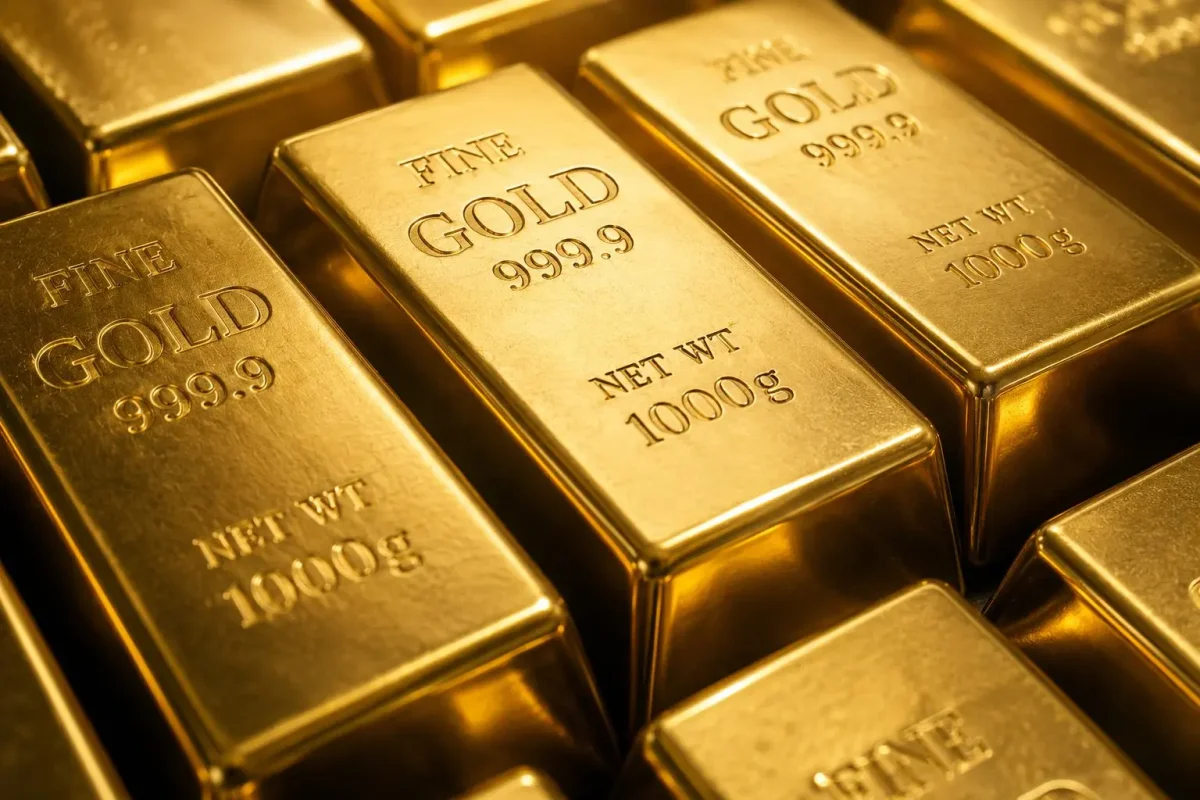
Gold prices tumbled to their lowest level in over seven months on Wednesday, briefly dipping below the psychologically significant $4,000 per ounce mark as a resurgent U.S. dollar and renewed expectations of Federal Reserve interest rate hikes triggered a wave of selling across the precious metals complex. Spot gold fell 2.1% to $4,021.99 an ounce by 1405 GMT, while U.S. gold futures settled 2.6% lower at $4,039.30.
Fed Policy and Dollar Strength Drive Selloff
The decline accelerated after the Federal Reserve left interest rates unchanged at 3.5%-3.75% last week but signaled that inflation remains stubbornly above its 2% target, partly due to elevated energy prices. Markets interpreted the statement as hawkish, increasing the probability of additional rate hikes later this year. A higher-for-longer rate environment tends to weigh on gold, which does not yield interest, while a stronger dollar makes bullion more expensive for holders of other currencies.
Independent metals trader Tai Wong noted that precious metals are under "heavy pressure" from the combination of a hawkish Fed and a firmer dollar. However, he pointed to ongoing central bank purchases as a stabilizing factor, suggesting that "a collapse is unlikely" even as gold may face an extended period of range-bound trading.
Technical Levels and Market Sentiment
The $4,000 level had been closely watched by traders. InvestingLive highlighted that gold's 38.2% Fibonacci retracement was being tested again at $4,079.35, with a swing area ranging from $4,006.99 to $4,098.74. Breaking below $4,000 would significantly damage the chart setup, according to the firm. Kitco reported that CPM Group's Jeffrey Christian sees a potential move toward $3,800 if support at $4,100 fails, while any sharp drop in gold or silver may not be sustained.
SchiffGold warned that gold and silver have not yet found a firm bottom. Open interest for both metals has dropped to multi-year lows, indicating that speculative traders have largely exited the market. The firm sees risk of gold declining toward $3,700 and silver slipping toward $50 if the $4,000 and $60 levels fail to hold.
ETF Demand Remains a Key Weakness
Bullion-backed exchange-traded funds (ETFs) have been a major source of concern. Data from the World Gold Council, cited by Reuters, showed gold ETFs lost 16 metric tons in May and continued to shed metal through the first half of June, though last week saw the largest weekly inflows since mid-April. Carsten Menke of Julius Baer noted that ETF flows are closely tied to U.S. monetary policy, while Adrian Ash of BullionVault said investors are currently looking elsewhere for returns.
Morgan Stanley analysts Amy Gower and Martijn Rats emphasized that gold requires much stronger ETF inflows to reach $5,200 in the second half of 2026. "The missing piece is ETF demand," they wrote. Similarly, Bank of America's metals team, led by Michael Widmer, has abandoned its near-term bullish outlook, stating that "hitting our $6,000/oz target looks unlikely for now." The bank still maintains a long-term bullish view based on U.S. fiscal deficits and declining dollar reserves.
Broader Precious Metals Selloff
The weakness extended across the precious metals complex. Silver dropped 4.8% to $59.08 an ounce, its lowest since December 2025. Platinum fell 4.1%, and palladium slid 4.8%. The broad-based selloff underscores the impact of a stronger dollar and rising rate expectations on the entire sector.
Outlook Depends on Inflation Data
A significant part of the bearish scenario hinges on upcoming U.S. inflation data. If the Personal Consumption Expenditures (PCE) index, due on June 25, comes in softer than expected, it could cool bets on further Fed rate hikes and provide support for gold. Conversely, a stronger reading would likely bolster the dollar and push gold toward recent lows. The April core PCE index stood at 3.3% year-over-year.