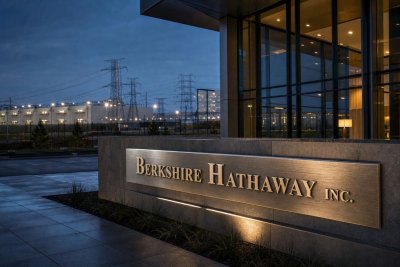
In a historic shift, Greg Abel took the helm at Berkshire Hathaway's annual shareholder meeting on Saturday, marking his first appearance as chief executive while Warren Buffett, now chairman, observed from the audience. The transition comes as the conglomerate disclosed a first-quarter operating profit of $11.35 billion, up from $9.64 billion a year earlier, and a cash reserve that has swelled to a record $397 billion.
Financial Highlights
Berkshire's net earnings attributable to shareholders more than doubled to $10.11 billion, though the company reiterated that such figures can be misleading due to investment fluctuations. The balance sheet reveals $51.48 billion in cash and equivalents across insurance and other units, $339.26 billion in short-term U.S. Treasury bills, and $6.64 billion in cash at its railroad, utilities, and energy divisions. The company sold $24.09 billion in equities during the quarter while purchasing $15.94 billion, and resumed share buybacks with $235 million spent—the first such activity since May 2024. Berkshire also completed its $9.5 billion acquisition of Occidental Petroleum's OxyChem unit in January.
Operational Performance
Several key businesses delivered mixed results. BNSF Railway saw after-tax earnings rise 13.4%, driven by higher revenue and improved efficiency. Berkshire Hathaway Energy posted a modest 1.5% gain in earnings. Insurance underwriting profits climbed to $1.72 billion, benefiting from a quiet period for major catastrophe losses. However, Geico's pre-tax underwriting profit fell to $1.42 billion from $2.17 billion, pressured by higher claim frequency, severity, and acquisition costs. The auto insurer continues to battle for market share against competitors like Progressive.
Retail operations faced headwinds. Clayton Homes reported lower home sales, while consumer product sales declined at Fruit of the Loom, Garan, Jazwares, and Forest River, reflecting softer demand amid a challenging economic outlook. Berkshire flagged that several retail units were hit by tougher competition and shifting consumer confidence.
Shareholder Meeting and Transition
Attendance at this year's meeting was notably sparse, with just over half the arena's seats filled, compared to the 40,000-plus crowds that once gathered for Buffett and the late Charlie Munger. The event opened with a video tribute to Buffett, and Abel announced that the company would retire jerseys for both Buffett and Munger, with their names hanging from the arena rafters.
Investors are closely watching Abel's strategy for deploying Berkshire's massive cash pile. The company's stock has trailed the S&P 500 by 39 percentage points since Buffett named Abel as his successor. Analysts and shareholders are eager to see whether buybacks will increase or if Abel will pursue major acquisitions. The meeting also included votes on executive compensation and an employee oversight proposal.
Despite the changing of the guard, Berkshire's leadership emphasizes continuity. Brooks Running CEO Dan Sheridan noted that Abel's approach will closely follow Buffett's six decades of values. Dairy Queen chief Troy Bader added that Buffett's continued role as chairman ensures a smooth transition. As the market fixates on tech and AI, Berkshire's diversified portfolio of insurance, rail, energy, and retail businesses faces the challenge of staying relevant in a rapidly evolving landscape.