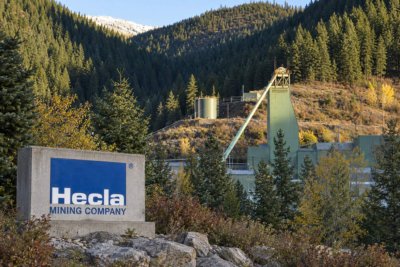
Hecla Mining Company (NYSE: HL) saw its shares retreat 4.1% to $15.86 on Thursday, a pullback after a strong post-earnings rally. Despite the daily decline, the stock remains up 12.3% since July 31, reflecting investor optimism about the company's ability to maintain cash generation in a softer revenue environment.
The company's second-quarter results, released Wednesday, showed revenue of $333.9 million, down 18.9% from the prior quarter but up 52.4% year-over-year. Adjusted EBITDA came in at $199.2 million, down 24.9% sequentially but more than double the year-ago figure. Free cash flow totaled $135.8 million, only 5.5% lower than Q1 and up 106.6% from Q2 2025. The free-cash-flow margin improved to 40.7% from 34.9% in Q1.
Key to the cash flow performance was a $63 million reduction in receivables, which accounted for 46.4% of stated free cash flow, according to initial estimates. The improvement was driven by shipment schedules, payment collections, and decreased concentrate values. However, analysts are questioning whether this benefit can be sustained in the second half.
Capital expenditures are expected to rise significantly in the back half of the year. In the first half, Hecla spent $78.4 million. With annual guidance set at $208 million-$223 million, the implied second-half spend is $129.6 million-$144.6 million, representing a projected increase of 65%-84% over first-half levels.
With a market capitalization of $10.72 billion, annualized free cash flow from Q2 implies a straightforward yield of 5.1%. This figure does not factor in any receivables reversal or increased investment anticipated in the second half.
Hecla's balance sheet has strengthened considerably. The company ended the quarter with $483 million in cash and no debt, apart from finance leases. An additional $225 million revolving credit line was available and unused. CEO Rob Krcmarov noted, "We ended the quarter with the strongest balance sheet in the Company's history."
Operationally, results were mixed. Lucky Friday achieved a quarterly record with 1.533 million ounces of silver, driven by a 31% grade increase, though management cautioned that this higher grade would not continue. Keno Hill produced 0.625 million ounces but has yet to reach commercial production status. Greens Creek saw lower output but shipped stockpiled concentrate in early August.
For 2026, Hecla raised its guidance midpoint for Greens Creek by 4.5% to 8.0-8.3 million ounces and for Lucky Friday by 2.0% to 4.9-5.2 million ounces. Keno Hill's midpoint was cut by 21.3% to 2.2-2.6 million ounces. The consolidated midpoint declined only 1.3% to 15.1-16.1 million ounces, as improvements at the established mines offset the slower ramp at Keno Hill.
In sector trading, Hecla lagged the Global X Silver Miners ETF (NYSEARCA: SIL) but outperformed Coeur Mining (NYSE: CDE), which fell 10.2%. Pan American Silver (NYSE: PAAS) slipped 0.3%, and First Majestic Silver (NYSE: AG) slid 1.9%.
Analyst price targets vary widely. Scotiabank lowered its target to $21 from $25, while H.C. Wainwright reduced its target to $26.75 from $36.50. Canaccord Genuity upgraded the stock to Buy with a $24 target, and CIBC raised its target to $32. BMO Capital Markets increased its target to $28. Consensus ratings from Barron's show six buys and five holds with an average target of $23.53.
Looking ahead, key macroeconomic data will influence the silver price: U.S. July employment figures are due Friday, followed by July CPI on August 12 and PPI on August 13. Risks include declines in silver or gold prices, delays in Keno Hill's ramp-up, shipment scheduling, and the potential unwinding of the receivables benefit.