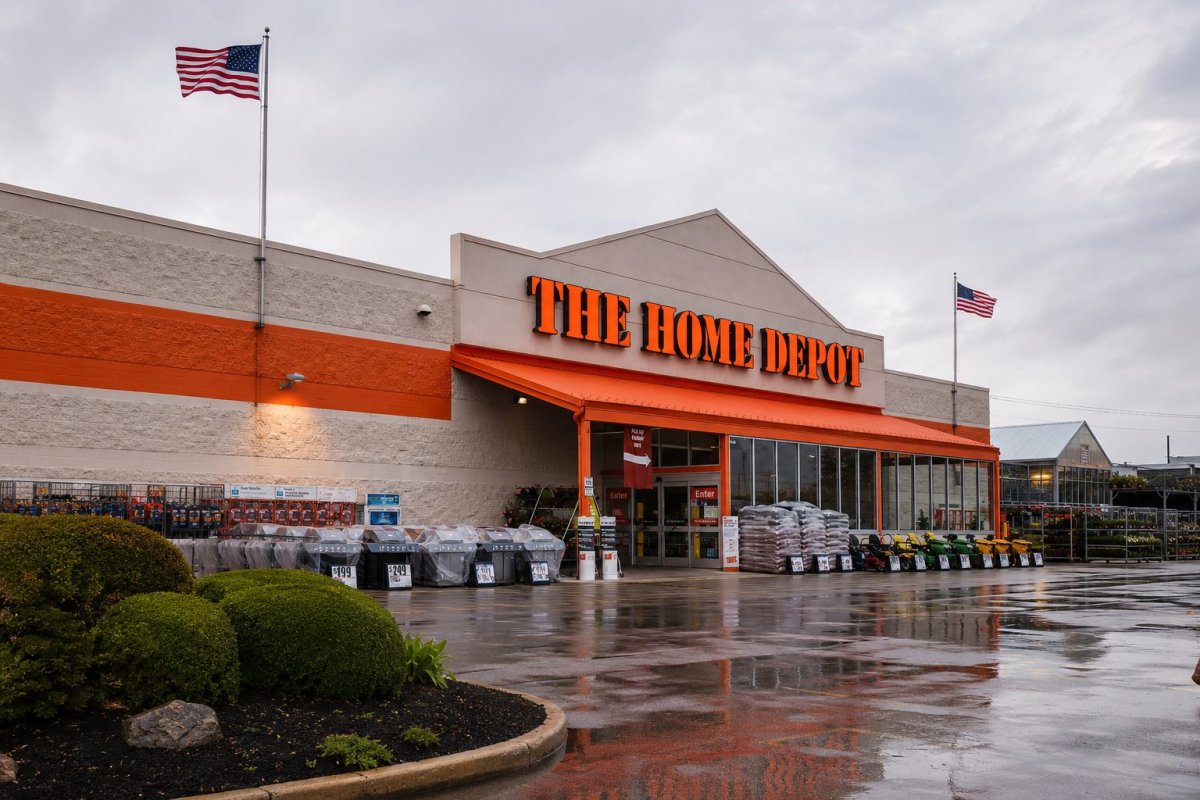
Home Depot (NYSE: HD) delivered stronger-than-expected second-quarter results, yet the market response was muted, with shares closing the week 0.96% lower. The stock ended Friday at $335.61, trimming the company's market capitalization to roughly $336.0 billion—about $1.5 billion below the prior week's close.
The tepid reaction underscores the quality of the beat. While customers increased their average spending per trip, the number of transactions continued to decline, signaling that demand remains defensive. A $730 million tariff refund also provided a significant cushion to product costs, complicating the underlying growth picture.
Quarterly Performance: Sales and Earnings Top Estimates
For the fiscal second quarter, Home Depot reported net sales of $47.86 billion, up 5.7% from $45.28 billion a year earlier and above the analyst consensus of approximately $47.27 billion. Adjusted earnings per share came in at $4.92, surpassing the $4.73 expected by Wall Street. On a GAAP basis, diluted EPS rose 4.6% to $4.79, while net earnings increased 3.7% to $4.77 billion.
Comparable sales grew 1.7%, the fastest pace since late 2022, with U.S. comparable sales up 1.3%. Online sales jumped 11%, marking the fifth consecutive quarter of double-digit e-commerce growth. However, the demand mix remained tilted toward smaller projects. Customer transactions fell 1% year-over-year, while the average ticket rose 2.8% to $92.50. Small-ticket repairs and maintenance projects grew 1.5%, but large projects—often tied to remodeling and housing turnover—declined 2.1%.
The Tariff Refund Effect
The $730 million tariff refund, of which $685 million reduced cost of goods sold, provided a notable tailwind. This benefit exceeded the roughly $189 million aggregate adjusted-EPS surprise, suggesting that without the refund, the earnings beat would have been far narrower. Management acknowledged the refund but maintained its full-year guidance, signaling that it views the benefit as non-recurring.
Guidance and Analyst Sentiment
Home Depot reaffirmed its fiscal 2026 outlook, projecting total sales growth of 2.5% to 4.5%, comparable sales ranging from flat to 2% growth, and adjusted EPS growth of 0% to 4%. The company also guided to a gross margin of about 33.1% and an adjusted operating margin between 12.8% and 13.0%.
Analysts remain largely positive, though target prices vary widely. Guggenheim holds a Buy rating with a $425 target, implying 26.6% upside, while UBS has a Buy with a $420 target. Evercore ISI rates the stock Outperform with a $400 target, and Goldman Sachs maintains a Buy with a $377 target. Truist also rates it Buy with a $373 target. On the more cautious side, RBC Capital has a Sector Perform rating with a $342 target. The divergence reflects uncertainty about the pace of housing recovery and its impact on big-ticket demand.
Lowe's Warning Highlights Sector Fragility
Rival Lowe's (NYSE: LOW) provided a stark contrast, cutting its annual sales and profit forecasts after comparable sales rose only 0.2%. The weaker DIY business at Lowe's supports Home Depot's Pro-led strategy, but it also confirms that the overall home improvement market remains fragile, particularly for discretionary projects.
Rates and Housing: The Next Test
Investors now turn to macroeconomic signals. The July PCE inflation report is due Wednesday at 8:30 a.m. EDT, followed by the Federal Reserve's Jackson Hole symposium from August 27-29, where Fed Chair Kevin Warsh is scheduled to speak on Friday. A clearer path toward lower interest rates would likely support housing turnover and larger renovation projects, which have been constrained by elevated mortgage rates.
Risks remain: mortgage rates could stay high, tariff refunds will not recur indefinitely, and CEO Ted Decker's temporary medical leave introduces leadership uncertainty. Additionally, the integration of SRS Distribution and softer Pro demand could pressure margins in the back half of the year.
Despite the mixed signals, Home Depot's ability to beat estimates and maintain guidance offers some reassurance. The stock's modest decline suggests investors are waiting for more concrete evidence of a housing rebound before bidding shares higher.