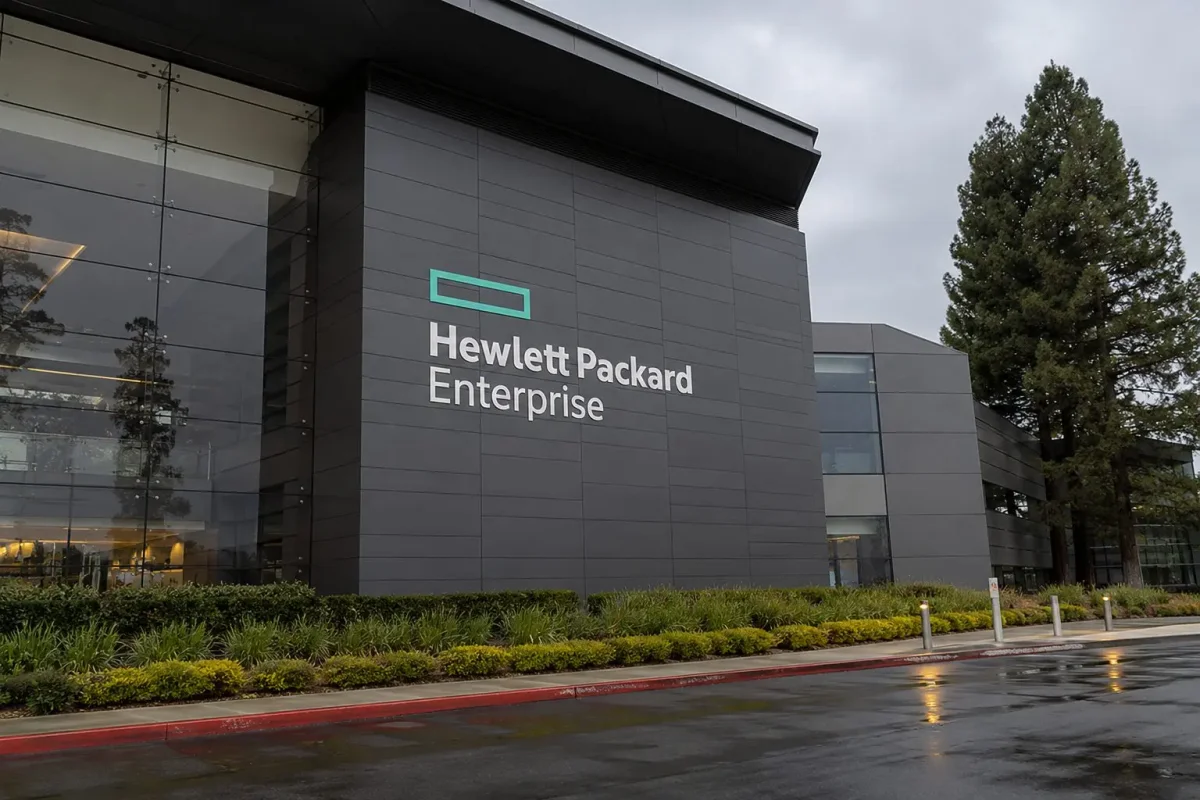
Hewlett Packard Enterprise (HPE) is set to report its fiscal second-quarter results after the market closes on June 1, with an analyst conference call scheduled for 4 p.m. CT (5 p.m. ET). The report covers the period ending April 30, and Wall Street expectations are centered on revenue of approximately $9.77 billion and adjusted earnings per share in the low-to-mid 50-cent range, specifically 53 cents according to consensus among 18 analysts.
The stock has already experienced a significant rally, closing recently at $38.21, up $1.01 from the prior session, and posting a 117.5% gain over the past year. This performance places valuation under scrutiny ahead of the earnings release. Investors are keen to see whether the company's strategic pivot toward networking and AI infrastructure can sustain growth without eroding profit margins.
HPE's own guidance from March projected fiscal Q2 revenue between $9.6 billion and $10.0 billion, with adjusted earnings in the range of 51 to 55 cents per share. The company also raised its full-year fiscal 2026 adjusted earnings forecast to $2.30–$2.50 per share and increased its networking revenue growth target to 68%–73%. These targets reflect management's confidence in the integration of Juniper Networks, which closed earlier this year.
The prior quarter set a strong precedent: fiscal Q1 revenue reached $9.3 billion, up 18% year-over-year, driven by a 151.5% surge in networking revenue following the Juniper acquisition. CEO Antonio Neri cited double-digit order growth across all segments, while CFO Marie Myers highlighted faster-than-anticipated synergies from the Juniper and Catalyst deals. This momentum has raised the bar for the upcoming report.
Key areas of focus for the market include the sustainability of networking revenue growth, the conversion of AI-related orders, and management of input cost pressures. Zacks Research flagged DRAM and NAND memory cost inflation—critical components in servers and storage—as well as geopolitical risks and uneven AI systems revenue as potential headwinds. The company's "Networks for AI" orders are expected to reach $1.7–$1.9 billion by fiscal year-end 2026.
Profitability will be a critical metric. Consensus revenue of $9.77 billion would represent a 28% increase from the year-ago quarter, when HPE generated $545 million in adjusted net income on $7.63 billion in revenue, a 7.1% margin. This provides a clear baseline for assessing whether the growth is translating into improved bottom-line performance.
Recent operational developments include an expanded partnership with Rowan University covering networking, compute, storage, and high-performance computing. Patrick Osborne, HPE's senior vice president of technology acceleration for hybrid cloud, stated the deployment would help the university accelerate its research outcomes.
Competitive dynamics remain intense, with HPE facing rivals Dell Technologies and Super Micro Computer in the AI server market. Reuters reported in March that HPE is prioritizing higher-margin networking products while navigating supply chain challenges and volatility in AI systems revenue. The company's ability to balance growth with margin protection will be a key theme on the earnings call.
Given the stock's sharp run-up, an in-line quarter may not suffice. Investors will scrutinize guidance and margin commentary for signs that networking growth is durable, AI orders are converting, and cost pressures are under control. A miss on any of these fronts could make the recent valuation harder to justify.