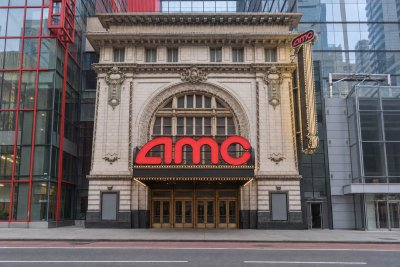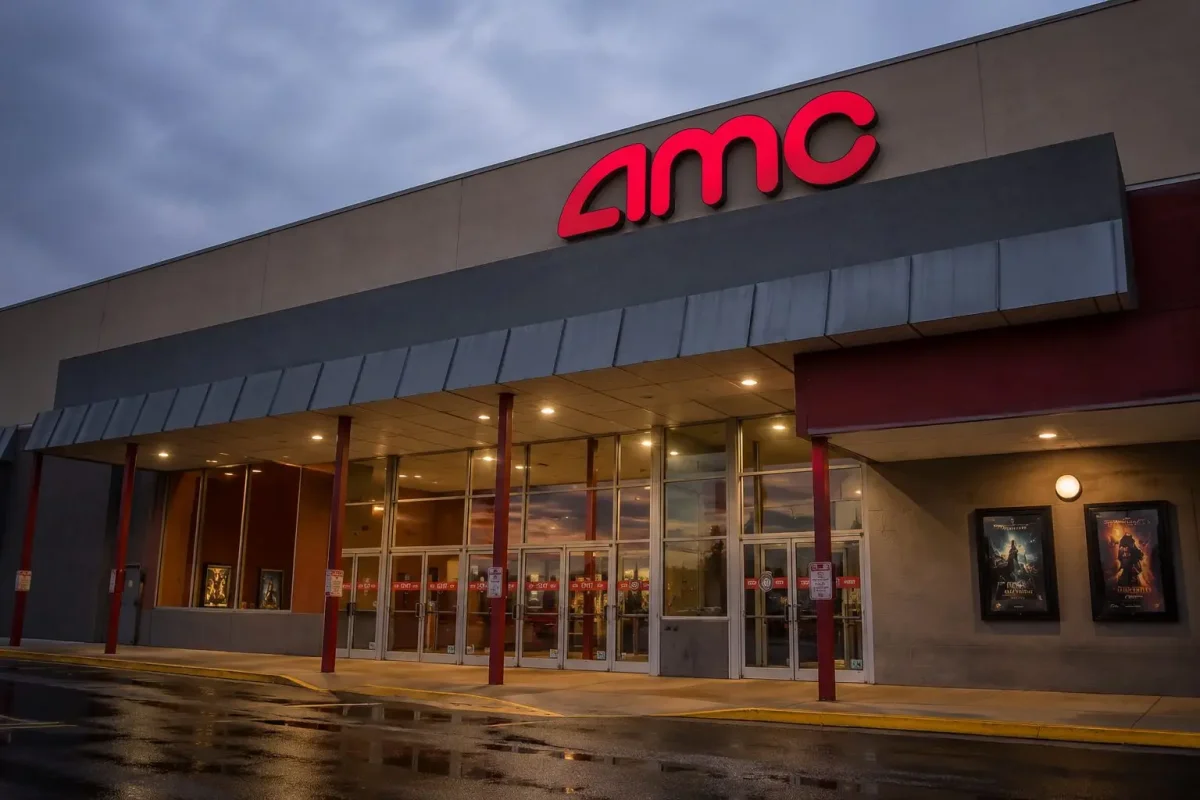
AMC Entertainment Holdings (NYSE:AMC) closed Monday at $1.87, roughly 11% below the $2.10 per share institutional investors paid in its June offering. The transaction's $11 million placement fee alone surpasses the $7.7 million in annual cash interest the company expects to save by retiring debt, underscoring the steep price of financial maneuvering. Market commentator Jim Cramer recently warned that the turnaround has a 'limited shelf life because the balance sheet was heinous.'
Uneven Recovery
The broader cinema recovery is lifting revenue but remains uneven, leaving little margin for error at a company saddled with heavy fixed financing costs. North American box office stands at just under $5.2 billion for 2026, up about 10.7% year-over-year. However, July has slowed after May and June each topped $1 billion. Recent releases like the live-action Moana opened with $43 million, while Minions & Monsters and Toy Story 5 took $20.5 million and $18.5 million respectively. Paul Dergarabedian, head of marketplace trends at Rentrak, noted: 'Families love going to the movies, but right now there are three of them.'
Strong Slate, Persistent Losses
AMC has demonstrated what a strong slate can achieve. Toy Story 5, released by Walt Disney (NYSE:DIS), drew more than 4.8 million patrons to AMC's U.S. and Odeon international theaters over its opening weekend. AMC called it its busiest U.S. weekend of 2026, with year-to-date highs for attendance, admissions revenue, and food-and-beverage revenue. CEO Adam Aron described simultaneous strength across genres as 'such an encouraging sign for the theatrical business.' Yet Simply Wall St's analysis continues to highlight ongoing losses, reliance on new capital, and dilution as central to the investment case.
Dilution and Cash Waterfall
The share sale's mechanics reveal the trade-offs. AMC issued 95.25 million shares, raising the pro-forma count to 892.60 million from 797.35 million—a 10.7% dilution for existing holders. Most proceeds redeemed $125.5 million of 6.125% senior subordinated notes due 2027, bonds that rank below senior debt. The company said it does not expect material principal maturities before 2029. The key figures are: gross proceeds of $200 million, a placement fee of about $11 million (5.5%), net proceeds before other expenses of $189 million, notes redeemed of $125.5 million, a maximum residual of about $63.6 million, and annual cash-interest reduction of about $7.7 million.
Maturity Relief, Not Economic Fix
Maturity relief, rather than the interest reduction, is the deal's main economic benefit. The placement fee equals about 17 months of the stated interest saving, and the annual saving works out to just 0.86 cent per post-offering share. It is also only 5.5% of the $139.9 million in interest expense AMC recorded in the first quarter, a reminder that retiring one bond issue does not reset the broader cost structure.
Competitive Gap with Cinemark
The competitive gap is clearer against Cinemark Holdings (NYSE:CNK). In the same quarter, AMC generated 63% more revenue but less than half Cinemark's adjusted EBITDA. Interest coverage—adjusted EBITDA divided by interest expense—was 0.27x for AMC versus 2.55x for Cinemark. AMC had roughly $1 of adjusted EBITDA for every $3.65 of interest, while Cinemark had $2.55 for each $1 of interest. AMC's interest expense was four times its peer's despite larger revenue, and its operating cash outflow was more than six times as large.
Outlook and Risks
Box-office growth must translate into margin and cash materially faster than in the first quarter. A stronger late-summer slate and better per-patron spending could lift cash generation, given cinema operators' substantial fixed costs. However, weaker releases, studio schedule changes, or another funding need could overwhelm that operating leverage. AMC has warned that insufficient liquidity could lead to an in-court or out-of-court restructuring, and that common shareholders would likely lose their investment in a liquidation or bankruptcy.
Bridge to 2029
The offering changes AMC's calendar more than its economics. For equity investors, the next proof point is whether second-half adjusted EBITDA and operating cash flow rise enough to cover interest without another share sale. Until then, the $200 million raise is a bridge to 2029—not evidence that the balance sheet has been repaired.