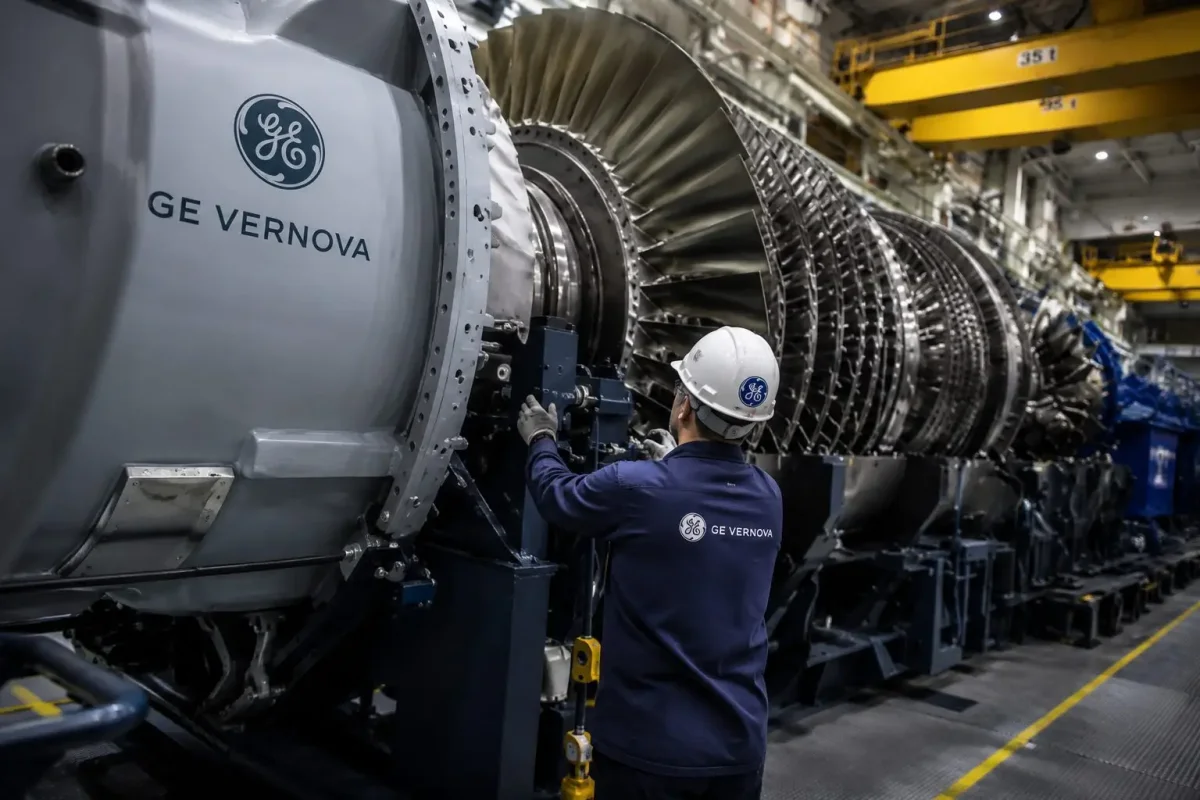
GE Vernova (NYSE:GEV) saw its shares decline 4.49% to $1,042.60 on Monday, closing below the 20-day moving average after a brief breakout above that level was highlighted by Zacks. The reversal has dampened the short-term bullish outlook for a company whose turbine order book is often described as sold out through 2030. The drop significantly outpaced the S&P 500's 0.79% decline.
The scarcity of gas turbines is no longer new information for investors. The key question ahead of second-quarter results is whether GE Vernova can convert its substantial backlog and reservations into firm orders, shipments, and cash flow quickly enough to justify a market capitalization of roughly $280 billion. Based on management's 2026 guidance of $45 billion in revenue and $7 billion in free cash flow, the stock trades at approximately 6.2 times sales and 40 times free cash flow. That implies about 2.5 cents of guided annual cash generation for every dollar of equity value.
Technical indicators show a mixed picture. While the stock closed below its 20-day moving average, it remains slightly above the 50-day average and well above the 200-day line. The short-term breakout has failed, but the longer-term trend remains positive. The stock is also 12.8% below its 52-week high of $1,195.94.
Company data provides context for why longer-term investors may not view the failed crossover as a broken thesis. GE Vernova ended the first quarter with 100 gigawatts (GW) of combined gas-turbine backlog and slot reservations, including 44 GW in firm backlog and 56 GW in reservations. The company signed contracts for 21 GW of new gas equipment and shipped 4 GW in the quarter. Using planned production rates, the book represents four to five years of output capacity, though reservations can change and turbine models differ.
The 'sold out through 2030' narrative is an overstatement. On April 22, CEO Scott Strazik noted that about 10 GW of capacity remained across 2029 and 2030, with lead times around three years. He also pointed out that turbines are not the primary bottleneck for many projects; instead, engineering, procurement, and construction (EPC) work, permitting, and fuel availability are more critical. Direct data-center customers account for about 20% of the 100-GW book, or 20 GW, equivalent to one full year of planned output. However, management indicated that 30 to 35 broader framework discussions remain incomplete, leaving a significant portion of the AI power opportunity outside firm orders.
Pricing power is evident. CFO Ken Parks said reservations approaching conversion are priced 10 to 20 percentage points above the existing order book, suggesting future sales could carry materially higher pricing. The capacity shortage extends beyond GE Vernova, with Siemens Energy and Mitsubishi Heavy Industries expanding U.S. production. Wood Mackenzie expects domestic turbine manufacturing capacity to add about 15 GW over the next year and reach 70-80 GW by 2030. RMI estimates that new combined-cycle plants now cost at least $2,400 per kilowatt, more than double the level of 12-24 months ago.
Valuation remains a concern. GE Vernova's trailing price-to-earnings ratio is about 30.5, compared to 59.2 for Siemens Energy and 36.6 for Mitsubishi Heavy. However, this apparent discount is distorted by a nearly $4 billion pretax gain from the Prolec GE transaction. The 40-times guided free-cash-flow multiple is a cleaner gauge of what investors are paying for near-term operating cash. The order book also contains downside risks: reservations may not convert to firm contracts, customers could delay projects due to permits or labor shortages, and the Wind division posted a $382 million adjusted EBITDA loss in the first quarter.
GE Vernova's July 22 results will be judged less on backlog size and more on conversion metrics: contracts signed versus shipments, reservations becoming firm orders, remaining 2029-2030 capacity, and progress toward management's target of at least 110 GW in backlog and reservations. The stock's high valuation leaves little room for disappointment, and any signs of slowing data-center investment or increasing competition could pressure both pricing and the stock's multiple.